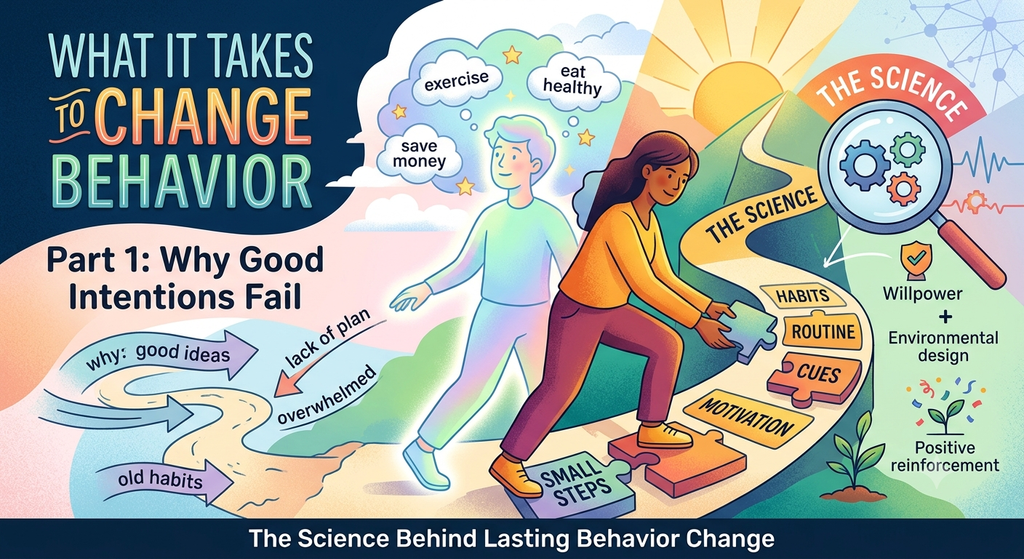
What It Takes to Change Behavior (Part 1): Why Good Intentions Fail
The Science Behind Lasting Behavior Change
“Knowing what to do is easy. Doing it consistently is where the real challenge begins.”
A Father’s Dilemma
Every evening at seven, Rajesh would call out to his twelve-year-old son.
“Time to study.”
The boy would nod, open his books, stare at them for a few minutes, and then drift toward the television, his phone, or anything that looked more interesting than mathematics.
Rajesh tried everything he could think of.
He explained why education mattered. He spoke about the future, about careers, about how hard life could become without good grades. When those conversations didn’t work, he became stricter. He reduced television time, hid the phone, and occasionally lost his temper.
For a few days, things would improve. Then everything would return to exactly where it had started.
One evening, while discussing the issue with a friend, Rajesh heard a very different suggestion.
“Don’t try to change your son,” his friend said. “Change the environment around him.”
The advice sounded almost too simple.
Instead of reminding his son every day, Rajesh made three small changes.
First, he decided to sit with his son during study time—not to supervise, but to read a book of his own. The room suddenly had two people studying instead of one reluctant child.
Second, they hung a calendar on the wall. Every day his son completed an uninterrupted forty-minute study session, he got to place a bright green sticker on the date.
Third, after ten stickers, the family would go out for ice cream together.
No lectures.
No shouting.
No threats.
Within a month, something unexpected happened.
The boy no longer needed to be reminded.
Studying had quietly become part of the evening routine.
What changed?
Not his intelligence.
Not his dreams.
Not even his discipline.
The system had changed.
And that made all the difference.
If Knowing Were Enough…
Take a moment and think about the advice we hear every day.
Exercise regularly.
Eat healthy food.
Sleep for eight hours.
Save money.
Read more books.
Spend less time on your phone.
None of this is new.
In fact, most of us could probably write a decent self-help book simply by listing everything we already know we should be doing.
Yet knowledge alone rarely changes behavior.
Doctors know they should exercise.
Financial advisors sometimes struggle with their own spending habits.
Nutritionists occasionally reach for junk food.
Parents who tell their children to stay away from screens often find themselves scrolling through social media late into the night.
Clearly, information isn’t the missing ingredient.
If it were, behavior change would be easy.
Instead, there’s a gap between knowing and doing.
Understanding that gap has fascinated researchers for nearly a century.
Their discoveries have quietly shaped everything from classroom teaching and workplace management to public health campaigns and government policies.
The remarkable part is that many of these researchers weren’t trying to answer the same question. Each came from a different field, studying a different problem. Yet their findings kept pointing toward a common truth: people don’t simply respond to information. They respond to incentives, environments, and feedback.
To appreciate that idea, it’s worth briefly meeting a few of the people who helped uncover it.
Standing on the Shoulders of Giants
Science rarely moves forward because of one brilliant idea. More often, it advances because curious people spend years asking difficult questions, testing assumptions, and accepting that many of their ideas will turn out to be wrong.
Behavioral science is no different.
One of the earliest pioneers was B. F. Skinner, an American psychologist who wanted to understand why certain behaviors repeat while others disappear. Through carefully designed experiments, he observed that behavior is deeply influenced by its consequences. Actions followed by rewarding outcomes tend to occur more often. Those followed by unpleasant outcomes usually become less frequent.
While some of Skinner’s methods and conclusions have been debated over the years, one lesson has endured: consequences matter.
A few decades later, two Israeli psychologists—Daniel Kahneman and Amos Tversky—began asking a different question.
Economists had long assumed that people made rational decisions.
But real life didn’t seem to agree.
People bought lottery tickets while neglecting retirement savings.
They feared losses more than they valued equivalent gains.
They delayed important decisions even when they knew procrastination would hurt them.
Through years of research, Kahneman and Tversky showed that human judgment is filled with predictable biases. We are not irrational all the time, but we are far from perfectly rational.
One of their most important insights was that our minds give disproportionate weight to what happens now compared to what might happen months or years later.
Suddenly, many everyday struggles made more sense.
Why skip exercise today when the health benefits are years away?
Why save money now when spending it brings immediate pleasure?
Why study for an exam weeks in advance when entertainment is available instantly?
Around the same time, another psychologist, Albert Bandura, was looking at behavior from a different angle.
He noticed that people don’t learn only through personal experience.
We also learn by watching others.
Children imitate parents.
Employees copy workplace culture.
Neighbors influence one another’s habits.
Without realizing it, we constantly look around to understand what is considered normal.
This simple observation became the foundation of social learning theory and has had enormous influence on education and leadership.
Then came Robert Cialdini, whose work explored why people say “yes.”
Rather than focusing on force or persuasion, Cialdini studied the subtle social signals that influence our decisions. One of his most influential findings was that people are heavily guided by what they believe others are already doing. If we think a behavior is common, acceptable, or expected, we become much more likely to adopt it ourselves.
Years later, economist Richard Thaler brought many of these ideas into economics. Along with legal scholar Cass Sunstein, he argued that small changes in the way choices are presented can lead to surprisingly large changes in behavior—without taking away people’s freedom to choose.
This approach came to be known as a nudge.
Today, governments around the world use these insights to improve tax compliance, increase organ donation, encourage energy conservation, and design more effective public services.
Each of these researchers studied a different piece of the puzzle.
Skinner looked at consequences.
Kahneman and Tversky explored decision-making.
Bandura examined learning.
Cialdini investigated social influence.
Thaler connected psychology with economics and public policy.
Individually, their work answered different questions.
Together, they reveal something much bigger.
Changing behavior isn’t about giving better advice.
It’s about designing better conditions for good behavior to happen.
That idea lies at the heart of everything we’ll discuss in this article.
Part 1B: The Behavior Change Triangle
At this point, you might be wondering:
“So what is the secret? Is there one technique that works every time?”
Unfortunately, no.
Human behavior is too complex for a single formula. Our decisions are influenced by personality, upbringing, culture, emotions, health, finances, relationships, and sometimes pure chance.
But while there is no magic solution, decades of research point to a handful of ideas that appear again and again whenever lasting behavior change succeeds.
To make those ideas easier to understand, we’ll organize them into a simple framework that we’ll call the Behavior Change Triangle.
Before we continue, one clarification is important.
The Behavior Change Triangle is not a scientific theory proposed by psychologists or economists. It is simply a practical way of bringing together recurring insights from the work of researchers such as Skinner, Kahneman, Tversky, Bandura, Cialdini, Thaler, and many others.
The triangle has three sides.
- Immediate Rewards – Give today’s brain a reason to act.
- Social Incentives – Let people know they are not changing alone.
- Visible Progress – Make improvement easy to see.
Think of a three-legged stool.
Remove one leg, and the stool becomes unstable.
Similarly, habits built on only one of these ideas often struggle to survive everyday life.
Let’s begin with the one that quietly defeats most of our good intentions.
Principle One: Immediate Rewards – Today’s Brain Doesn’t Care About Next Year
Imagine that someone gives you two choices.
Option A: Receive ₹500 today.
Option B: Receive ₹700 one month from now.
Many people choose the smaller amount today, even though waiting would clearly be the better financial decision.
Economists once found this puzzling. Why would anyone knowingly reject the better deal?
Behavioral economists Daniel Kahneman, Amos Tversky, and later Richard Thaler helped explain why.
Our brains naturally discount future rewards. A reward that arrives today feels more valuable than a larger reward that arrives later.
This tendency, often called present bias, explains an astonishing number of everyday struggles.
The benefits of exercise may take months to appear.
Healthy eating prevents diseases years into the future.
Reading every day gradually builds knowledge over decades.
Saving money creates security that may not be needed until retirement.
Meanwhile…
The couch is comfortable now.
The dessert is delicious now.
The phone is entertaining now.
Our brains aren’t broken.
They’re simply responding to what feels immediate.
That is why willpower alone often loses the battle.
Skinner’s Simple but Powerful Insight
Years before behavioral economics became popular, psychologist B. F. Skinner had already demonstrated something remarkably similar.
Through years of research, Skinner observed that behaviors followed by rewarding consequences tend to occur more often.
The principle sounds obvious today, but at the time it fundamentally changed how psychologists thought about learning.
Teachers began using positive reinforcement.
Animal trainers used it.
Therapists adapted it.
Even modern apps unknowingly borrow from it.
Of course, human beings are far more complicated than laboratory experiments, and many psychologists later expanded or challenged Skinner’s ideas.
But one lesson has remained remarkably durable:
People repeat behaviors that feel rewarding.
The challenge is that many good habits don’t provide immediate rewards.
So we need to create them.
Why Fitness Apps Feel Surprisingly Motivating
Consider two people trying to lose weight.
The first person goes to the gym.
Nothing changes.
After a week, the weighing scale barely moves.
The effort feels invisible.
The second person uses a fitness app.
After every workout, the app celebrates.
“Workout Complete!”
A streak increases.
Points are earned.
Badges appear.
Friends congratulate them.
Has their body changed dramatically?
Not yet.
But their brain has already received several small rewards.
That is why millions of people continue using these apps.
The rewards themselves are tiny.
The feeling they create is not.
Children Understand This Better Than Adults
Think about a child learning to brush their teeth.
If the only benefit were avoiding cavities twenty years later, almost no child would cooperate.
Parents instinctively understand this.
So they make the activity enjoyable.
Colorful toothbrushes.
Songs.
Stories.
Sticker charts.
High-fives.
The cavity prevention is still the real goal.
But the immediate reward keeps the child engaged long enough for the habit to develop.
Interestingly, adults are not very different.
We simply prefer more sophisticated stickers.
Fitness badges.
Reading streaks.
Savings milestones.
Employee recognition.
The psychology hasn’t changed.
Only the packaging has.
Try This Today
Instead of relying on future benefits, pair your habit with an immediate reward.
For example:
Want to exercise regularly?
Only listen to your favorite podcast while walking.
Trying to read more?
Enjoy your favorite coffee only during reading time.
Learning a language?
Watch one short comedy clip in that language after every completed lesson.
Saving money?
Maintain a visible chart showing your growing savings instead of keeping the numbers hidden.
The reward doesn’t have to be expensive.
It simply needs to make today’s effort feel worthwhile.
Principle Two: Social Incentives – We Rarely Change Alone
Suppose you’re staying in a hotel.
You notice that almost every guest hangs their towel up for reuse instead of leaving it on the floor.
Without anyone asking you, you’re suddenly more likely to do the same.
Why?
Because people like knowing they’re behaving normally.
This isn’t weakness.
It’s one of humanity’s greatest strengths.
For thousands of years, survival depended on living within groups.
Our ancestors who learned from others often survived longer than those who ignored everyone around them.
Even today, we constantly scan our surroundings for clues.
How should I dress?
How loudly should I speak?
Is this acceptable?
Is everyone else doing it?
Psychologist Albert Bandura showed that much of human learning happens through observation.
We imitate.
We copy.
We model ourselves on people we admire or simply spend time with.
Later, Robert Cialdini explored another fascinating idea.
When people believe a behavior is already common, they become much more willing to adopt it themselves.
This principle became known as social proof.
Today it influences everything from online reviews to public policy.
The Invisible Power of Groups
Have you ever noticed how difficult it is to become healthier when everyone around you eats poorly?
Or how much easier reading becomes when your friends regularly discuss books?
Our environment quietly sets expectations.
If everyone in an office stays late, leaving on time feels uncomfortable.
If everyone wears helmets while cycling, not wearing one begins to feel unusual.
Culture isn’t created through rules alone.
It’s created through repeated observation.
A Classroom Experiment Every Parent Recognizes
Imagine two teachers.
Teacher A announces,
“You must read thirty minutes every evening.”
Teacher B begins every morning by asking students to share one interesting thing they read the previous night.
Soon the children begin talking excitedly about books.
Reading becomes something classmates discuss.
Students who were previously indifferent now want to participate—not because reading suddenly became easier, but because it became socially meaningful.
The second teacher hasn’t changed the curriculum.
She’s changed the culture.
The Family Dinner Experiment
Many parents worry about excessive screen time.
Their first instinct is often to create stricter rules.
“No phones at dinner.”
Sometimes it works.
Often it leads to arguments.
Now imagine a different approach.
Instead of singling out the children, the entire family places their phones in a basket before sitting down to eat.
Parents do it too.
Nobody lectures.
Nobody monitors.
The behavior becomes a shared family ritual.
Children notice something important:
“This isn’t a punishment for me.”
“It’s simply how our family eats together.”
The social environment has changed.
And with it, the behavior.
Friends Are Stronger Than Motivation
Researchers studying exercise repeatedly find that people are more likely to continue when they have workout partners.
The same is true for running clubs.
Book clubs.
Support groups.
Study circles.
Why?
Because commitment becomes social.
Missing one workout doesn’t just disappoint you.
Someone notices.
Encourages you.
Sometimes even teases you.
That gentle accountability often succeeds where self-discipline struggles.
Try This Today
Before setting another personal goal, ask yourself one question.
Who else can join me?
If the answer is “no one,” ask another question.
Who can at least know about it?
Tell a friend you’re learning guitar.
Join a reading group.
Walk with your spouse after dinner.
Start a family savings challenge.
Cook healthy meals together instead of dieting alone.
Changing behavior is difficult.
Changing behavior together is often surprisingly easier.
By now, two sides of the Behavior Change Triangle have emerged.
Give today’s brain a reason to care.
Surround yourself with people who make the behavior feel normal.
There’s just one piece missing.
Even with rewards and encouragement, many people eventually lose momentum.
Why?
Because they can no longer tell whether they’re making progress.
In the next section, we’ll explore why seeing even the smallest improvement can become one of the strongest motivators of all—and how governments, businesses, families, and individuals use this simple idea every day without realizing it.
Part 1C: The Third Side of the Triangle
By now, we’ve seen two important ideas.
First, people are more likely to repeat a behavior when it offers some form of immediate reward.
Second, we’re strongly influenced by the people around us. Good habits spread through families, workplaces, and communities just as easily as bad ones.
But there is one more ingredient that quietly keeps motivation alive.
It answers a simple question:
“How do I know I’m getting anywhere?”
If that question goes unanswered for too long, even motivated people begin to lose interest.
Principle Three: Visible Progress – We Stay Motivated When We Can See Improvement
Imagine planting a mango tree.
You water it every day.
You protect it from insects.
You wait.
For weeks, nothing seems to happen.
No fruit.
Very little visible growth.
Many people would eventually stop watering it—not because they no longer wanted mangoes, but because their effort felt invisible.
Now imagine another activity.
You’re saving money for a vacation.
Every month you update a chart on the refrigerator.
₹5,000.
₹12,000.
₹18,500.
₹25,000.
The vacation is still months away, but every update reminds you that your effort is producing results.
The destination hasn’t changed.
Only the visibility of progress has.
That difference matters more than we often realize.
The Power of Small Wins
Organizational psychologist Teresa Amabile spent years studying what keeps people motivated at work.
One might assume that promotions, bonuses, or major achievements are the biggest drivers of motivation.
Surprisingly, her research pointed to something much simpler.
People become more engaged when they experience small, meaningful wins.
Progress—even modest progress—creates momentum.
Think about learning to play the guitar.
The first few weeks can be frustrating.
Your fingers hurt.
The chords sound terrible.
You wonder if you’re making any progress at all.
Then one day, you play an entire song without stopping.
It’s not a concert-worthy performance.
But it’s enough to tell your brain,
“I’m getting better.”
That feeling often carries people through the next few weeks of practice.
Progress fuels persistence.
Why We Love Crossing Things Off
Have you ever written something on a to-do list after you’ve already completed it—just so you could cross it off?
If you have, you’re in good company.
There’s something deeply satisfying about seeing a task move from “unfinished” to “done.”
The act itself changes nothing.
The work was already completed.
But your brain now has evidence that something moved forward.
Visible progress turns effort into achievement.
This is one reason habit trackers have become so popular.
A simple chain of checkmarks on a calendar can become surprisingly motivating.
After ten consecutive days, people don’t just want to continue the habit.
They don’t want to break the chain.
The calendar becomes a quiet partner, reminding them of the commitment they’ve already made.
Duolingo Didn’t Just Teach Languages
If you’ve ever used Duolingo, you’ve probably noticed that the app celebrates almost everything.
Finish a lesson?
Congratulations!
Maintain a streak?
Amazing!
Reach a milestone?
Here’s a badge.
Move up a leaderboard?
Well done!
None of these celebrations make you fluent overnight.
They do something more subtle.
They make learning feel visible.
Instead of thinking,
“I’ve been studying Spanish for three months.”
You begin thinking,
“I’ve completed 82 lessons.”
That’s measurable.
That’s visible.
And because it’s visible, it’s motivating.
Many successful products—from fitness watches to budgeting apps—use the same principle.
They don’t just help people perform an activity.
They help people see themselves improving.
When the Three Principles Come Together
Let’s return to Rajesh and his son.
Why did the new approach succeed where lectures failed?
Because all three sides of the triangle quietly came together.
His father studied alongside him.
That created a social incentive.
The family celebrated every ten successful study sessions with an ice cream outing.
That provided an immediate reward.
The calendar full of green stickers showed exactly how many days he had succeeded.
That created visible progress.
None of these changes required expensive technology.
None required extraordinary willpower.
The system simply made the desired behavior easier to repeat.
The Triangle Isn’t Magic
At this point, it’s important to avoid a common misunderstanding.
The Behavior Change Triangle is not a shortcut.
It won’t magically eliminate procrastination.
It won’t instantly transform someone who has no interest in changing.
It certainly can’t solve every problem.
Mental health, financial stress, chronic illness, addiction, trauma, and social inequality all influence behavior in ways that no simple framework can fully address.
Behavior is messy because life is messy.
But what these three ideas do offer is something practical.
They increase the odds.
Instead of fighting against the way our minds naturally work, they work with those tendencies.
That’s why governments use them.
Schools use them.
Businesses use them.
Sports coaches use them.
Parents use them—often without realizing it.
A Word of Caution: When Rewards Backfire
If rewards are so effective, should we reward every good behavior?
Not necessarily.
Psychologists Edward Deci and Richard Ryan, through decades of research on motivation, found something important.
External rewards can sometimes reduce intrinsic motivation—our natural desire to do something because we genuinely enjoy or value it.
Imagine a child who loves drawing.
If every drawing is rewarded with money, the child may slowly begin drawing for the reward rather than for the joy of creating.
If the reward disappears, the motivation may fade as well.
This doesn’t mean rewards are bad.
It means they should be used thoughtfully.
Rewards are excellent for helping people begin a difficult habit or sustain effort until the behavior becomes routine.
But over time, the habit should ideally develop its own rewards.
A runner begins to enjoy running.
A reader begins to love books.
A saver begins to appreciate financial security.
The external reward opens the door.
The internal reward keeps it open.
Designing Your Environment Instead of Fighting Yourself
One of the biggest lessons from behavioral science is surprisingly liberating.
You don’t have to become a different person before you can build better habits.
You don’t need extraordinary discipline.
You don’t need endless motivation.
More often than not, you need a better environment.
Want to eat healthier?
Put fruit where you can see it and keep unhealthy snacks out of immediate reach.
Want to read more?
Leave a book on your bedside table instead of your phone.
Want to reduce social media?
Move the app off your home screen or set specific times to check it.
Want your children to study?
Study beside them, celebrate consistency, and let them see their progress.
These changes seem small.
But behavior is often shaped by small decisions repeated hundreds of times.
As architect Ludwig Mies van der Rohe famously said,
“God is in the details.”
Behavioral science suggests that habits are, too.
Three Questions Before You Start Any New Habit
Before beginning your next goal—whether it’s exercising, saving money, reading, or helping your child build a better routine—pause for a moment and ask yourself three simple questions.
1. What makes this rewarding today?
If the answer is “nothing,” create a small immediate reward.
2. Who can make this journey less lonely?
Invite a friend, involve your family, or join a community.
3. How will I know I’m improving?
Use a journal.
A checklist.
A savings chart.
A habit tracker.
A calendar.
Don’t leave progress to memory.
Make it visible.
Looking Beyond the Individual
So far, we’ve looked at behavior change from a personal perspective.
How can I exercise more?
How can my child study consistently?
How can my family build healthier routines?
But these questions lead to an even bigger one.
If these ideas work for one person…
…could they work for an entire city?
Could they help millions of people pay taxes on time, conserve electricity, wear seat belts, donate organs, vaccinate their children, or keep neighborhoods clean?
For years, governments tried to answer these questions with more rules, bigger budgets, and louder awareness campaigns.
Sometimes those approaches worked.
Often, they didn’t.
Then policymakers began borrowing ideas from behavioral science.
Instead of asking,
“How do we force people to change?”
they asked a different question:
“How do we make the better choice the easier choice?”
That shift in thinking quietly gave birth to one of the most fascinating developments in modern public policy.
Our journey continues in Part 2.
There, we’ll leave the living room and the classroom behind and step into government offices, city streets, hospitals, schools, and public institutions to see how small changes in human behavior have transformed outcomes on a national scale. Along the way, we’ll also discover what families, teachers, managers, and community leaders can learn from these experiments—and where behavioral science reaches its limits.
Because changing one person’s habits is interesting.
Changing the behavior of millions is extraordinary. How to Ignore Insults and Stay calm: A 20 minute RoadmapHow to Handle Public Insults: 5 Tips to Stay Calm Keeping Your Self-Respect