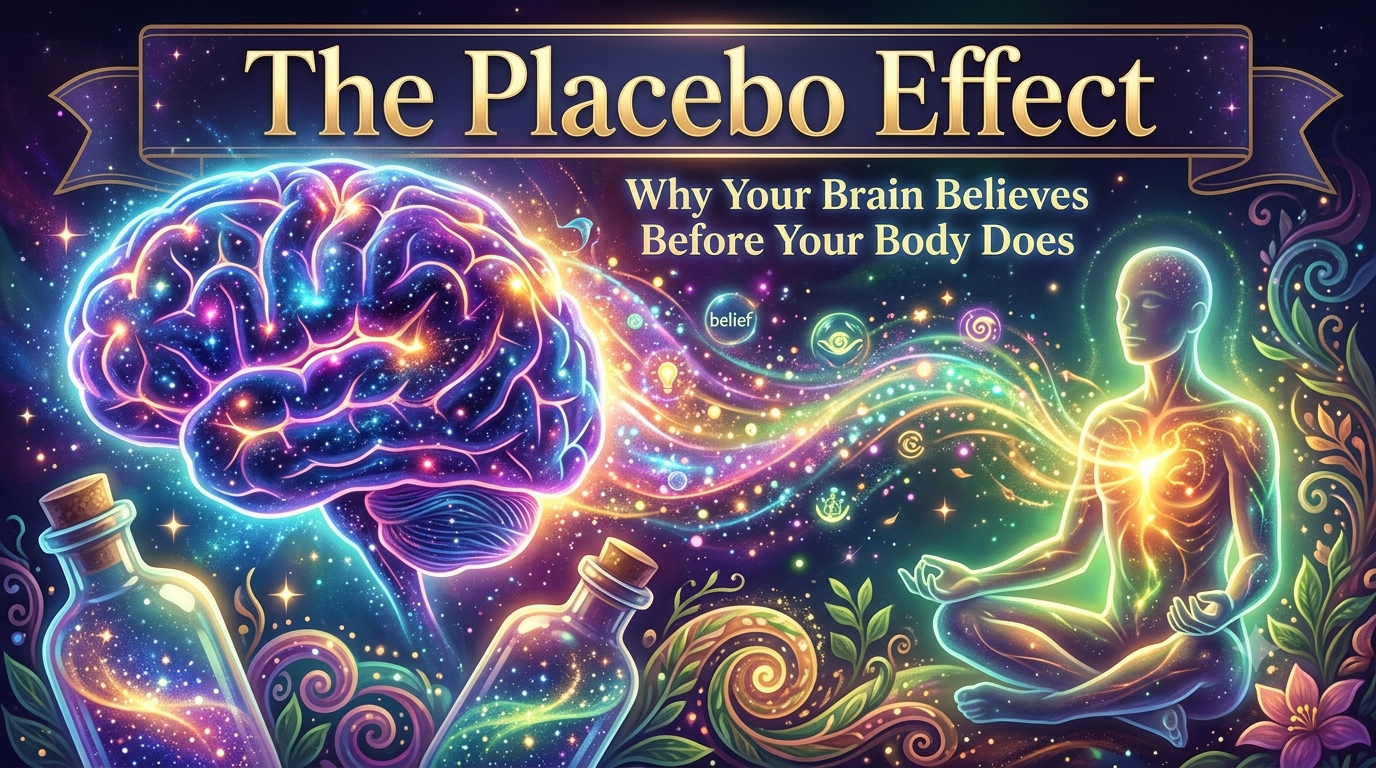
The Placebo Effect: Why Your Brain Believes Before Your Body Does (Part 1)
Part 1: The Medicine We Didn’t Know We Were Taking
A few years ago, I came across a story about two marathon runners preparing for the same race.
One of them had an elaborate ritual.
He wore the same pair of socks every race. They weren’t new. In fact, they were slightly faded, probably ready for retirement. Before the race, he would listen to the same song, tie his shoelaces in a particular order, tap his watch twice, close his eyes for a few seconds, and only then step onto the starting line.
His friend laughed at him.
“You know those socks aren’t magical, right?”
He laughed too.
“I know,” he replied.
“But every time I wear them, my body remembers it’s race day.”
That sentence stayed with me.
Not because of the socks.
But because of what they represented.
For years, I believed the placebo effect was simply another fancy psychological term—a sugar pill fooling someone’s mind into feeling better. A trick. A deception. Something interesting enough to appear in documentaries but too far removed from ordinary life.
I couldn’t have been more wrong.
The more I read, the more I realized that the placebo effect isn’t confined to hospitals or research labs. It quietly follows us everywhere—in classrooms, gyms, boardrooms, relationships, interviews, examinations, and even in the conversations we have with ourselves before falling asleep.
Once you begin noticing it, it’s almost impossible to stop.
Because the placebo effect isn’t really about pills.
It’s about expectations.
And expectations, it turns out, are among the most powerful forces shaping human behavior.
Imagine you’re sitting in a doctor’s office.
The doctor hands you a small white pill and says with confidence,
“This has helped many people. I think it’ll help you too.”
You swallow it.
Within an hour, your pain feels lighter.
Your breathing feels easier.
Your anxiety settles.
Later, you discover the pill contained no medicine at all.
Just sugar.
Most people hear stories like this and immediately think,
“So the patient imagined everything.”
That’s probably the biggest misunderstanding about the placebo effect.
The improvement wasn’t imaginary.
The pill was.
The brain, however, was very real.
When scientists place volunteers in brain scanners during placebo experiments, something remarkable happens. Areas involved in pain, emotion, attention, and expectation become active. The brain releases chemicals like endorphins—the body’s own natural painkillers—and dopamine, which is closely linked to motivation and reward.
Nothing magical entered the body.
The body itself responded to what the mind expected.
That’s an astonishing idea if you stop to think about it.
Your expectations can alter your biology.
Not infinitely.
Not magically.
But measurably.
For centuries, we imagined the brain as a machine reacting to the outside world.
Something hurts.
The brain feels pain.
Something tastes sweet.
The brain recognizes sweetness.
Simple.
Modern neuroscience paints a far stranger picture.
Your brain isn’t merely reacting.
It’s constantly predicting.
Every second, it asks a silent question:
“What do I think is about to happen?”
Then it prepares your body accordingly.
This idea, often called predictive processing, completely changed how I think about everyday life.
Suppose you hear a loud bang outside your house.
Before you’ve even identified the sound, your heart speeds up.
Your muscles tense.
Your attention sharpens.
The body didn’t wait for certainty.
It acted on expectation.
The same principle operates in countless situations.
If you expect a speech to go badly, your palms sweat before you’ve spoken a single word.
If you expect tomorrow’s presentation to be exciting, you wake up energized.
If you expect the gym to be miserable, climbing those stairs somehow feels heavier.
Expectation isn’t merely an opinion floating around inside your head.
It’s one of the inputs your brain uses to construct your experience.
This is probably why placebos show up in places where you’d never expect them.
Take sports.
Elite athletes are among the most rational, data-driven people you’ll ever meet.
They measure sleep.
Calories.
Heart rate.
Recovery.
Milliseconds.
Yet many of them have rituals bordering on superstition.
The same shoes.
The same breakfast.
The same playlist.
The same warm-up.
The same entrance onto the field.
The outsider smiles.
“Professional athletes still believe in lucky charms?”
But perhaps that’s asking the wrong question.
Maybe the socks aren’t lucky.
Maybe they’re familiar.
Maybe they tell the brain,
“We’ve been here before.”
“We know what to do.”
“We’re ready.”
Confidence, after all, isn’t some mysterious personality trait bestowed upon a fortunate few.
It’s partly a prediction.
A prediction that says,
“I’ve done this before.”
“I can do it again.”
And when your brain predicts success instead of disaster, your breathing changes.
Your focus sharpens.
Your movements become smoother.
Not because the socks contained power.
Because your expectations did.
The first time I learned that researchers had actually improved athletic performance using fake performance-enhancing substances, I thought it sounded absurd.
Athletes were told they had received something that would improve endurance or strength.
Some hadn’t.
Yet many still performed better.
Not dramatically enough to violate the laws of biology.
But enough to remind us that biology itself listens to psychology more often than we’d like to admit.
Our minds don’t merely observe our bodies.
They constantly negotiate with them.
Here’s where things become even stranger.
Suppose I hand you a pill and honestly say,
“This contains absolutely no medicine. It’s a placebo.”
Surely it shouldn’t work anymore.
The trick has been exposed.
The illusion is gone.
Except…
In several studies, many people still improved.
This was quite surprising for me. I know that this is fake. Now I acknowledge that it doesn’t have any real impact but still it is found to be working.
Researchers call these open-label placebos.
Patients knew they were taking an inactive pill.
Yet some still reported less pain, reduced stress, or improvements in symptoms.
At first glance, this sounds impossible.
Until you realize something.
Our brains learn through repetition.
Think about brushing your teeth before bed.
Brushing doesn’t chemically produce sleep.
Yet after years of repetition, your body begins winding down the moment the toothbrush comes out.
Or think about walking into a library.
You instinctively lower your voice.
Nobody needs to remind you.
The environment has trained your brain.
A placebo can work in a similar way.
Not because you’re fooled.
Because your nervous system has learned an association.
Doctor’s office.
Treatment.
Recovery.
Care.
Hope.
Sometimes those associations alone are enough to nudge the brain in a healthier direction.
That realization changed the way I looked at everyday habits.
Maybe the cup of coffee on my desk wasn’t making me productive.
Maybe years of sitting down with that mug before beginning work had quietly trained my brain to associate one with the other.
Maybe the notebook I reserved only for writing wasn’t special because of the paper inside it.
Maybe it had become a signal.
A gentle whisper to my brain that said,
“It’s time.”
And perhaps that’s the greatest lesson the placebo effect offers us.
Not that we should fool ourselves.
But that our minds are constantly learning from the rituals, objects, environments, and expectations we repeat every single day.
The question isn’t whether you’re taking placebos.
The question is:
Who chose them?
We will move beyond medicine into everyday life—exploring the nocebo effect, why negative suggestions can quietly poison our thinking, how advertisements, parents, teachers, movies, and social media plant beliefs in us without our noticing, and how to deliberately build expectations that help rather than hinder us.
The Suggestions We Never Knew We Accepted (Part 2)
A few days after reading about placebo research, I caught myself saying something so ordinary that I almost missed it.
“I never study well at home.”
I’ve probably said that sentence a hundred times over the years.
It sounded factual.
Objective.
Almost scientific.
Except…
Who conducted the experiment?
How many times had I actually tested it?
Had I failed every single time I studied at home?
Of course not.
It wasn’t a fact.
It was a story.
A suggestion that had become so familiar my brain had quietly promoted it to reality.
The longer I observed myself, the more I realized that most of us aren’t living only with placebos.
We’re also living with something far more dangerous.
Meet the Placebo’s Evil Twin

If the placebo effect is a positive expectation producing positive outcomes, the nocebo effect is exactly the opposite.
Negative expectations produce negative experiences.
Imagine two patients about to receive the exact same injection.
The nurse tells the first patient,
“This will just feel like a tiny pinch.”
She tells the second,
“This injection is extremely painful.”
The needle hasn’t changed.
The medicine hasn’t changed.
But the experience often does.
The second patient usually reports more pain.
Not because the injection became more painful.
Because the expectation did.
The brain prepared for suffering.
And suffering became easier to notice.
The nocebo effect teaches us something unsettling.
Sometimes we don’t experience reality exactly as it is.
We experience reality mixed with what we expected it to be.
Once I understood this, I started noticing nocebos everywhere.
Not in hospitals.
In conversations.
Parents unknowingly hand them to children.
Teachers hand them to students.
Friends hand them to each other.
Sometimes we hand them to ourselves every morning before breakfast.
Think about the sentences children hear growing up.
“You’re careless.”
“You’re shy.”
“You’re lazy.”
“You’re terrible at mathematics.”
“You’re not leadership material.”
Adults usually think they’re describing behavior.
Children often think they’re describing identity.
There’s an enormous difference between saying,
“You forgot your homework.”
and saying,
“You’re irresponsible.”
One criticizes an action.
The other quietly defines a person.
Repeated often enough, that definition becomes part of how someone sees themselves.
Years later, that child becomes an adult saying,
“I’ve always been this way.”
No.
You’ve always been told you were that way.
Those are two very different things.
Schools do this too.
Sometimes intentionally.
Often accidentally.
Imagine two teachers.
The first says,
“You haven’t understood this chapter yet.”
The second says,
“You’re weak in science.”
The first leaves room for growth.
The second sounds permanent.
One speaks about learning.
The other speaks about identity.
Small difference.
Massive consequences.
Then there are advertisements.
This one fascinated me.
Advertisements rarely sell products.
They sell feelings.
Buy this watch.
Become successful.
Buy this perfume.
Become attractive.
Buy this car.
Become respected.
Notice the invisible suggestion.
Without the product…
…perhaps you aren’t enough.
No advertisement says that directly.
It doesn’t have to.
Your brain completes the sentence.
Thousands of repetitions later, status quietly becomes linked to possessions.
Not because anyone forced you.
Because the suggestion was planted gently, repeatedly, and beautifully.
Movies and social media work similarly.
If every romantic film tells you that perfect love should feel effortless, ordinary relationships begin feeling disappointing.
If every Instagram feed shows luxury vacations, sculpted bodies, flawless skin, and endless smiles, your ordinary Tuesday afternoon suddenly feels like failure.
Nothing in your own life changed.
Only your expectations did.
That’s one reason social media can leave people feeling inadequate even when nothing objectively bad has happened.
Comparison isn’t always born from reality.
Sometimes it’s born from repeated suggestion.
Then comes perhaps the loudest voice of all.
The one inside your own head.
It’s funny how we speak to ourselves.
Imagine your closest friend makes a mistake at work.
Would you say,
“You’re useless.”
“You’re hopeless.”
“You’ll never succeed.”
Probably not.
Yet many of us say exactly those things to ourselves after the smallest failure.
That’s a nocebo.
Not because the words contain magical power.
But because repeated expectations shape future behavior.
Suppose before every presentation you tell yourself,
“I’m terrible at public speaking.”
Your body prepares for disaster.
Your breathing changes.
Your attention narrows.
You become hyper-aware of every tiny mistake.
Afterward, your brain collects evidence supporting the original belief.
“I knew I was bad.”
A vicious cycle quietly begins.
Expectation.
Behavior.
Outcome.
Reinforced expectation.
No magic.
Just psychology.
This made me rethink failure itself.
Failure isn’t only what happened.
It’s also the meaning we attach to what happened.
There’s a world of difference between these two sentences.
“I failed.”
“I am a failure.”
The first describes an event.
The second creates an identity.
Events pass.
Identities linger.
Perhaps much of resilience comes from refusing to let temporary events become permanent labels.
If suggestions are constantly entering our minds, an obvious question follows.
How do we know which ones deserve to stay?
I’ve settled on asking myself a few simple questions whenever I hear a strong opinion—from a news anchor, an advertisement, a teacher, a motivational speaker, or even my own inner voice.
Is this a fact…
…or an interpretation?
Who benefits if I believe this?
Does evidence support it?
Does this belief help me grow…
…or merely make me afraid?
Would I say this to someone I deeply care about?
Those questions don’t guarantee perfect answers.
But they slow down automatic acceptance.
And that alone is powerful.
Here’s something I don’t think we appreciate enough.
The human brain is astonishingly generous.
It believes whatever it hears most often.
That’s wonderful if you’re repeatedly hearing,
“You can learn.”
“You can improve.”
“Mistakes are part of growth.”
It’s dangerous if you’re repeatedly hearing,
“People never change.”
“You’re not good enough.”
“You’ll always fail.”
Our brains aren’t perfect judges of truth.
They’re excellent learners of repetition.
So perhaps the goal isn’t to eliminate suggestion.
That’s impossible.
Every conversation contains suggestion.
Every book.
Every teacher.
Every film.
Every friend.
Every parent.
Even this article.
The goal is becoming conscious of it.
To stop swallowing every belief simply because it has been repeated often enough.
To ask,
“Is this helping me become the person I want to be?”
Some suggestions deserve a permanent home.
Exercise improves health.
Sleep matters.
Practice compounds.
Kindness strengthens relationships.
Curiosity expands understanding.
Those are suggestions worth repeating.
Others deserve to be shown the door.
“I’m too old.”
“I’m not creative.”
“I’m just unlucky.”
“I’m not a people person.”
Those may feel like facts.
Often, they’re merely old stories that have overstayed their welcome.
The placebo effect taught me that belief can help.
The nocebo effect taught me that belief can harm.
Together, they revealed something far more important.
Our minds are not empty rooms waiting for information.
They’re living gardens.
Every conversation plants something.
Every headline waters something.
Every compliment strengthens something.
Every insult bruises something.
Every repeated thought grows into something.
The only question left is this:
Who is tending your garden?
And perhaps more importantly…
When will you begin doing it yourself?
Next in the series: The Pygmalion Effect: How Other People’s Expectations Quietly Become Our Reality—where we’ll explore the Greek myth of the sculptor, the famous classroom experiment, why mentors often shape futures without realizing it, why labels like “late bloomer” matter, and how expectations can either sculpt potential or bury it.
Read more
Positive Thinking: Can Believing Make a Difference?
Shiny Object Syndrome: Meaning, Causes, Symptoms and How to Overcome It