A Practical Guide to Mental Resilience
(Not Motivation, Just Methods)
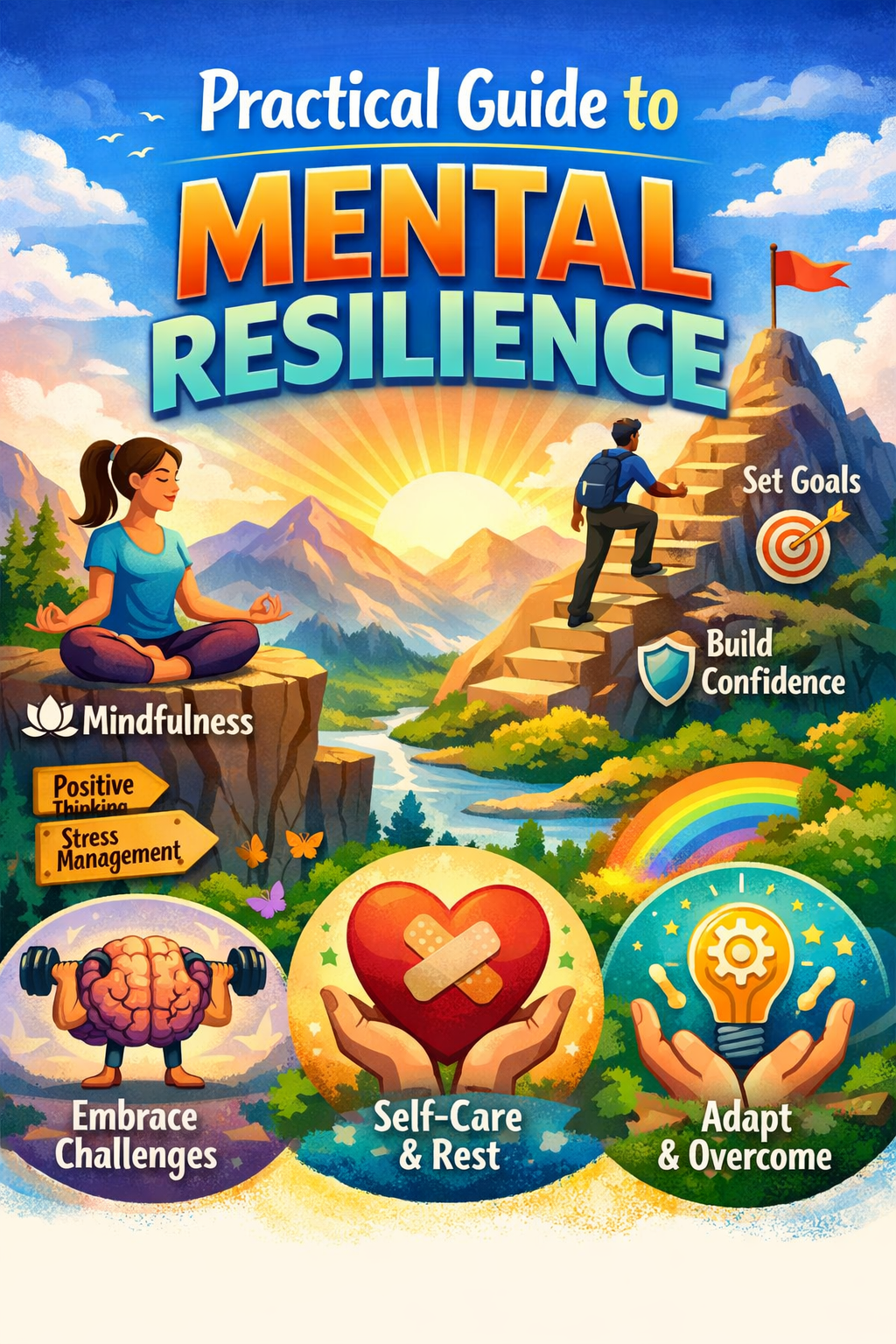
Mental resilience is not about being positive.
It is not about being tough.
It is not about pretending everything is fine.
Mental resilience is the ability to remain functional, clear, and grounded when life
becomes uncertain, stressful, or painful.
Most people try to build resilience using motivation.
Motivation fails under pressure.
This guide is about building resilience using methods that work even when you don’t
feel strong.
What Mental Resilience Really Means
Mental resilience is the capacity to:
-
Stay emotionally regulated under stress
-
Recover faster from setbacks
-
Continue functioning during uncertainty
-
Think clearly when emotions are intense
It does not mean:
-
You don’t feel pain
-
You don’t get tired
-
You don’t struggle
It means you don’t collapse internally every time life challenges you.
Why Motivation is a Weak Strategy
Motivation depends on:
-
Mood
-
Energy
-
Hope
-
Confidence
All four fluctuate.
When life hits hard:
-
Motivation disappears
-
Discipline weakens
-
Positivity feels fake
Resilience must be structural, not emotional.
The 5 Foundations of Real Mental Resilience
These are not ideas.
They are trainable systems.
1. Nervous System Regulation (The Hidden Base Layer)
You cannot be mentally resilient if your nervous system is constantly in survival mode.
Signs your nervous system is overloaded:
-
Chronic tension
-
Shallow breathing
-
Hypervigilance
-
Constant fatigue
-
Irritability
Daily method:
-
Slow breathing (inhale 4, exhale 6) for 5 minutes
-
Gentle walking without phone
-
Body scanning before sleep
A calm body creates a stable mind.
2. Emotional Processing (Instead of Suppression)
Suppressed emotion becomes:
-
Anxiety
-
Overthinking
-
Exhaustion
-
Depression
Resilient people don’t suppress feelings.
They process them regularly.
Daily method:
-
Write what you are feeling without censoring
-
Name the emotion
-
Ask: “What triggered this?”
Expression prevents emotional buildup.
3. Cognitive Framing (Reality Without Catastrophe)
Resilient thinking is not positive thinking.
It is accurate thinking.
Replace:
“This will ruin everything”
With:
“This is difficult, not fatal.”
Replace:
“I can’t handle this”
With:
“This is uncomfortable, not impossible.”
Method:
Ask:
“What is fact right now?”
“What am I adding mentally?”
4. Behavioral Stability (Routines that Hold You)
When life collapses, routines hold identity.
Resilient people keep:
-
Basic hygiene
-
Movement
-
Nutrition
-
Sleep structure
Even at low energy.
Rule:
Never let your worst day destroy your base habits.
5. Meaning Anchors (Why You Endure)
People without meaning break faster.
Meaning does not need to be spiritual.
It can be:
-
Responsibility
-
Children
-
Creative work
-
Healing journey
-
Contribution
Ask:
“What is worth suffering for in my life?”
That answer stabilizes you when comfort disappears.
A Real-Life Resilience Scenario
Imagine:
-
You lose a job
-
Your relationship is unstable
-
Finances are uncertain
A non-resilient response:
-
Panic
-
Catastrophizing
-
Emotional collapse
-
Paralysis
A resilient response:
-
Fear is present
-
Sadness is present
-
But actions continue
-
Structure remains
-
Perspective is held
Same pain.
Different internal system.
The 7-Day Mental Resilience Reset
This is a starter framework.
Day 1–2: Nervous System Reset
-
Walk 20 minutes
-
No phone during walk
-
Slow breathing
-
Early sleep
Day 3–4: Emotional Clearing
-
Write daily
-
Identify emotional patterns
-
Allow crying or release
Day 5: Thought Hygiene
-
Track catastrophic thoughts
-
Replace with neutral framing
Day 6: Routine Stabilization
-
Fix sleep timing
-
Add light exercise
-
Eat regularly
Day 7: Meaning Reflection
-
Write what matters
-
Write what you tolerate unnecessarily
-
Decide one life boundary
Common Myths About Mental Resilience
Myth 1: Resilient people don’t feel weak
→ They do. They just don’t quit life.
Myth 2: Resilience is genetic
→ It is trained.
Myth 3: Resilience means independence
→ Resilient people ask for help early.
When Resilience Requires Life Change
Sometimes resilience training fails because:
-
The job is toxic
-
The relationship is abusive
-
The lifestyle is unsustainable
In these cases:
Resilience is not endurance.
It is exit courage.
A Simple Daily Resilience Routine (15–25 minutes)
Morning (5–10 min)
-
Stretch
-
Slow breathing
-
Set one intention
Midday (3–5 min)
-
Pause
-
Ask: “How am I really doing?”
Evening (10 min)
-
Write emotional state
-
Note one strength shown
-
Prepare for sleep
Read one of my most popular blogs on Heart Brain Coherence
https://kvshan.com/2026/01/heartbrain-coherence-how.html
Final Perspective
Mental resilience is not heroism.
It is maintenance.
It is built in small, boring, invisible acts:
-
Breathing
-
Writing
-
Walking
-
Resting
-
Framing thoughts
Resilient people are not stronger.
They are better regulated and better structured.
You don’t rise to your best moments.
You fall to your training.
Build the training.
How being available makes people take you for granted and reduces your value
https://kvshan.com/2026/03/dont-be-available-how-strategic-absence.html
This guide is for educational purposes and does not replace professional mental health
support. If mental health struggles significantly interfere with daily functioning, seeking
qualified help is recommended.