Mastering Communication: Types, Tools, Tips and Trends, for Every Age
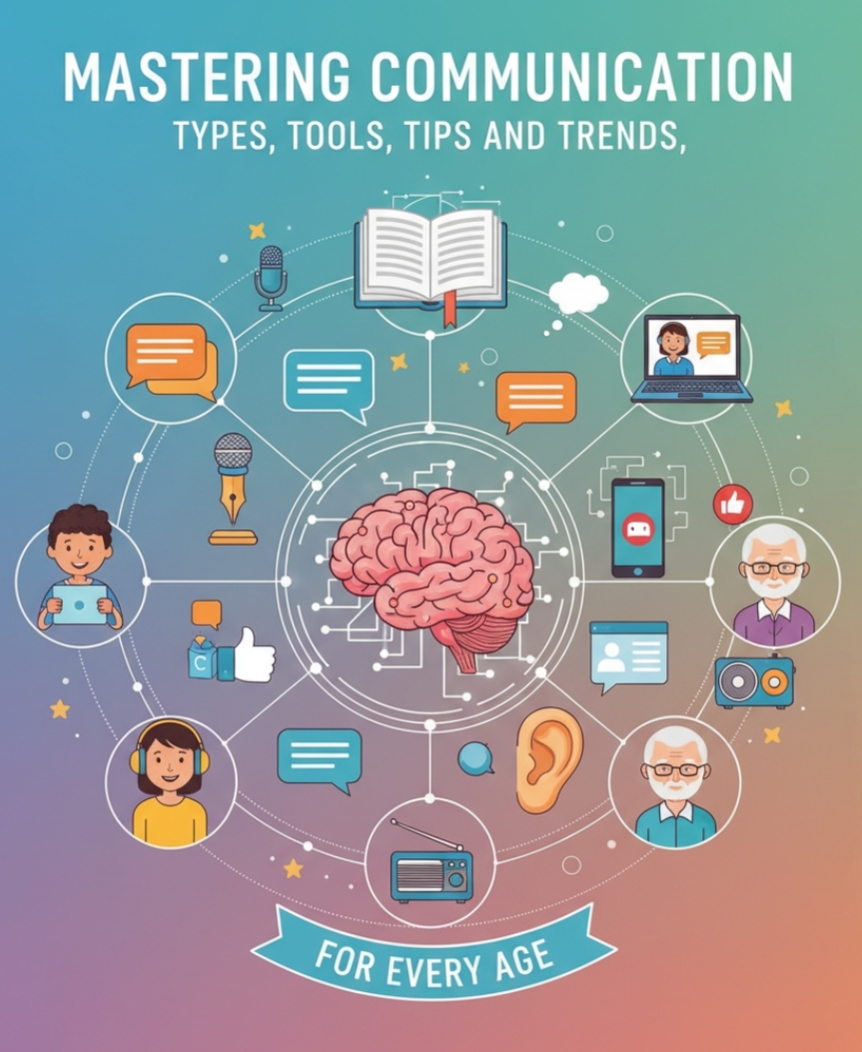
The Invisible Bridge that Connects Us All
Communication is more than just talking. It’s how we connect, understand, lead, love, and build everything — from relationships to empires. In a world that’s noisier than ever, good communication is like a superpower. Yet, miscommunication is everywhere: broken friendships, office conflicts, online outrage, and even international tensions. Why?
Because while we’re always talking, we’re not always connecting.
This blog explores the core of communication — its types, science-backed tips, latest changes in how we talk today, and how anyone (at any age) can learn to communicate better.
Section 1: What Is Communication, Really?
Communication is simply the act of exchanging information. But it’s more than just words.
It’s how you speak.
It’s your tone, your face, your silence, and even your intent.
Great communication is when the other person not only hears your words but understands your meaning.
Key Elements of Communication:
Sender (who is communicating)
Message (what is being shared)
Medium (how it’s being sent — voice, text, image, etc.)
Receiver (who gets the message)
Feedback (the response or reaction)
Section 2: Types of Communication
1. Verbal Communication
Spoken words
Examples: Phone calls, meetings, conversations
Importance: Clarity, tone, and vocabulary matter a lot
2. Non-Verbal Communication
Body language, eye contact, posture, facial expressions
Fun fact: According to Dr. Albert Mehrabian’s research, 55% of communication is body language. Different experts have different opinion but one thing is for sure that we communicate with our body more.
3. Written Communication
Emails, texts, blogs, reports, letters
Good writing can build trust or break deals
4. Visual Communication
Images, charts, infographics, videos
Used heavily in marketing, education, and social media
5. Digital Communication
Social media posts, emojis, voice notes, virtual meetings
Growing fastest with Gen Z and Alpha
Section 3: Why Communication is a Game-Changer Today
In an age of information overload, communication isn’t optional — it’s everything.
Jobs require it: The top skill employers seek in 2025-26 is communication (Projection by World Economic Forum, 2023).
Relationships need it: Couples who practice clear communication are 40% less likely to split (Gottman Institute).
Mental health depends on it: People who express themselves regularly report 30% less anxiety (APA, 2022).
Leaders thrive on it: Every great leader — from Gandhi to Oprah — mastered communication.
Section 4: Latest Developments in the Field of Communication
1. Digital Transformation
Zoom, Teams, Slack have redefined work communication.
Asynchronous messaging allows flexible conversations.
AI is writing emails, drafting reports, even replying to DMs.
2. AI & Communication
AI tools like ChatGPT are used to practice conversations.
Language learning is being revolutionized with AI-powered tutors.
AI now helps detect tone and emotion in messages.
3. Neuroscience of Communication
Studies now use brain scans (like fMRI) to understand how people process communication.
Dr. Uri Hasson (Princeton University) found that during deep communication, brains “sync” — called neural coupling.
4. Global Shift
Cross-cultural communication is key in a globalized world.
Understanding different communication styles — direct (Western) vs. indirect (Asian) — is crucial.
Section 5: What Reliable Studies Say About Communication
Here are five powerful studies and stats:
1. Harvard Business Review (2021):
69% of managers are uncomfortable communicating with employees.
2. Gottman Institute:
Couples who use “soft starts” in conflict discussions (gentle tone and words) have 80% better conflict outcomes.
3. UCLA Study (Mehrabian & Ferris):
93% of communication effectiveness is determined by non-verbal cues — tone, expression, body language.
4. LinkedIn Workplace Report (2023):
Communication is the top soft skill employees are most lacking — even over tech skills.
5. APA (American Psychological Association):
Teens who communicate openly with parents are 60% less likely to experience depression.
Section 6: Most Effective Communication Methods (That Actually Work)
1. Active Listening
Listen to understand, not to reply
Make eye contact, nod, paraphrase
2. Ask, Don’t Assume
Use open-ended questions: “How did you feel about that?”
Reduces misunderstandings
3. Clarity Over Cleverness
Say what you mean. Fancy words confuse people.
Be clear, concise, and kind
4. Use the Power of Pause
Silence is a tool. It gives space for reflection.
Great for negotiation and emotional talks
5. Watch Your Non-Verbal Cues
Your face speaks louder than your words
Calm posture, open gestures, gentle tone
6. Empathy Is Everything
See from the other person’s point of view
Builds trust instantly
Section 7: Steps to Improve Your Communication Skills
Whether you’re 10 or 70, it’s never too late.
Step 1: Start with Self-Awareness
Record yourself speaking. Watch it.
Do you interrupt? Ramble? Avoid eye contact?
Step 2: Read and Watch Good Communicators
TED Talks, great speeches, classic interviews
Read books like “How to Win Friends and Influence People” by Dale Carnegie
Step 3: Practice Daily
Speak slowly and mindfully
Have one meaningful conversation a day
Step 4: Get Feedback
Ask: “How do I come across when I speak?”
Be open to improvement
Step 5: Join a Speaking Group
Toastmasters, debate clubs, or online courses help immensely
Step 6: Limit Digital Distractions
Multitasking kills presence
Be fully present in every conversation
Section 8: When Is the Right Age to Learn Communication?
The earlier, the better — but it’s never too late.
Early Childhood (0–5 years)
Language learning peaks
Kids absorb tone, gestures, and expressions
Encourage storytelling and expression
Adolescence (13–19 years)
Crucial for building confidence and identity
Teach emotional expression, conflict resolution, assertiveness
Adulthood (20–60 years)
Career growth depends on communication
Relationship depth increases with better listening and expression
Later Life (60+)
Great communication boosts mental health
Helps prevent isolation, depression, and cognitive decline
Key Insight:
Neuroplasticity proves we can learn new skills — including communication — at any age.
Section 9: The Biggest Communication Mistakes to Avoid
Avoiding these can instantly elevate how people perceive and respond to you:
Interrupting
Over-talking without listening
Talking “at” someone, not “with” them
Using filler words (like, um, you know…)
Closed body language
Sarcasm and mixed signals
Speaking to win, not understand
Section 10: The Future of Communication
As tech evolves, human connection will matter even more.
AI won’t replace emotions.
Real conversations will be premium.
People who master human skills like empathy and expression will lead.
Communication won’t just be about talking.
It’ll be about resonating — with clarity, sincerity, and warmth.
Speak to Connect, Not Just to Be Heard
In a world bursting with content and chatter, true communication stands out.
It’s not about having the loudest voice — it’s about having the clearest heart.
It’s not about flawless grammar — it’s about honest presence.
Whether you’re a parent, teacher, student, leader, or just someone who wants to build deeper bonds — learning communication is like learning magic.
So pause, look up, and speak with meaning.
Because someone out there needs to feel heard — maybe even you.
Do you want to understand more about communication and to be a better communicator?
I recommend you this ebook,
Communicate Better : Master Your Communication Skills to Boost Confidence, Advance Your Career, and Build Strong Relationships
US
https://www.amazon.com/dp/B0FRNKC3D4

IN
https://www.amazon.in/dp/B0FRNKC3D4?dplnkId=88f06076-ecd0-4166-bb85-9b04bc0ac5aa