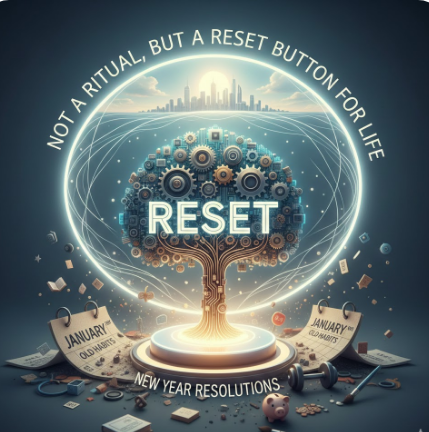
New Year Resolutions: Not a Ritual, But a Reset Button for Life
Every year, the calendar flips.
And with it comes a silent question we rarely ask honestly:
“ will this year actually be different — or just renamed?”
New Year resolutions were never meant to be wish lists or motivational slogans. They were
meant to alter the course of life, even if only by a few degrees. A small shift in direction,
sustained over time, can take you to an entirely different destination.
This blog is not about dreaming big for a week and quitting quietly.
It is a complete, practical, no-nonsense guide to making resolutions that work — and
more importantly, change you.
1. Why New Year Resolutions Matter More Than We Admit

Life doesn’t usually collapse dramatically.
It drifts.
Missed routines.
Delayed decisions.
Postponed courage.
A New Year resolution is not about the date — it’s about interrupting drift.
A resolution:
- Forces reflection instead of autopilot
- Creates a pause between who you were and who you can become
- Gives psychological permission to reset patterns, not just habits
When done right, resolutions don’t add pressure — they restore direction.
2. Why Most Resolutions Fail (And it’s Not Lack of Willpower)

People don’t fail resolutions because they are weak.
They fail because they design them wrong.
The most common reasons resolutions collapse:
1. They are identity-free
“I will wake up early.”
But why? Who are you becoming?
Without identity change, habits feel forced.
2. They are outcome-obsessed
Lose 10 kg.
Earn more money.
Read 50 books.
Outcomes don’t create momentum — systems do.
3. They are emotionally disconnected
People set goals based on:
- Social media trends
- Peer pressure
- What sounds impressive
Not what genuinely matters to their life.
4. They are too big, too fast
The brain resists radical overnight change.
What feels inspiring on Jan 1 feels undoable by Jan 15.
5. They rely on motivation
Environment and structure are not.
3. The Right Kind of Resolutions to Take
The best resolutions are not loud.
They are quiet, structural, and sustainable.
Take resolutions in these 5 categories:
Identity-Based Resolutions (Foundation)
Instead of:
- “I will exercise”
Choose:
- “I become a person who respects my body”
Examples:
- I become someone who finishes what he starts
- I become someone who speaks honestly
- I become someone who protects his mental peace
Identity first. Actions follow.
Directional Resolutions (Life Course)
These don’t demand speed — they demand clarity.
Examples:
- This year, I move towards financial stability
- This year, I reduce chaos, not add ambition
- This year, I stop postponing difficult conversations
Direction beats intensity.
System-Based Resolutions (Daily Life)
Replace goals with repeatable actions.
Instead of:
- “Read 30 books”
Choose:
- “Read 10 minutes daily after dinner”
Instead of:
- “Save a lot of money”
Choose:
- “Automate savings on salary day”
Subtraction Resolutions (Underrated & Powerful)
Some of the best resolutions are about removal.
Examples:
- Reduce social media exposure
- Stop over-committing
- Stop saying yes to drainers
- Stop self-criticism
Growth accelerates when friction reduces.
One Courage Resolution
Pick one thing you’ve been avoiding.
Examples:
- Starting that long-delayed project
- Addressing health seriously
- Setting boundaries with someone
- Asking for help
One brave decision can change a year.
4. How to Stick to Resolutions (Without Burnout)
Sticking is not about discipline alone.
It’s about designing life so quitting becomes inconvenient.
Practical strategies that actually work:
Shrink the commitment
If it feels too easy, it’s probably right.
- 5 push-ups > 1-hour workout
- 1 page > 1 chapter
- 5 minutes > skipped day
Consistency beats enthusiasm.
Anchor habits to existing routines

Never start from zero.
Examples:
- Meditate after brushing
- Journal before sleep
- Walk after meals
Habits stick when attached to habits.
Track behavior, not mood
Don’t ask:
“How do I feel today?”
Ask:
“Did I do the action?”
Progress is built on behavioral evidence, not emotional states.
Expect imperfect days
Missing once is human.
Missing twice is the danger zone.
Rule:
Never miss twice.
Change environment, not personality
If your environment stays the same, your behavior will too.
- Keep junk food out of sight
- Keep books visible
- Reduce friction for good habits
- Increase friction for bad ones
5. Daily & Weekly Practices to Follow
Daily Practice (10–15 minutes total)
-
One priority for the day
Ask: What single action moves my life forward today? -
One micro-win:
Do something small that reinforces your identity. -
One reflection
- What went right today?
- What drained me?
Weekly Practice (20–30 minutes)
- Review what worked
- Adjust what didn’t
- Recommit — without self-judgment
Weekly reviews prevent silent drift.
6. How to Reach Goals Without Losing Yourself
Goals should serve life, not consume it.
The sustainable path:
- Focus on process, not pressure
- Measure progress, not perfection
- Align goals with values, not validation
Ask these questions monthly:
- Is this goal still meaningful?
- Is it improving my quality of life?
- Do I feel stronger or more exhausted pursuing it?
If a goal destroys peace, it needs redesign — not abandonment.
7. The Truth About New Year Resolutions
A resolution is not a promise to the future.
It is a decision in the present.
You don’t need:
- A perfect plan
- Massive motivation
- External approval
You need:
- Clarity
- Small consistent actions
- Patience with yourself
The real success of a New Year resolution is not how fast you achieve it —
but how deeply it changes the way you live.
Final Thought
Don’t use the New Year to demand a new life from yourself.
Use it to build one — slowly, intentionally, and honestly.
If even one habit, one boundary, or one courageous step changes this year…
That is not a resolution fulfilled.
That is a life redirected.
You may also like to read https://kvshan.com/2025/04/brain-rot-and-brain-fog.html