Most children are not struggling because they are incapable.
They are struggling because they feel unseen.
Between instructions, corrections, advice, and expectations, one vital emotional nutrient
quietly disappears from modern homes and classrooms — appreciation.
Research in psychology repeatedly shows that a child’s confidence does not grow from
intelligence alone, nor from discipline, nor even from achievement.
It grows from recognition — from someone noticing effort before judging outcome.
When a child is constantly corrected, they learn to avoid mistakes.
But when a child is appreciated, they learn to explore the world.
This is not a parenting trick or a teaching method.
It is the difference between raising a performer and raising a person.
The story you are about to read is not about marks, behavior, or success.
It is about how a single change in the way adults spoke transformed a child’s identity — at
home and inside a classroom.
Because sometimes, confidence is not taught.
It is reflected.
The Language That Heals: How Appreciation Rebuilt a Home, a Classroom, and a Human Being
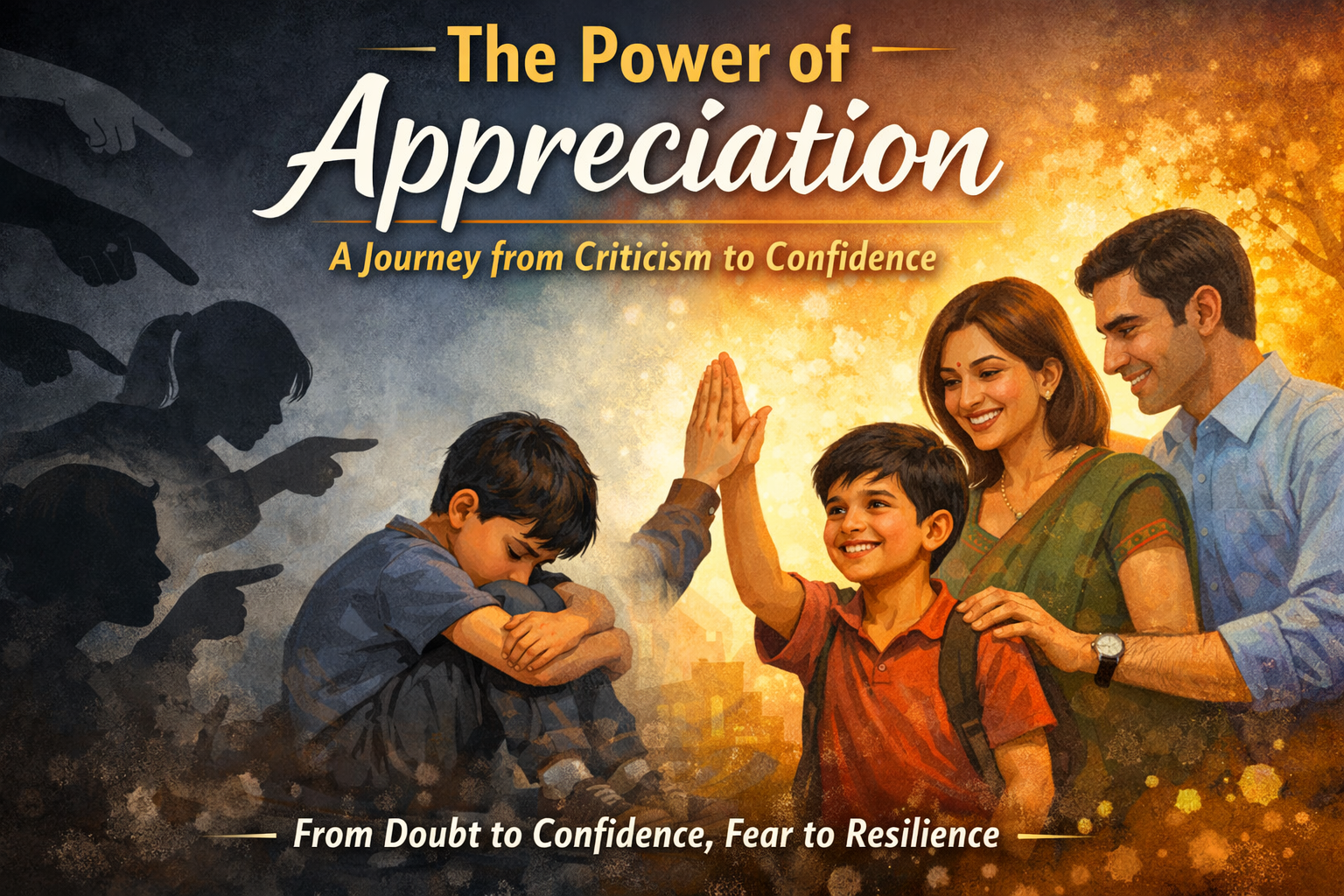
There are two kinds of homes in this world.
One where people live together.
And another where people feel seen.
The difference between the two is rarely money, education, culture, or discipline.
It is appreciation.
We often imagine appreciation as politeness — a “thank you,” a compliment, a formal
acknowledgment.
But appreciation is not etiquette.
It is oxygen.
A human being can survive criticism, instructions, rules, and expectations…
But cannot thrive without recognition.
Modern psychology now confirms what ancient wisdom quietly practiced: appreciation
strengthens self-confidence, improves mental health, deepens relationships, builds empathy,
and even fosters social harmony .
Yet strangely — it is the rarest emotional currency in families and classrooms.
This is the story of how one child changed when appreciation entered his life.
And how two adults discovered they were not raising or teaching a child — they were shaping
a nervous system. And tis is important.
The Boy Who was Always Wrong
Arjun was ten years old and permanently “almost good.”
Not bad.
Not excellent.
Just almost.
Almost neat.
Almost attentive.
Almost obedient.
Almost smart.
And therefore, always corrected.
His father was a disciplined bank manager.
“Sit straight.”
“Hold the pencil properly.”
“You can do better.”
“Why only 92? Where are the missing 8 marks?”
His mother loved him deeply — but her love spoke the language of worry.
“Don’t run.”
“Don’t spill.”
“Don’t forget.”
“Don’t embarrass us.”
Nothing cruel.
Nothing abusive.
Just constant improvement.
At school, his class teacher, Mrs. Meera, was efficient and structured.
“Arjun, you’re careless.”
“Arjun, concentrate.”
“Arjun, again incomplete.”
Every adult around him was trying to make him better.
And slowly… he became smaller.
The Silent Shift
By class 5:
• He stopped raising his hand
• He erased answers repeatedly before submitting
• He avoided eye contact
• He began saying: “I’ll try…” instead of “I know.”
His report card still looked fine.
But his mind had begun forming a belief:
“I am someone who disappoints people.”
And once a child believes that — effort feels dangerous.
Because effort risks exposure.
So he chose safety.
Minimum participation. Minimum enthusiasm. Minimum mistakes.
Minimum self.
The Teacher Who Changed One Sentence
One day, during a science activity, students had to build a simple windmill model.
Arjun’s model didn’t spin properly.
He quietly moved it aside.
Mrs. Meera noticed — and was about to say what she had always said:
“You didn’t follow instructions carefully.”
But she paused.
Because the previous week she had attended a teacher training workshop about appreciation-
based reinforcement.
A line from the training echoed in her mind:
Children repeat behavior that is noticed — not behavior that is demanded.
So instead she said:
“Arjun, you chose very strong blades. That shows good observation.”
He looked up.
Confused.
Nobody had ever appreciated the process — only the result.
She continued:
“If you adjust the angle slightly, it will rotate better.”
Something small happened in his brain.
Not excitement.
Not confidence.
Permission.
The Neuropsychology of Appreciation
When a child hears correction repeatedly, the brain enters defensive mode.
Learning stops.
But appreciation activates safety.
And a safe brain experiments.
That day, Arjun rebuilt the model three times.
For the first time, he didn’t hide mistakes.
He explored them.
The First Crack in the Wall
The next week:
Math test.
Arjun scored 95.
His father said automatically:
“Good… but careless in step 3.”
He waited for Arjun’s usual silence.
Instead, Arjun replied:
“I solved it differently. Teacher said method was creative.”
The father was stunned.
Not by the marks.
By the tone.
The boy wasn’t defensive.
He was explaining.
That evening, his mother noticed he was doing homework without reminders.
Not faster.
But calmer.
Appreciation Doesn’t Inflate Ego
Many parents fear appreciation makes children arrogant.
It does the opposite.
Praise for identity (“You are brilliant”) creates pressure.
Appreciation for effort and observation creates ownership.
Arjun wasn’t trying to impress anymore.
He was trying to understand.
And motivation had shifted from fear → curiosity.
The Day the Father Learned Parenting
One Sunday, father and son assembled a broken table fan.
It didn’t work.
His father almost said:
“Move, I’ll do it.”
But remembered something the teacher had written in the diary:
“Arjun shows strong problem-solving when encouraged.”
Encouraged?
He had never encouraged. Only guided.
So he tried:
“You noticed the wire loosened. Good catch.”
Arjun immediately leaned closer.
Twenty minutes later — the fan ran.
The boy smiled wide.
And then something unexpected happened.
He didn’t look proud.
He looked relieved.
As if a lifelong doubt had loosened:
Maybe I’m not careless… maybe I was just scared.
The Classroom Transformation
Mrs. Meera made a rule for herself:
Correct the error.
But appreciate the thinking first.
Examples:
Instead of
“Wrong answer.”
She used
“Your approach is logical. Check step two.”
Instead of
“Not neat.”
She used
“You organized the points well — now make the writing clearer.”
Within 2 months:
• Participation doubled
• Fearful students spoke
• Fights reduced
• Homework completion increased
Because appreciation creates psychological safety — the foundation of learning .
Children stopped performing for marks.
They started engaging with ideas.
The Hidden Damage of Constant Correction
Correction teaches accuracy.
But continuous correction teaches inadequacy.
A child raised without appreciation learns:
Love is conditional upon performance.
Later in adulthood, this becomes:
• Perfectionism
• Procrastination
• Fear of starting
• Fear of success
• Chronic self-criticism
Many adults who “lack confidence” are not incompetent.
They are unacknowledged.
Their brain learned:
Effort leads to evaluation, not connection.
So they avoid effort.
The Family Meeting
One evening, Arjun’s teacher called both parents.
They feared complaints.
Instead she said:
“He didn’t become smarter. He became safer.”
Silence.
She explained:
Children do not resist learning.
They resist humiliation.
Appreciation does three things:
-
Validates effort
-
Encourages risk-taking
-
Builds resilience
Then she added gently:
“At home, reduce instructions. Increase noticing.”
The Experiment at Home
They started small.
Mother changed:
Instead of
“Eat properly.”
She said
“You finished vegetables today without reminder.”
Father changed:
Instead of
“Why late?”
He said
“You remembered to pack your bag yourself.”
Within weeks:
Arjun became talkative at dinner.
He began telling stories.
Not achievements.
Experiences.
That is the moment a child feels emotionally secure — when conversation replaces
performance.
Appreciation and Identity Formation
Identity is built from reflected messages.
A child becomes what the environment repeatedly mirrors.
Mirror of correction → cautious personality
Mirror of appreciation → exploratory personality
Appreciation does not mean ignoring mistakes.
It means separating the person from the error.
“Your answer is wrong” hurts.
“This step needs change” teaches.
The Unexpected Change in the Father
Months later, the father realized something strange.
He was calmer at work.
He stopped reacting aggressively to junior staff mistakes.
Because appreciation had not only changed the child — it rewired the adult.
When we practice noticing effort, the brain shifts from threat detection to observation mode.
And observation reduces anger.
Appreciation as Emotional Nutrition
Just like the body needs vitamins, the mind needs recognition.
Without it:
• Motivation weakens
• Relationships harden
• Learning becomes mechanical
With it:
• Confidence stabilizes
• Empathy grows
• Responsibility increases
Communities even become cooperative because appreciation builds belonging .
May this blog help you to stay grounded by reclaiming the lost grounds https://kvshan.com/2026/02/why-your-mood-keeps-falling-back-and.html
The Annual Day
Arjun participated in a science presentation.
He forgot a line midway.
The hall went silent.
He paused… smiled… and continued explaining in his own words.
No panic.
No freeze.
Afterward, his father asked:
“You weren’t scared?”
He replied:
“I knew mistakes are okay if I keep trying.”
That sentence revealed the true function of appreciation:
Not happiness.
Resilience.
The Teacher’s Realization
Mrs. Meera later wrote in her journal:
“Discipline controls behavior.
Appreciation builds character.”
Control works in presence.
Character works in absence.
That is education.
The Psychological Mechanism
Why appreciation works:
1. It reduces threat response
Brain exits survival mode.
2. It increases dopamine
Motivation becomes internal.
3. It builds secure identity
Self-worth detaches from outcomes.
4. It encourages experimentation
Learning accelerates.
What Appreciation is NOT
Not flattery
Not bribery
Not lowering standards
Not ignoring mistakes
It is accurate recognition of effort, intention, or progress.
Bad:
“You’re amazing.”
Good:
“You tried three methods before solving.”
A Small Daily Practice
Families and classrooms can transform with one rule:
Notice before you instruct.
Every day:
3 appreciations
1 correction
Not artificial — observational.
Years Later
In class 10 farewell, Arjun spoke:
“I wasn’t afraid of exams. I was afraid of disappointing people. When teachers and
parents began noticing effort instead of errors, I began noticing my own thinking.”
He didn’t top the school.
But he chose engineering confidently.
Because appreciation doesn’t produce toppers.
It produces self-directed humans.
FINAL THOUGHT — The Invisible Architecture
A building stands on pillars.
A personality stands on reflections.
Criticism shapes behavior.
Appreciation shapes identity.
Families think they are raising children.
Teachers think they are delivering subjects.
But in reality, they are writing internal dialogues.
And one day, when no one is present…
The child will speak to himself in the same tone.
That voice will decide:
Whether he tries
Whether he gives up
Whether he fears mistakes
Whether he lives fully
So the real question is not:
Did you educate the child?
It is:
What voice did you leave inside him?
Because appreciation is not a reward.
It is inheritance.
When you suffer from deep RESENTMENT and desperately want to fix your mind these tips can steer you clear through https://kvshan.com/2026/01/resentment-detox-case-studies-and-7-day.html
A Soulful Confession
Knowingly or unknowingly I too had done the wrong thing just like the father above. Though
I have remained an appreciative person but somehow you know your deep embedded DNA
will peep out to ensure that you followed the instructions.
Sadly I learnt about the science behind only after my children had crossed the initial stages
and for which I deeply regret.
May this article serve as a reminder to the young parents, teachers and my children too
to become good parents. Before going to school it’s the home that prepares those little minds.
My sincere advice to you is the art of appreciation isn’t limited to and directed only towards
young children . You can practice this with everyone you see irrespective of their age.
Thank You