Do you wake up already feeling exhausted, dreading the day ahead? When life gets
overwhelming, it is easy to dismiss constant fatigue as just “having a busy week.”
However, chronic stress has a way of quietly building up until you completely hit a wall.
The truth is, your body and mind usually scream for help long before a total collapse
happens—we simply tend to tune them out. Recognizing the emotional exhaustion
symptoms early is the only way to stop the cycle. If you are feeling drained,
overwhelmed, or completely detached, you do not have to just push through it. In this
guide, we will look at 4 early signs of burnout you are ignoring and break down a
realistic, 5-step sustainable recovery plan to help you reclaim your energy and figure out
how to recover from burnout without turning your entire life upside down.
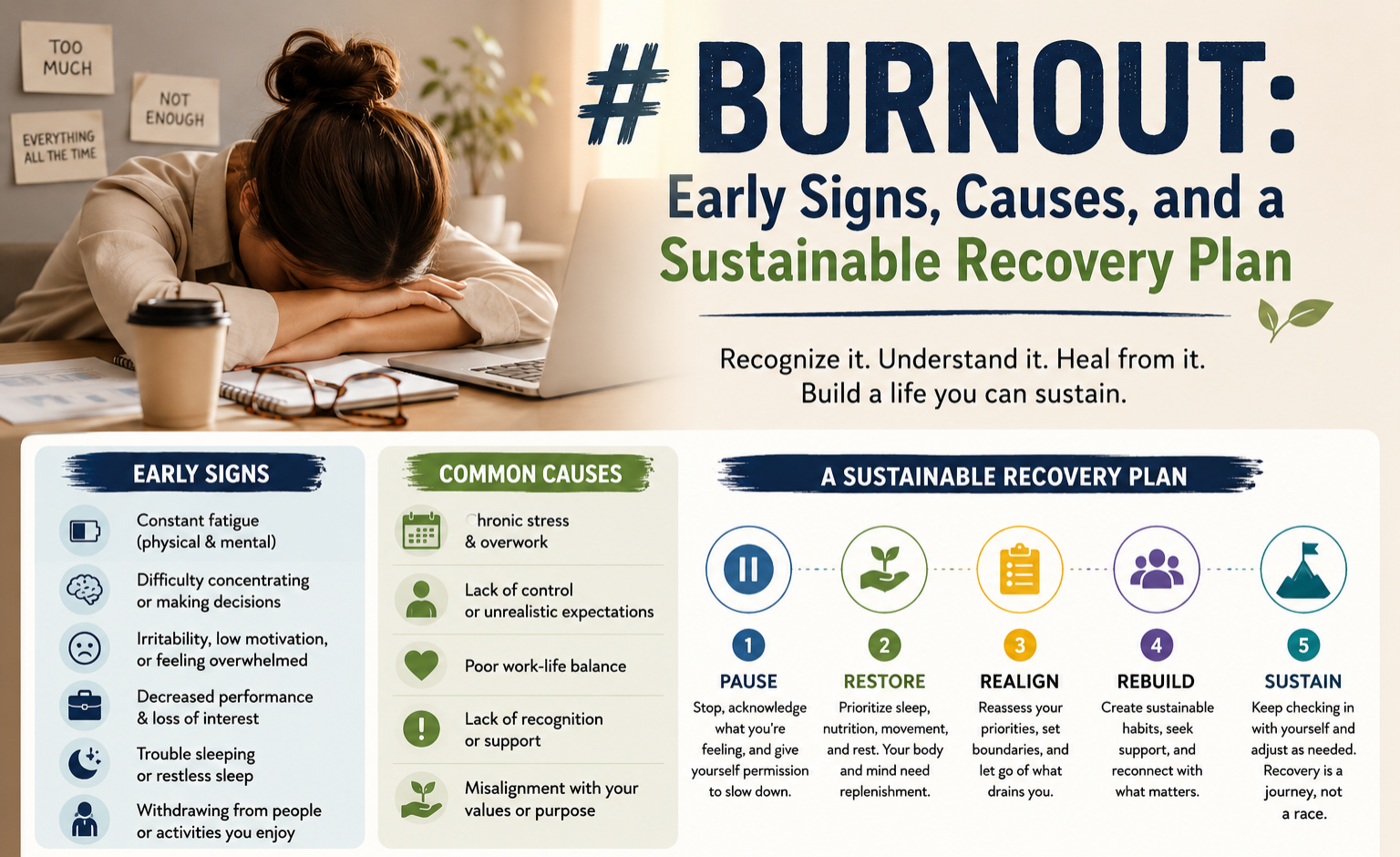
Burnout: Early Signs, Causes, and a
Sustainable Recovery Plan
Burnout does not arrive suddenly.
It builds quietly, day after day, while you keep functioning.
Most people do not realize they are burnt out.
They think they are just tired, stressed, or unmotivated.
Burnout is not laziness.
It is not weakness.
It is a state of chronic psychological and nervous-system depletion.
This guide explains what burnout really is, how to recognize it early, why it happens, and
how to recover in a sustainable, realistic way.
What Burnout Really is
Burnout is a condition caused by prolonged exposure to stress without adequate
recovery or emotional processing.
It affects three core areas:
-
Energy (you feel constantly drained)
-
Emotion (you feel numb, cynical, or detached)
-
Performance (your efficiency and motivation collapse)
Burnout is not just about work.
It can come from caregiving, relationships, financial pressure, or emotional suppression.
How Burnout is Different From Normal Stress
| Normal Stress | Burnout |
|---|---|
| Temporary | Chronic |
| Improves with rest | Persists despite rest |
| You still care | You stop caring |
| Energy fluctuates | Energy stays low |
| Pressure feels external | Pressure feels internal and inescapable |
This is why people say:
“I don’t even care anymore, and that scares me.”
The 4 Early Warning Signs of Burnout that You Kept
Ignoring
Catching burnout early can prevent collapse.
1. Mental Signs
-
Poor concentration
-
Memory issues
-
Feeling overwhelmed by simple tasks
2. Emotional Signs
-
Irritability
-
Cynicism
-
Loss of empathy
3. Physical Signs
-
Chronic fatigue
-
Headaches
-
Muscle tension
-
Digestive problems
-
Frequent illness
4. Behavioral Signs
-
Procrastination
-
Excessive scrolling or numbing
-
Increased caffeine or sugar use
The 5 Root Causes of Burnout
Burnout is rarely caused by one thing.
1. Chronic Overwork Without Recovery
When effort is continuous and rest is shallow, your nervous system never resets.
Vacations don’t fix this if daily recovery is missing.
2. Emotional Suppression
When you hide frustration, sadness, anger, or fear to “stay functional,” your system
stores that stress.
Stored emotion becomes burnout.
3. Loss of Autonomy
Feeling trapped in:
-
A job you hate
-
A life you didn’t choose
-
A role you can’t escape
Creates learned helplessness.
4. Identity Tied to Performance
If your worth = productivity,
rest feels like failure.
This creates self-driven exploitation.
5. Meaning Deprivation
When effort feels pointless, energy collapses.
Humans endure stress better when it feels meaningful.
A Common Burnout Progression
Stage 1: Overdrive
You push harder, ignore fatigue, suppress emotion.
Stage 2: Exhaustion
You feel tired all the time but keep functioning.
Stage 3: Detachment
You stop caring. You feel numb.
Stage 4: Collapse
You can’t function normally anymore.
Most people seek help only at Stage 4.
The Hidden Cost of Ignoring Burnout
Unresolved burnout leads to:
-
Anxiety disorders
-
Depression
-
Relationship breakdowns
-
Job loss
-
Physical illness
-
Identity collapse
Burnout untreated becomes trauma.
The 5 Step Sustainable Burnout Recovery Plan
Burnout recovery is not a weekend fix.
It is nervous-system rehabilitation + life redesign.
Phase 1: Stop the Bleeding (Stabilization)
Goal: Reduce overload.
-
Cut non-essential commitments
-
Reduce screen time
-
Sleep more
-
Eat regularly
-
Say no more often
You cannot heal in the same conditions that broke you.
Phase 2: Nervous System Reset
Daily practices:
-
Slow breathing (inhale 4, exhale 6)
-
Gentle walks
-
Body relaxation before sleep
-
Quiet time without stimulation
This teaches your body that danger is over.
Phase 3: Emotional Processing
Burnout stores suppressed emotion.
Daily:
-
Journal what you feel
-
Name the emotion
-
Express anger, sadness, grief safely
Unfelt emotion blocks recovery.
Phase 4: Structural Life Changes
Ask honestly:
-
What drains me the most?
-
What am I tolerating that I shouldn’t?
-
What boundaries am I avoiding?
Small life changes > therapy alone.
Phase 5: Meaning Reconstruction
Burnout often destroys purpose.
Rebuild meaning through:
-
Contribution
-
Creativity
-
Learning
-
Service
-
Spiritual practice
Meaning fuels resilience.
A Simple 14-Day Burnout Reset
Days 1–3: Load Reduction
-
Cancel one obligation
-
Sleep more
-
Walk daily
Days 4–7: Nervous System Care
-
Slow breathing
-
Gentle movement
-
No late screens
Days 8–11: Emotional Clearing
-
Journal daily
-
Talk to someone safe
-
Allow emotional release
Days 12–14: Life Realignment
-
Identify 3 draining patterns
-
Set one new boundary
-
Choose one life change
When Burnout Requires Professional Help
Seek support if you have:
-
Persistent depression
-
Panic attacks
-
Suicidal thoughts
-
Total functional collapse
Burnout is treatable.
You don’t have to suffer alone.
Final Perspective
Burnout is not failure.
It is a survival response to prolonged overload.
Your body is not betraying you.
It is protecting you by shutting down.
Recovery is not about becoming stronger.
It is about:
-
Becoming slower
-
Becoming honest
-
Becoming bounded
-
Becoming aligned
You are not broken.
You are exhausted.
And exhaustion is reversible.
This guide is for educational purposes and does not replace professional mental health support. If burnout symptoms significantly interfere with daily functioning, seeking qualified help is recommended.
Topics that may interest you