The Subconscious Mind Explained: From the Hypnagogic State to Neuroplasticity and Manifestation
“The subconscious mind is always listening. The real question is: What are you telling it?”
For decades, books like The Power of Your Subconscious Mind by Joseph Murphy have captivated millions with ideas that seemed almost mystical. Murphy spoke of the hypnagogic state, autosuggestion, the subjective mind, and Infinite Intelligence long before neuroscience became a mainstream topic.
Today, advances in psychology and brain science have given us a fascinating opportunity. Many of Murphy’s concepts can now be viewed through the lenses of neuroplasticity, psychoneuroimmunology, cognitive psychology, and behavioral science. While science doesn’t validate every spiritual claim associated with manifestation, it does explain why belief, expectation, emotion, and repetition profoundly influence our thoughts, behaviors, and ultimately, our results.
The intersection of these ideas is where the real magic—or rather, the real psychology—begins.
The Hidden Power of the Subconscious
Joseph Murphy divided the mind into two parts:
- The objective mind, responsible for reasoning, analysis, and conscious decision-making.
- The subjective mind, better known today as the subconscious, which stores habits, memories, beliefs, emotional associations, and automatic behaviors.
Modern neuroscience doesn’t literally separate the brain into objective and subjective minds, but it does recognize that much of our daily functioning happens outside conscious awareness.
Researchers estimate that a significant portion of our daily decisions, emotional reactions, and behavioral patterns are automatic. These automatic responses arise from neural networks built over years of repetition and experience.
This explains why changing habits is difficult.
You are not simply fighting old thoughts.
You are competing against well-established neural pathways.
The Hypnagogic State: Why Murphy Loved It
One of Murphy’s favorite concepts was the hypnagogic state—the brief transition between wakefulness and sleep.
During this period:
- external awareness decreases,
- analytical thinking becomes quieter,
- imagination becomes more vivid,
- the mind becomes highly receptive to suggestion.
Murphy encouraged readers to use this state for affirmations and visualization because conscious resistance is reduced.
Modern sleep research also recognizes this unique transition. Although scientists don’t claim it magically programs reality, they acknowledge that the hypnagogic period is associated with altered attention, creativity, memory consolidation, and increased imagery.
This is precisely why athletes, musicians, entrepreneurs, and psychologists often recommend visualization before sleep.
Not because the universe suddenly changes.
Because your brain becomes more willing to encode what you repeatedly imagine.
Autosuggestion: Talking to Your Own Brain
Murphy frequently discussed autosuggestion, a term popularized by French pharmacist and psychologist Émile Coué.
Autosuggestion simply means influencing yourself through deliberate repetition.
Statements such as:
“I become calmer every day.”
“I solve problems confidently.”
“I deserve healthy relationships.”
may appear simplistic.
Yet repeated self-talk influences attention, expectation, emotional regulation, and eventually behavior.
Your subconscious cannot distinguish between a statement repeated once and one repeated thousands of times without consequence. Repetition strengthens familiarity.
Familiarity becomes belief.
Belief influences behavior.
Behavior shapes outcomes.
The affirmation itself is not magic.
The repeated psychological conditioning often is.
Heterosuggestion: When Others Program You
If autosuggestion is self-programming, heterosuggestion is programming by others.
Parents.
Teachers.
News.
Friends.
Social media.
Advertising.
Cultural beliefs.
Every repeated message contributes to your internal model of reality.
Children especially absorb heterosuggestions because their critical thinking is still developing.
A child repeatedly told,
“You are lazy.”
“You are difficult.”
“You’ll never succeed.”
may unconsciously carry these identities into adulthood.
The subconscious accepts repetition far more readily than logic.
Fortunately, the process works both ways.
Healthy repetition can gradually replace unhealthy programming.
Mirror Neurons: Why We Become Like the People Around Us
Have you ever noticed yourself adopting someone else’s expressions, posture, or even way of speaking without realizing it? This isn’t merely coincidence. Neuroscientists have identified specialized brain cells known as mirror neurons, which become active not only when we perform an action ourselves but also when we observe someone else performing it.
While researchers continue to study the full extent of their role, mirror neurons appear to contribute to learning through observation, imitation, empathy, and aspects of social behavior. They help explain why children often mirror their parents’ habits, why spending time with optimistic people can feel energizing, and why persistent exposure to negativity can gradually influence our own mindset.
This idea connects naturally with heterosuggestion. The beliefs, attitudes, and behaviors repeatedly demonstrated by parents, teachers, mentors, friends, and even social media personalities don’t just shape our conscious opinions—they can become part of our subconscious programming through repeated observation and experience.
Think about the people you spend the most time with. If they consistently respond to setbacks with resilience, discipline, and optimism, your brain repeatedly witnesses those behavioral patterns. Over time, those observations may strengthen similar neural pathways in your own brain. Conversely, if your environment is dominated by fear, criticism, or hopelessness, those patterns can also become familiar and easier to reproduce.
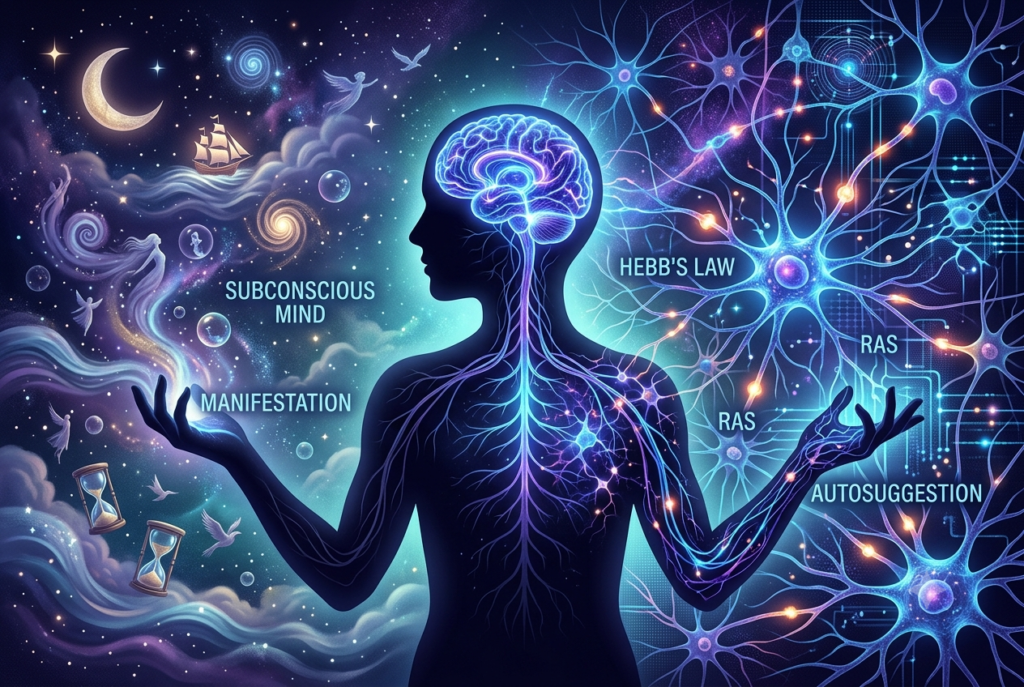
This is where mirror neurons meet Hebb’s Law—the principle that “neurons that fire together wire together.” Every meaningful observation activates neural circuits, and repeated activation strengthens them. In other words, your brain is constantly learning not only from what you do, but also from what you repeatedly see.
This is one reason psychologists often emphasize the importance of choosing positive role models, supportive communities, and growth-oriented environments. Your surroundings don’t determine your future, but they do influence the mental patterns your brain rehearses every day. By intentionally exposing yourself to people who embody the qualities you wish to develop, you give your subconscious—and your brain—the opportunity to build healthier, more empowering neural pathways.
Neurons that Fire Together Wire Together
Perhaps no phrase summarizes neuroplasticity better than Canadian psychologist Donald Hebb’s famous principle:
“Neurons that fire together wire together.”
Often called Hebb’s Law, this idea suggests that when two neurons repeatedly activate at the same time, the connection between them strengthens.
Think of the brain as a forest.
Walking through untouched grass once leaves almost no trail.
Walk the same path every day.
Eventually a visible pathway forms.
Repeat it for years.
Now it becomes the default route.
Your brain works similarly.
Every repeated thought strengthens certain neural circuits.
Every repeated emotional reaction reinforces particular networks.
Every practiced behavior becomes increasingly automatic.
This is why worrying becomes easier with practice.
Confidence also becomes easier with practice.
Gratitude.
Resilience.
Compassion.
Fear.
All of them become neurological habits through repetition.
Murphy did not use the term neuroplasticity, but the underlying principle aligns remarkably well with his emphasis on repeated mental impressions.
Neuroplasticity: Your Brain is Not Fixed
This one has opened many an eye. We all grew up hearing that your brains are inherited and it is fixed. For many years scientists believed adult brains were largely unchangeable.
Today we know otherwise.
Neuroplasticity refers to the brain’s ability to reorganize itself by forming and strengthening new neural connections throughout life.
Every new language.
Every skill learned.
Every healthy habit.
Every emotional breakthrough.
Every therapeutic intervention.
Each can physically reshape neural pathways.
This doesn’t mean anyone can become anything simply by thinking positively.
But it does mean that repeated thoughts combined with consistent action can gradually alter how the brain processes information.
The brain changes because experience changes it.
Mental Equivalents and the Brain
Murphy often used the phrase mental equivalent.
Before something exists externally, he argued, it first exists internally as an image, expectation, or belief.
Modern psychology offers an interesting parallel.
Elite athletes rehearse performances mentally.
Surgeons mentally practice complex procedures.
Olympic competitors visualize entire events repeatedly before competing.
Brain imaging studies have shown that mental rehearsal activates many of the same neural networks involved in actual performance.
Visualization alone won’t build muscles.
But visualization combined with action improves learning, confidence, and execution.
The mental equivalent prepares the brain for the physical equivalent.
Psychosomatic Medicine: When Thoughts Affect the Body
Murphy repeatedly discussed the relationship between the mind and physical health.
Today we describe many of these interactions under psychosomatic medicine.
The term simply means that psychological factors can influence physical symptoms.
Stress may contribute to:
- headaches,
- digestive problems,
- muscle tension,
- elevated blood pressure,
- sleep disturbances.
Importantly, psychosomatic does not mean “imaginary.”
The symptoms are real.
The psychological influences are also real.
The brain and body constantly communicate through hormones, neurotransmitters, and the nervous system.
Psychoneuroimmunology: The Mind-Body Connection
We hear of mind healing and you must have heard of such instances where people got cured or bettered their medical conditions. That is why one of the most fascinating modern disciplines remains psychoneuroimmunology.
Although the name sounds intimidating, it simply studies how psychological processes, the nervous system, hormones, and the immune system influence one another.
Researchers have found that chronic stress can alter immune responses, while healthy emotional regulation, good sleep, exercise, and social connection can support immune functioning.
This doesn’t mean positive thinking cures every illness.
It doesn’t.
However, mental health genuinely influences physical health.
The mind and body are partners, not separate systems.
Murphy intuited this relationship decades before the field became widely recognized.
Mesmerism, Faith, and Belief
Murphy also discussed mesmerism, named after eighteenth-century physician Franz Anton Mesmer.
Many of Mesmer’s theories have been rejected scientifically.
Yet one lesson remains valuable.
Expectation matters.
Modern medicine recognizes the placebo effect, where belief itself can influence perceived symptoms and measurable physiological responses in some circumstances.
The placebo effect does not prove supernatural healing.
Instead, it demonstrates that expectation can influence the body’s responses in complex ways.
Belief changes biology more often than people realize.
Mind you like placebo there exists nocebo effect too.
Manifestation: Where Psychology Meets Possibility
Manifestation is perhaps the most misunderstood topic in personal development.
Some portray it as wishing for wealth while sitting on a couch.
Others dismiss it entirely.
Reality is far more interesting.
Manifestation can be viewed as a psychological process involving:
- attention,
- belief,
- expectation,
- emotional regulation,
- goal clarity,
- behavioral consistency,
- persistence.
When you repeatedly visualize a goal, affirm it, emotionally connect with it, and consistently take action, several things happen.
Your attention begins filtering opportunities differently.
Your confidence gradually improves.
Fear becomes less dominant.
Your decisions become more aligned with your intentions.
These shifts can increase the likelihood of achieving meaningful outcomes.
This doesn’t imply that thoughts alone reshape external reality.
Rather, your internal world influences how you perceive, interpret, and respond to the external world.
And those responses often determine your results.
The Reticular Activating System: Your Brain’s Opportunity Filter
Closely connected with manifestation is the Reticular Activating System (RAS), a network within the brainstem that helps filter the overwhelming amount of sensory information you encounter every day.
You don’t consciously notice every car on the road, every conversation around you, or every object in your peripheral vision. Your RAS decides what deserves your attention based on what your brain considers important, (The Red Car theory)
Have you ever decided to buy a particular car and suddenly started seeing that model everywhere?
The cars weren’t magically appearing.
Your RAS simply began prioritizing them.
The same principle applies to goals.
When you consistently focus on learning a skill, starting a business, improving your health, or nurturing relationships, your brain becomes more sensitive to relevant opportunities, ideas, and resources.
The RAS doesn’t create reality.
It changes what you notice within reality.
Combined with visualization, autosuggestion, and purposeful action, this selective attention can become a powerful catalyst for change.
Bringing it All Together
Let’s connect the dots.
You enter the hypnagogic state, where the mind becomes deeply relaxed.
You use autosuggestion to reinforce empowering beliefs.
Repeated thoughts strengthen neural pathways because neurons that fire together wire together.
Through neuroplasticity, those pathways gradually become your default responses.
Your Reticular Activating System starts noticing opportunities that align with your goals.
Reduced stress benefits both your emotional wellbeing and, through mechanisms explored in psychoneuroimmunology, aspects of your physical health.
Your mental equivalent influences your behavior.
Your behavior influences your outcomes.
And what once felt like manifestation increasingly resembles the remarkable capacity of the human brain to adapt, learn, focus, and act.
In a Nutshell
Joseph Murphy wrote during a time when neuroscience was still in its infancy. He described the subconscious using the language available to him—subjective mind, Infinite Intelligence, autosuggestion, faith, and the hypnagogic state.
Modern science has given us new vocabulary: neuroplasticity, Hebbian learning, cognitive psychology, the Reticular Activating System, psychosomatic medicine, and psychoneuroimmunology.
The language has changed.
The central insight remains strikingly familiar.
Your repeated thoughts influence your beliefs.
Your beliefs influence your emotions.
Your emotions influence your choices.
Your choices shape your habits.
Your habits shape your life.
Whether you call it subconscious programming, neuroplasticity, or manifestation, one principle stands above the rest:
The mind changes first. The life often follows—not by magic, but because the brain, the body, and behavior are deeply interconnected.
FAQ
Q1. What is the hypnagogic state?
The hypnagogic state is the transitional period between wakefulness and sleep. During this relaxed state, the mind becomes more receptive to imagery, suggestions, and creative thinking, making it a popular time for visualization and affirmations.
Q2. What does ‘neurons that fire together wire together’ mean?
This principle, known as Hebb’s Law, explains that repeatedly activated neurons strengthen their connections. It forms the basis of neuroplasticity and explains how habits, beliefs, and learned behaviors become automatic over time.
Q3. Does neuroplasticity support manifestation?
Neuroplasticity doesn’t prove manifestation in a supernatural sense. However, it shows that repeated thoughts, visualization, emotional engagement, and consistent action can reshape neural pathways, influencing behavior and increasing the likelihood of achieving goals.
Q4. What is autosuggestion?
Autosuggestion is the practice of intentionally repeating positive thoughts or affirmations to influence the subconscious mind. Over time, consistent repetition can shape beliefs, attitudes, and behaviors.
Q5. What is the Reticular Activating System (RAS)?
The Reticular Activating System is a network in the brain that filters sensory information. It helps you notice opportunities and information that align with your goals, beliefs, and priorities.
Q6. Can thoughts affect physical health?
Research in psychosomatic medicine and psychoneuroimmunology suggests that chronic stress and emotional states can influence physical health, immune function, and overall well-being. Positive thinking alone isn’t a cure, but mental health plays an important role in physical health.