Changing Millions: What Public Policy Teaches Families About Human Behavior
“Public policy is often imagined as laws, budgets, and grand speeches. Increasingly, it is also about understanding something much smaller: the tiny decisions ordinary people make every day.”
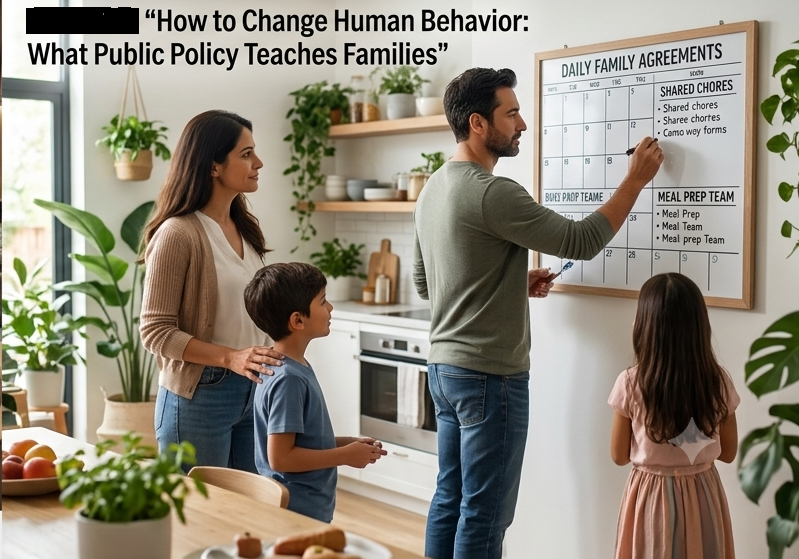
This is an interesting story that is cited as the perfect example for enforced change in behavior by a government without the subjects knowing. A smart strategy indeed.
One Sentence That Collected Millions : How to Change Human Behavior
In the early 2000s, the British government faced a familiar problem.
Millions of people were paying their taxes on time.
But many weren’t.
The traditional response was predictable.
Send reminder letters.
Warn about penalties.
Quote the law.
Threaten legal action.
The letters were professionally written, legally accurate, and completely logical.
Yet they weren’t solving the problem.
Instead of asking how to make the warning stronger, a small team asked a different question.
Why wasn’t the existing letter changing behavior?
That team would later become famous as the Behavioural Insights Team (BIT)—often called the “Nudge Unit.”
Rather than assuming people ignored taxes because they lacked information, the team suspected something else.
People often look to others before deciding what is normal.
So they tested a remarkably simple change.
Some reminder letters included a single additional sentence.
“Most people in your area have already paid their taxes.”
Nothing else changed.
The legal obligations remained the same.
The penalties remained the same.
Only one sentence was different.
Yet that small change significantly increased tax payments and helped the government recover millions in revenue.
The lesson wasn’t that people suddenly became more honest.
The lesson was that behavior often follows perceived social norms.
When people believe responsible behavior is common, they are more likely to act responsibly themselves.
For decades, governments had tried to change behavior primarily through information and enforcement.
Behavioral science introduced a third tool.
Design.
From “What’s Wrong With People?” to “What’s Wrong With the System?”
One of the biggest shifts in modern behavioral science is surprisingly compassionate.
Instead of asking,
“Why are people so irresponsible?”
researchers increasingly began asking,
“Why is the environment making the wrong choice easier than the right one?”
That change in perspective transformed public policy.
Imagine a busy railway station.
People litter everywhere.
One response is to install more signs saying,
DO NOT LITTER.
Another is to place more bins exactly where litter tends to accumulate.
The second approach doesn’t assume people are morally superior.
It simply removes friction from doing the right thing.
Behavioral science doesn’t excuse bad behavior.
It asks a practical question:
How can we make good behavior easier?
This simple shift has influenced governments across the world.
The Birth of the “Nudge”
Economist Richard Thaler had spent much of his career puzzled by a recurring observation.
People consistently made decisions that seemed to go against their own interests.
They delayed saving for retirement.
Ignored healthier lifestyles.
Procrastinated important paperwork.
Economics had long assumed people behaved like careful calculators.
Real life suggested otherwise.
Together with legal scholar Cass Sunstein, Thaler introduced an idea that would become enormously influential.
Instead of forcing people to make better choices, why not design the environment so that the better choice becomes the easier one?
They called this a nudge.
A nudge does not remove freedom.
People remain free to choose.
It simply changes how choices are presented.
Think of a cafeteria.
Healthy food can be placed at eye level while desserts remain available on a lower shelf.
Nothing is banned.
Nothing is forced.
Yet countless studies have shown that placement influences choice.
The environment quietly shapes behavior.
The Organ Donation Story
One of the most famous examples involves organ donation.
Many countries depend on citizens voluntarily registering as organ donors.
Despite widespread public support for organ donation, registration rates often remained surprisingly low.
The question puzzled policymakers.
Did people oppose donation?
Not necessarily.
Many simply postponed making the decision.
Others forgot.
Some never got around to filling out the forms.
Behavioral scientists noticed something interesting.
In some countries, citizens were automatically considered willing donors unless they chose to opt out.
In others, people had to actively opt in.
The difference seemed tiny.
Yet registration rates differed dramatically.
The default mattered.
People still had complete freedom.
Anyone could opt out.
But because the beneficial choice required less effort, many more people remained registered.
This wasn’t manipulation.
It was an acknowledgment of something deeply human.
We often stick with the default option.
That insight has influenced retirement savings, health insurance, pension enrollment, and countless other public services.
A Lesson for Families
At first glance, organ donation and parenting seem worlds apart.
They’re not.
Imagine two homes.
In the first, healthy snacks are hidden somewhere in the refrigerator.
Chips and chocolates sit on the dining table.
Parents constantly remind children to eat fruit.
In the second home, fruit sits in a bowl on the kitchen counter.
Biscuits are stored in a cabinet that’s slightly harder to reach.
Nothing is forbidden.
Children remain free to choose.
But over time, the easier option quietly wins more often.
The family has unknowingly used the same principle governments use.
They designed the environment instead of depending entirely on willpower.
Electricity, Neighbors, and a Smiley Face
(This one should work in India and elsewhere to0)
One of the most fascinating applications of behavioral science came from an American company called Opower.
The challenge seemed straightforward.
How do you encourage households to conserve electricity? Will people listen?
The traditional answer was simple.
Tell people electricity is expensive.
Explain the environmental benefits.
Ask them to save energy.
Some people listened.
Many didn’t as expected.
Opower tried something different.
Instead of only sending monthly bills, households received reports comparing their electricity usage with similar homes in the neighborhood.
The reports answered a question people hadn’t even thought to ask.
“How am I doing compared to everyone else?” When you are put into competition with your neighbor helplessly the raw human emotions bubble up.
If a household used more electricity than similar homes, the report gently pointed it out.
If they used less, they sometimes received a small smiley face or positive symbol.
That’s it.
No prize.
No discount.
No punishment.
Just comparison and recognition. You know humans crave for recognition.
The results surprised many observers.
Energy consumption declined in numerous communities.
Why?
Because people don’t make decisions in isolation.
Knowing that neighbors were using less electricity encouraged many households to reconsider their own habits.
The smiley face may seem trivial.
But remember what we learned in Part 1.
Immediate rewards.
Social incentives.
Visible progress.
The same three ideas appeared again. Here we need to think positive. We are championing energy conservation here.
Why Awareness Campaigns Often Fall Short
Governments frequently launch campaigns encouraging healthier lifestyles.
Eat better.
Exercise more.
Wear helmets.
Stop smoking.
The messages are usually accurate.
The intentions are admirable.
Yet awareness alone often produces disappointing results.
Why?
Because knowing and doing are different things.
Imagine telling people,
“Exercise is good for your heart.”
Most already know that.
Behavioral science asks a different question.
What stops them from exercising today?
Is there no safe place to walk?
Are parks too far away?
Do people have no exercise partners?
Is progress invisible?
Are immediate rewards missing?
Suddenly, the problem becomes more practical.
Instead of repeating information people already know, policymakers begin removing obstacles.
That shift—from information to implementation—is one of the most important contributions behavioral science has made to public policy.
Singapore: When Culture Reinforces Policy
Singapore is often cited as an example of a country that combines clear laws with carefully cultivated public norms.
Its clean streets are sometimes attributed solely to strict enforcement.
Enforcement certainly plays a role.
But visitors also notice something else.
Cleanliness has become part of the country’s social expectation.
When public spaces remain consistently clean, littering feels unusual.
The behavior of others reinforces the rule.
This is an important lesson.
Laws influence behavior.
Culture sustains it.
The strongest societies often rely on both.
India and the Challenge of Changing Habits
India’s Swachh Bharat Mission is one of the largest public sanitation initiatives in history.
Its achievements are often measured in terms of toilets constructed.
But many policymakers quickly realized that infrastructure alone wasn’t enough.
Building toilets does not automatically guarantee their use.
Long-standing habits, cultural practices, and social norms also had to change.
Community meetings.
School programs.
Local champions.
Village-level discussions.
These efforts recognized an important truth.
Behavioral change cannot simply be built with bricks and cement.
It must also be built in minds and communities.
The lesson extends far beyond sanitation.
Whether the goal is reducing plastic waste, increasing vaccination rates, conserving water, or encouraging road safety, physical infrastructure and human behavior must work together.
Neither is enough on its own.
Governments around the world continue to discover a humbling truth.
People are rarely changed by information alone.
They are changed by environments that make the better choice easier, more visible, and more socially accepted.
The city administrations in Mysuru (Mysore) and Bengaluru (Bangalore) in Karnataka, India have installed mirror polished surfaces on public walls to deter people from urinating. This is one of the perfect examples of providing an environment to change human behavior.
The same principles that helped one father transform his son’s study habits have quietly helped governments improve tax collection, energy conservation, public health, and civic participation.
The scale is different.
The psychology is remarkably similar.
The question now becomes even more personal.
If these ideas can influence millions of strangers…
how can we use them more wisely in our own homes, schools, workplaces, and communities?
That’s where the next section begins.
Where Behavioral Science Meets Everyday Life
By now, it might be tempting to think behavioral science has an answer for everything.
It doesn’t.
In fact, one of the reasons the field has earned respect over the years is because good researchers are careful about its limits.
Human beings are wonderfully unpredictable.
The same strategy that works for one person may fail completely for another. A reward that motivates a child might leave an adult indifferent. A social norm that encourages good behavior in one culture may not have the same effect elsewhere.
Behavioral science is not a magic wand.
It is better thought of as a toolbox.
A carpenter doesn’t use only a hammer.
Likewise, a parent, teacher, manager, or policymaker shouldn’t expect one behavioral technique to solve every problem.
Understanding where these ideas succeed—and where they fail—is just as important as understanding why they work.
When Rewards Stop Working
Imagine a little girl who loves painting.
She spends hours drawing birds, trees, and imaginary castles simply because she enjoys it.
One day, her parents decide to reward every drawing with ₹100.
Initially, she becomes even more enthusiastic.
But after several weeks, something curious happens.
The parents stop offering money.
Gradually, the child begins painting less often.
What happened?
Psychologists Edward Deci and Richard Ryan, through decades of research on motivation, found that external rewards can sometimes crowd out intrinsic motivation—the joy of doing something because it is meaningful in itself.
When people begin associating an activity only with rewards, they may lose sight of why they enjoyed it in the first place.
This doesn’t mean rewards are harmful.
It means they should be used wisely.
A reward is often excellent for starting a difficult habit.
But if the habit is to last for years, the person eventually needs to discover an internal reason to continue.
A runner begins with the goal of losing weight.
Eventually, they run because they enjoy feeling energetic.
A child starts reading for stickers.
Later, they read because stories become irresistible.
A person saves money for a challenge.
Later, they save because financial peace becomes rewarding in itself.
External rewards should act like training wheels.
Helpful at the beginning.
Temporary by design.
The Wrong Crowd Can Be Powerful Too
Earlier, we saw how social incentives encourage positive behavior.
But social influence is morally neutral.
It can spread bad habits just as effectively.
A teenager may start smoking because friends smoke. Or he may get influenced by his fav film star’s smoking/drinking on screen.
An employee may begin arriving late because everyone else does.
A neighborhood can normalize littering just as easily as cleanliness.
Behavior spreads.
The only question is which behavior.
This is why parents often worry about their children’s friends.
It isn’t because they distrust their own children.
It’s because they understand, intuitively, what Albert Bandura demonstrated scientifically decades ago:
We learn by watching the people around us.
The lesson applies to adults as much as children.
If your closest circle constantly complains, spends recklessly, avoids exercise, or dismisses learning, resisting those norms requires far more effort than if your environment naturally encourages healthier choices.
As the old saying goes,
“You become like the people you spend the most time with.”
Behavioral science suggests there is more truth in that saying than we once realized.
Tracking Can Become an Obsession
Progress monitoring is powerful.
But like any tool, it can be overused.
Anyone who has ever counted calories, monitored investments every hour, or refreshed social media analytics repeatedly knows the feeling.
The measurement slowly becomes more important than the purpose.
A runner becomes obsessed with pace instead of enjoying the run.
A student studies only what will appear in tests.
An employee focuses on hitting numerical targets while ignoring creativity.
Psychologists sometimes summarize this problem with a simple observation:
“What gets measured gets managed—but not always wisely.”
Progress should guide us.
It should never imprison us.
What Families Can Learn from Governments
One of the surprising lessons from behavioral science is that families and governments face similar challenges.
Neither can rely entirely on rules.
Neither can constantly monitor every action.
Both ultimately depend on creating environments where good behavior becomes easier than bad behavior.
Consider a few examples.
Studying
Instead of repeatedly saying,
“Go study.”
Create a family study hour.
Parents read.
Children study.
Televisions remain off.
The expectation becomes shared rather than imposed.
Saving Money
Instead of discussing savings only during financial emergencies, create a visible family goal.
Perhaps everyone contributes to a vacation fund.
Or to buying a new bicycle.
Watching the amount grow each month turns saving into a shared achievement rather than a private sacrifice.
Chores
Many homes treat chores as punishments.
Behavioral science suggests another approach.
Rotate responsibilities.
Keep a visible chart.
Celebrate consistency instead of perfection.
Children often enjoy completing responsibilities when they can see themselves contributing to something larger.
Screen Time
The most successful families rarely depend on rules alone.
Parents model the behavior they expect.
If children are told to avoid phones while adults continue scrolling through dinner, the message quickly loses credibility.
Children imitate actions far more readily than instructions.
What Managers and Teachers Can Learn
Behavioral science isn’t limited to homes.
A manager who publicly appreciates small improvements often creates a more motivated team than one who notices only mistakes.
A teacher who celebrates effort instead of only high marks encourages students to persist through difficulty.
A coach who tracks personal improvement rather than comparing everyone to the strongest athlete often builds greater confidence.
These aren’t revolutionary ideas.
They’re simple.
And perhaps that’s why they are sometimes overlooked.
Designing a Better Environment for Yourself
When people fail to maintain a habit, they often blame themselves.
“I’m just not disciplined enough.”
Behavioral science invites a kinder question.
“Did I make the habit unnecessarily difficult?”
Suppose you want to read more.
Don’t begin by demanding an hour every evening.
Start by leaving a book on your pillow.
Want to drink more water?
Keep a bottle on your desk instead of in the kitchen.
Want to exercise?
Lay out your workout clothes the night before.
These actions appear almost laughably small.
Yet they reduce friction.
Every time you remove one small obstacle, the desired behavior becomes slightly easier.
James Clear, author of Atomic Habits, popularized this idea beautifully when he wrote that environment often matters more than motivation.
His work builds on many of the same psychological principles we’ve explored throughout this article.
The Quiet Success of Small Changes
When people imagine transformation, they often picture dramatic moments.
A life-changing seminar.
A powerful speech.
A New Year’s resolution.
Behavioral science paints a quieter picture.
Most lasting change begins with tiny adjustments that seem almost too ordinary to matter.
A bowl of fruit placed on the table.
A walking partner.
A checklist.
A congratulatory message.
A family routine.
A better default option.
Individually, these actions seem insignificant.
Repeated consistently, they reshape behavior.
Repeated across millions of people, they reshape societies.
Three Questions Worth Asking
Whether you’re a parent, a student, a manager, a teacher, or someone simply trying to become a little healthier or more productive, pause before chasing another motivational video or another productivity hack.
Instead, ask three questions.
Does the behavior feel rewarding today?
If not, create a small, immediate reward.
Does my environment support the behavior?
If not, change the environment before trying to change yourself.
Can I see my progress?
If not, make it visible.
Those three questions are simple.
Yet they contain decades of research, thousands of experiments, and the work of countless psychologists, economists, educators, and policymakers.
Final Thoughts: Designing for the Person We Want to Become
Let’s return one last time to Rajesh and his son.
Months after they began their new routine, something interesting happened.
The sticker chart disappeared.
The ice cream outings became less frequent.
Even the father occasionally missed the evening reading session because of work.
Yet the boy continued studying.
Not perfectly.
Not every single day.
But consistently.
The behavior had outgrown the system that helped create it.
That, perhaps, is the greatest success any parent, teacher, or leader can hope for.
Behavioral science is not about controlling people.
It is about understanding them.
It recognizes that human beings are neither perfectly rational nor hopelessly irrational. We are influenced by rewards, relationships, habits, emotions, and the environments we inhabit.
The encouraging part is that environments can be redesigned.
A better choice can be made easier.
A healthy habit can be made more attractive.
Progress can be made visible.
Communities can make positive behavior feel normal.
None of these ideas eliminate the need for responsibility or perseverance.
But they make perseverance more likely to succeed.
More than a century ago, psychologists began asking why people repeat certain behaviors.
Economists wondered why intelligent people make poor decisions.
Teachers explored how children learn.
Governments searched for better ways to improve public life.
Each discipline uncovered part of the answer.
Taken together, they leave us with a simple but hopeful message.
Lasting change is rarely the result of extraordinary willpower.
More often, it is the result of ordinary decisions repeated in environments designed to support them.
Perhaps that’s why the most successful people rarely rely on motivation alone.
They arrange their lives so that good choices become natural choices.
Families can do the same.
Schools can do the same.
Businesses can do the same.
Governments can do the same.
And each of us, beginning today, can quietly ask a different question.
Not,
“How do I force myself to change?”
But,
“How can I make the right choice just a little easier tomorrow than it was today?”
Sometimes, that small question is the beginning of a very big transformation.
Read the previous part : The Science of Behavior Change: Part 1
Further Reading: The Giants Behind These Ideas
If this article has sparked your curiosity, these thinkers are well worth exploring:
- B. F. Skinner Foundation biography B. F. Skinner Foundation— How consequences shape behavior and learning.
- Daniel Kahneman & Amos Tversky — Cognitive biases, judgment, and decision-making under uncertainty.
- Albert Bandura — Social learning theory and the power of observation.
- Robert Cialdini — Influence, persuasion, and social proof.
- Richard Thaler & Cass Sunstein — Behavioral economics and Nudge theory.
- Teresa Amabile — The motivating power of small wins and meaningful progress.
- Edward Deci & Richard Ryan — Intrinsic motivation and Self-Determination Theory.
- BJ Fogg — Tiny habits and behavior design.
- Katy Milkman — Behavioral science applied to real-world change, habit formation, and public policy.
Their work reminds us that behind every “simple” insight lies years—often decades—of careful observation, rigorous experimentation, debate, refinement, and a shared desire to better understand human behavior.Why Good Intentions Fail: The Science of Behavior Change