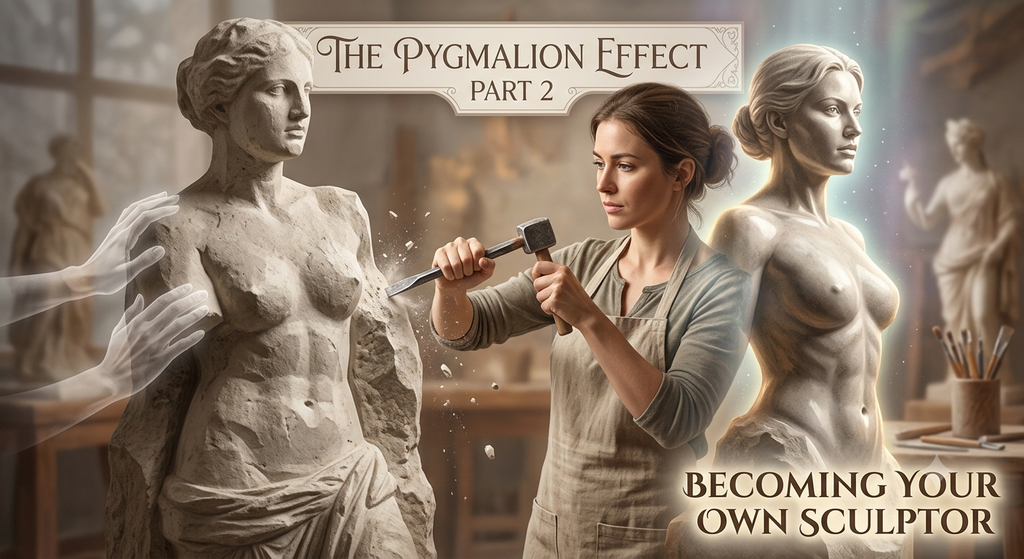
The Pygmalion Effect (Part 2): Becoming Your Own Sculptor Through Self-Expectation
There was one question that refused to leave my mind after learning about the Pygmalion Effect.
If other people’s expectations can shape me…
what happens when I start expecting things from myself?
That question quietly connected everything we’d explored so far.
The Placebo effect.
The Nocebo effect.
The Pygmalion effect.
At first, they seem like separate ideas from different branches of psychology.
Look closer, and they’re all variations of the same theme.
Expectation changes experience.
The only difference is where the expectation comes from. The source
With a Placebo, I expect something positive.
With a Nocebo, I expect something negative.
With the Pygmalion Effect, you expect something from me.
Three different doors.
The same room.
The Evil Twin of Pygmalion
Psychologists even have a name for the darker version.
The Golem Effect.
If high expectations help people grow…
low expectations can quietly shrink them.
Imagine a manager who has already decided an employee isn’t particularly capable.
He doesn’t announce it.
He simply acts on it.
He gives easier assignments.
Doesn’t ask for opinions during meetings.
Provides little feedback.
Rarely trusts the employee with responsibility.
Months later, the employee’s performance is mediocre.
The manager thinks,
“I was right.”
Except he wasn’t.
He helped create the very outcome he predicted.
It’s one of the cruelest tricks our minds play.
We mistake consequences for proof.
Expectations are Contagious
Something else struck me.
Expectations don’t stay inside the person who has them.
They spread.
Think about walking into a room where everyone looks anxious.
Within minutes, your own body becomes tense.
Nobody explained anything.
The atmosphere itself carried information.
Belief works similarly.
Spend enough time around someone who constantly says,
“You’ll figure it out.”
“You can improve.”
“This mistake isn’t the end.”
Eventually, some of those sentences become your own.
The opposite is equally true.
Live with someone who constantly predicts failure…
and before long you begin borrowing their fears.
Human beings are emotional mirrors.
We reflect far more than we realize.
The Most Important Mentor You’ll Ever Meet
Who is the most important person in your life?
You may name both of your parents/mom/dad, early days may be.
Then a lover in your youth days.
A teacher or mentor somewhere in the middle or later.
May be wife soon after marriage.
Then your children for sure.
But you forgot the one who has been travelling with you all these years when you kept switching sides.
That man(gender neutral) remains with you until just before you turn into the ‘remains’.
You guessed it right and that is none other than you.
You took so long to name yourself as the most important person in your life in this world.
Because eventually, every mentor disappears.
Teachers retire.
Parents grow old.
Managers change companies.
Friends move away.
At some point, another voice takes over.
Your own.
That’s when the real work begins.
Because the conversation inside your head never stops.
Mine certainly doesn’t.
Sometimes it’s encouraging.
Sometimes it’s unnecessarily cruel.
Sometimes it sounds suspiciously like people I haven’t met in years.
Have you noticed that?
A teacher’s criticism from school.
A relative’s offhand comment.
A parent’s worry.
A classmate’s joke.
Decades later, they’re still renting space inside your mind.
The strange part?
They often sound like your own thoughts.
Becoming Your Own Pygmalion
Here’s an idea I wish someone had taught me much earlier.
What if you deliberately became the person who believed in yourself—not blindly, not arrogantly, but honestly?
Notice I didn’t say,
“Pretend you’re perfect.”
That’s fantasy.
Instead, imagine speaking to yourself the way an exceptional coach speaks to an athlete.
Not with empty praise.
With confident realism.
Instead of…
“I’ll never understand this.”
try…
“I haven’t understood it yet.”
Instead of…
“I’m terrible under pressure.”
try…
“I’m still learning to perform under pressure.” When you have a habit of saying I am with a negative connotation that cements your position for future.
That tiny word—yet—is remarkable.
It turns a wall into a doorway.
It reminds the brain that today’s performance isn’t tomorrow’s identity.
Your Environment is Constantly Teaching You
Here’s something that surprised me while reading about learning.
Your environment is always whispering instructions.
A cluttered desk whispers,
“This probably isn’t important.”
A bookshelf whispers,
“Reading belongs here.”
A gym whispers,
“Movement happens in this place.”
A study table used only for studying slowly becomes a mental trigger.
Just like the runner’s lucky socks from the first blog.
The desk isn’t magical.
The socks aren’t magical.
The notebook isn’t magical.
They’re cues.
Signals.
Repeated often enough, they become expectations.
And expectations become habits.
Perhaps this is why some people appear incredibly disciplined.
Maybe they haven’t developed extraordinary willpower.
Maybe they’ve simply designed environments that expect the right behavior from them.
Choose Your Sculptors Carefully
If expectations shape people…
then one practical question becomes unavoidable.
Who are the sculptors in your life?
Not everyone who gives advice deserves influence.
Some people constantly see possibility.
Others constantly predict disaster.
One friend says,
“Why not try?”
Another immediately lists twenty reasons you’ll fail.
One mentor notices progress.
Another notices only mistakes.
One book leaves you curious.
Another leaves you cynical.
Every influence is carving something.
The frightening part is that carving happens slowly.
You rarely notice it while it’s happening.
One conversation won’t change your life.
Ten thousand conversations might.
Listen… But Don’t Surrender
This doesn’t mean rejecting criticism.
Far from it.
Some of the most valuable people in our lives are the ones who tell us uncomfortable truths.
The difference lies here.
Constructive criticism says,
“This behavior needs improvement.”
Destructive criticism says,
“This is who you are.”
One edits the work.
The other attacks the artist.
Learn to separate the two.
If someone tells you,
“You interrupted people several times during that meeting.”
Wonderful.
Useful.
Specific.
If someone says,
“You’re just rude.”
Pause.
That’s no longer feedback.
That’s identity.
And identities are much harder to change than behaviors.
The Question You Should Ask Most Often Now
Whenever someone makes a strong statement about me—or whenever I make one about myself—I try to pause and ask:
Is this describing my present…
or defining my future?
Those are very different things.
“I’m struggling with public speaking.”
describes the present.
“I’m not a public speaker.”
tries to define the future.
One leaves room for growth.
The other quietly closes the door.
The Invisible Sculptors
When I began writing this series, I thought it would be about fascinating psychological experiments.
Sugar pills.
Greek myths.
Classroom studies.
Instead, it became something far more personal.
It became a story about invisible sculptors.
Some sculptors wear white coats.
Some stand in classrooms.
Some coach football teams.
Some appear on television.
Some write headlines.
Some produce films.
Some create advertisements.
Some raise children.
Some are friends.
Some are strangers you’ll never meet again.
And then…
there’s the sculptor who speaks every day without moving their lips.
You.
That voice inside your head is shaping tomorrow’s version of you whether you notice it or not.
Every morning it picks up the chisel.
Every evening it puts it down.
Slowly.
Patiently.
One belief at a time.
When people ask whether the placebo effect is “real,” I smile.
They’re asking the wrong question.
The better question is:
How many placebos, nocebos, and Pygmalion effects are already operating in my life without my noticing?
Who taught me what success looks like?
Who taught me what failure means?
Who convinced me I was “good” at one thing and “bad” at another?
Which beliefs have evidence…
and which have merely been repeated often enough to feel true?
The older I get, the less interested I become in collecting answers.
I’m far more interested in examining beliefs.
Because beliefs are quiet.
They rarely announce themselves.
They simply sit in the background, influencing choices so subtly that we mistake them for personality.
Perhaps that’s why psychology is so endlessly fascinating.
It reminds us that human beings are not only products of genetics or circumstance.
We are also products of expectation.
The expectations others had of us.
The expectations we absorbed without questioning.
And, if we’re fortunate enough to become aware of them…
the expectations we finally choose for ourselves.
Maybe that’s the real lesson hidden inside the old Greek myth.
Pygmalion didn’t merely carve stone.
He imagined possibility where others might have seen only ivory.
The finest teachers do the same.
The finest parents do the same.
The finest leaders do the same.
And eventually, if life has taught us well…
we learn to do the same for ourselves.
Because one day, every one of us is handed an invisible block of marble.
The rest of our lives are spent discovering what we’re going to sculpt from it.
Going further ahead lets get a little deeper.
The Pygmalion Effect Part 1: When You are Sculpted by Others