How Your Thoughts, Habits, and Money Grow—For Better or Worse
The Compound Effect: How Your Thoughts, Habits, and Money Grow—For Better or Worse
When people hear the word compound, they usually think of money.
Banks, investments, mutual funds, and retirement plans often use the power of compounding to explain how wealth grows over time.
Invest ₹10,000 today. Earn returns. Next year, you don’t just earn on your original investment—you earn on the returns too.
Year after year, your money grows faster because every gain becomes the foundation for the next gain.
But money isn’t the only thing that compounds.
Our thoughts compound.
Our habits compound.
Our relationships compound.
Our health compounds.
Even our confidence compounds.
Every small decision we make today quietly shapes tomorrow.
One good decision may not change your life. Neither will one bad decision.
But repeated daily, both become powerful forces that eventually determine who we become.
The challenge is that compounding is invisible in the beginning. We don’t notice it after a day or a week.
But give it years, and the results become impossible to ignore.
The good news is that this works in our favour too.
You don’t need dramatic changes. You don’t need a new personality. You don’t need perfect discipline.
You only need better thoughts and slightly better habits, repeated consistently.
Understanding the Compound Effect Beyond Money
Imagine two friends graduating from college at the same time.
Both earn similar salaries.
One decides to save just 10% of every paycheck and invests it regularly.
The other spends everything, believing there will always be time to save later.
For the first few years, there’s hardly any difference.
They wear similar clothes.
Drive similar vehicles.
Go on similar vacations.
After ten or fifteen years, however, the difference becomes obvious.
The first person enjoys financial freedom, investment income, and peace of mind.
The second struggles with debt, financial stress, and limited choices.
Nothing dramatic happened overnight.
Small financial decisions simply compounded.
Exactly the same principle governs every other area of life.
A person who reads ten pages daily finishes nearly fifteen to twenty books a year.
Someone who walks thirty minutes every day stays healthier than someone who promises to start exercising “next Monday.”
A person who learns one new skill every few months becomes highly valuable in the workplace without ever attending expensive boot camps.
Success often looks sudden from the outside.
In reality, it is usually the result of years of invisible compounding.
Thoughts Are Seeds
Everything begins with a thought.
Before any action comes an idea.
Before every habit comes a decision.
Before every achievement comes a belief that it is possible.
Our brain constantly processes thousands of thoughts every day. Many of them repeat automatically.
“I’ll never be good at this.”
“I’m not disciplined.”
“I don’t have enough time.”
“I’ll start tomorrow.”
Repeated often enough, these stop feeling like thoughts and start feeling like facts.
But they aren’t facts.
They are simply mental habits.
Psychologists often describe this as self-reinforcing thinking.
When we repeatedly think something, our brain becomes more likely to notice evidence that supports it while ignoring evidence that contradicts it.
Suppose someone believes they are bad at public speaking.
Every small mistake confirms the belief.
Every successful presentation is dismissed as luck.
Over time, the belief grows stronger.
Eventually, the person avoids speaking opportunities altogether, limiting career growth.
The thought created the behaviour, and the behaviour strengthened the thought.
This is compounding in action.
Fortunately, positive thinking works exactly the same way.
A person who begins telling themselves:
“I can improve.”
“I don’t know this yet.”
“I’ll get better with practice.”
starts looking for opportunities instead of excuses.
Small successes build confidence.
Confidence encourages more action.
Action creates better results.
Better results strengthen confidence.
The cycle continues upward.
Why Small Habits Matter More Than Big Goals
Most people love setting ambitious goals.
Lose 20 kilograms.
Become a millionaire.
Write a book.
Learn a language.
Start a business.
Goals are exciting.
Habits are ordinary.
Yet habits matter far more.
Imagine someone decides to become fit.
They exercise intensely for four hours on the first day.
The next morning, every muscle hurts.
They quit.
Another person simply walks for twenty minutes every evening.
It doesn’t seem impressive.
But after one year, they have completed more than 120 hours of exercise.
The difference wasn’t motivation.
It was consistency.
James Clear, author of Atomic Habits, explains that habits are like the interest earned on self-improvement.
Tiny improvements may appear insignificant today, but they produce remarkable results over long periods.
Improving just one percent every day sounds trivial.
Yet over months and years, those improvements create an entirely different life.
Your Identity is Built One Habit at a Time
Many people try changing behaviour without changing identity.
They say,
“I want to stop procrastinating.”
Instead of asking,
“What would a disciplined person do today?”
This small shift changes everything.
Every completed task becomes evidence.
Every healthy meal becomes evidence.
Every workout becomes evidence.
Every saved rupee becomes evidence.
Eventually, the brain begins accepting a new identity.
“I am someone who finishes what I start.”
“I am someone who takes care of my health.”
“I am someone who saves before spending.”
Identity grows through repeated proof.
Not promises.
Not motivation.
Not wishful thinking.
Building Better Habits Without Feeling Overwhelmed
One reason people fail is because they try changing everything at once.
They wake up one morning determined to:
- Exercise daily.
- Read for an hour.
- Meditate.
- Eat perfectly.
- Sleep early.
- Wake up at 5 AM.
- Learn a new language.
- Stop using social media.
Within a week, exhaustion wins.
Real change works differently.
Start embarrassingly small.
Read one page.
Walk for ten minutes.
Drink one extra glass of water.
Save ₹50 a day.
Write three sentences in a journal.
When a habit feels too easy to fail, consistency becomes natural.
Once consistency is established, improvement follows almost automatically.
Small habits reduce resistance.
Big habits often increase excuses.
The Power of Daily Wins
Many people underestimate the emotional value of small victories.
Completing a simple task gives the brain a sense of progress.
Progress creates motivation.
Motivation encourages more action.
Action produces more progress.
This creates another positive compound cycle.
Imagine making your bed every morning.
By itself, it changes almost nothing.
But psychologically, it signals that the day has started with one completed task.
You become slightly more likely to complete the next task.
And then the next.
Momentum is one of the most underrated forms of productivity.
Success often grows because successful actions make future successful actions easier.
Money Follows Behaviour
People often believe wealth depends mainly on income.
Income certainly matters.
But behaviour matters more over time.
Someone earning ₹50,000 monthly while saving consistently can build greater wealth than someone earning ₹2 lakh but spending everything.
Financial success isn’t usually created by one brilliant investment.
It is built through repeated behaviours:
- Saving first.
- Avoiding unnecessary debt.
- Investing regularly.
- Increasing skills.
- Delaying gratification.
- Living below one’s means.
Each behaviour compounds quietly.
Just as investments earn interest, good financial habits earn future opportunities.
Money is often less about mathematics and more about behaviour.
The same principle applies to almost every area of life.
Health follows behaviour.
Relationships follow behaviour.
Career follows behaviour.
Confidence follows behaviour.
Behaviour follows thinking.
Everything begins with what we repeatedly tell ourselves.
The First Signs of Positive Compounding
One common question people ask is:
“If habits take years to transform life, how do I stay motivated?”
The answer lies in noticing smaller changes.
Within the first week, you may notice:
- Less resistance to starting tasks.
- Better mood.
- Slightly more energy.
- A sense of control.
Within a month:
- Greater confidence.
- Better focus.
- More consistency.
- Reduced stress.
- Better financial awareness if you’re tracking expenses.
None of these changes are dramatic.
Yet they are important.
They are the first visible signs that your new habits have started taking root.
Like a plant growing underground before breaking through the soil, lasting transformation often begins where nobody can see it—including you.
Those invisible improvements eventually become visible results.
The Other Side of Compounding: When Small Negatives Become Big Problems
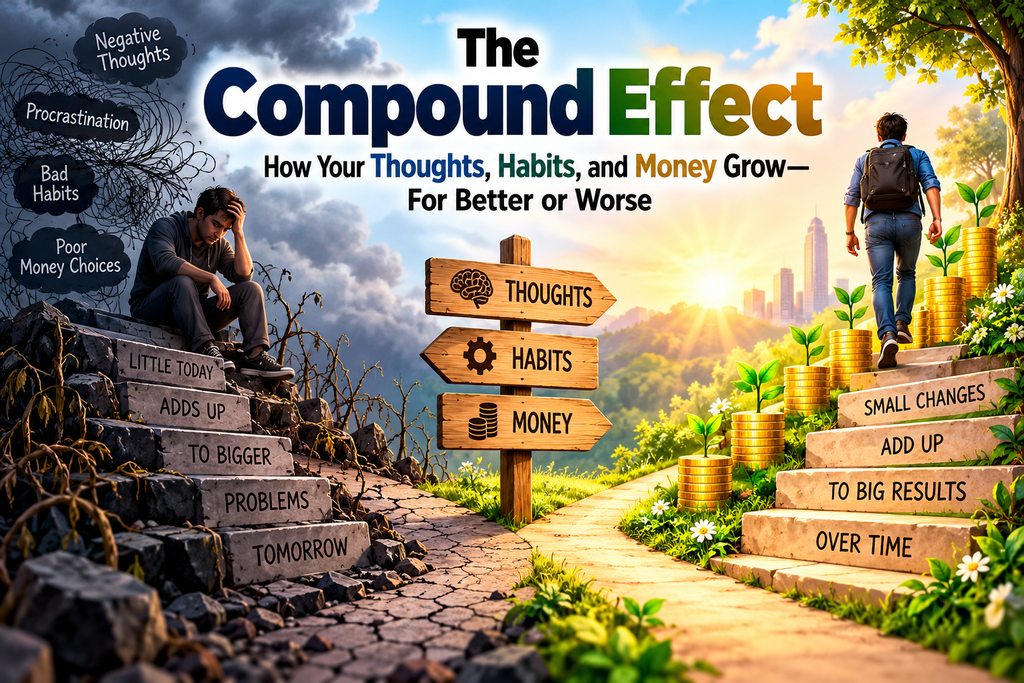
Compounding is neutral. It doesn’t care whether you’re building a better life or slowly damaging one. It simply multiplies whatever you repeat.
This is where many people get caught off guard.
No one wakes up one morning with poor health, financial stress, low confidence, or broken relationships. These outcomes usually develop gradually through hundreds of small decisions that seem harmless in isolation.
Skipping one workout doesn’t make you unhealthy.
Ordering fast food once doesn’t ruin your fitness.
Spending a little extra this month doesn’t make you broke.
Procrastinating on one task doesn’t destroy your career.
But repeat these choices often enough, and they begin to shape your future.
Negative compounding is dangerous because it is almost invisible in the beginning. The cost of today’s decision is rarely paid today. It arrives months or years later, often when reversing the damage requires much more effort.
Think of rust on metal. It doesn’t appear overnight. It slowly eats away at the surface until the structure weakens. Our habits work in much the same way.
The same mind that can build a fulfilling life through small positive actions can also slowly create stress, anxiety, financial problems, and poor health through repeated negative ones.
The encouraging part is that if negative habits were learned gradually, they can also be replaced gradually.
How Negative Thinking Compounds
Before negative habits appear, negative thoughts often arrive first.
“I’m not good enough.”
“People like me never succeed.”
“I’ll probably fail anyway.”
“I’m too old to learn.”
“It’s too late.”
A single negative thought is not harmful. Everyone has them.
The problem begins when those thoughts become the default way of interpreting life.
Imagine someone who believes they are incapable of learning new skills.
They avoid applying for better jobs.
They stop taking courses.
They refuse challenging assignments.
Years later, they wonder why their career hasn’t progressed.
The real barrier wasn’t their ability. It was the story they repeatedly told themselves.
Our brain is efficient. It likes familiar patterns. The more often we think something, the easier it becomes to think it again.
That’s why negative thinking often feels automatic.
Fortunately, the opposite is equally true.
Positive thinking isn’t pretending that life is perfect. It is choosing thoughts that help you act instead of thoughts that stop you from acting.
There is a significant difference between saying,
“Everything will magically work out,”
and saying,
“I don’t know how yet, but I can learn.”
The second statement creates movement.
Movement creates progress.
Progress creates confidence.
Confidence strengthens positive thinking.
Another positive cycle begins.
Bad Habits Don’t Start Big
Most destructive habits enter our lives quietly.
Five extra minutes on social media.
One unnecessary online purchase.
One skipped workout.
One postponed phone call.
One hour of mindless scrolling before bed.
None of these seem serious.
Yet habits rarely announce themselves as life-changing decisions. They disguise themselves as exceptions.
“I’ll do it tomorrow.”
“Just this once.”
“I deserve it.”
“I’ll start on Monday.”
Unfortunately, our brain doesn’t remember exceptions. It remembers repetition.
What we repeat becomes normal.
This is why awareness is more important than willpower.
If you can notice a habit early, you can change its direction before it gathers momentum.
Can Old Habits Really be Rewritten?
The simple answer is yes.
Our brain has an incredible ability to adapt throughout life. Scientists call this neuroplasticity—the brain’s capacity to create new neural pathways through repeated experiences and behaviors.
This doesn’t mean changing habits is easy.
It means changing habits is possible.
Research on habit formation shows that repeating behaviours consistently can gradually make them more automatic. A study by Phillippa Lally and colleagues found substantial variation in how long this process takes.
Every habit follows a simple pattern:
Cue → Routine → Reward
For example:
You feel stressed.
↓
You reach for your phone.
↓
You feel temporarily distracted.
The brain remembers the reward.
Next time stress appears, it suggests the same routine.
The key isn’t to eliminate the cue.
Stress will always exist.
The goal is to replace the routine.
Instead of reaching for social media, you might:
- Take a five-minute walk.
- Drink water.
- Write down what’s bothering you.
- Take a few deep breaths.
- Call a friend.
- Work on the task for just five minutes.
Over time, the brain begins connecting the same cue with a healthier response.
Old habits become weaker because they are used less.
New habits become stronger because they are practiced more.
Every repetition rewires the brain a little.
Five Practical Ways to Build Better Habits
Most habit advice fails because it focuses on motivation.
Motivation comes and goes.
Systems stay.
Here are five simple practices that work better than waiting to feel motivated.
1. Observe Before You Change
Spend a week simply noticing your habits.
When do you procrastinate?
What makes you snack unnecessarily?
When do you spend money impulsively?
Awareness removes autopilot.
You cannot change what you don’t notice.
2. Start Smaller Than You Think
If your goal is to read every day, begin with two pages.
If your goal is to exercise, begin with ten minutes.
Small habits survive busy days.
Large habits often don’t.
Consistency matters more than intensity.
3. Change Your Environment
Our surroundings influence our behavior more than we realize.
Want to eat healthier?
Keep fruits where you can see them.
Want to read more?
Place a book beside your bed.
Want to reduce screen time?
Charge your phone outside the bedroom.
Good environments make good habits easier.
Bad environments make bad habits automatic.
4. Track Progress, Not Perfection
Missing one day doesn’t erase your progress.
Missing many days without restarting does.
Instead of asking,
“Was I perfect today?”
Ask,
“Did I move one step forward?”
Progress builds confidence.
Perfection creates pressure.
5. Become Patient
Nature doesn’t rush.
Trees don’t become forests in a month.
Investments don’t multiply overnight.
Neither do habits.
People often quit just before results begin to appear.
Stay with the process.
The results almost always arrive later than expected—but they usually exceed expectations.
How to Know Your Habits are Working
Many people abandon good habits because they expect immediate transformation.
Real progress is subtle.
Instead of asking whether your life has completely changed, ask better questions.
After One Week
You may notice:
- You begin tasks with less hesitation.
- Your mood feels slightly more stable.
- You’re becoming aware of unhealthy patterns.
- You feel a little more in control of your day.
These changes may seem small, but they are the first signs that your brain is adapting.
After One Month
By now, consistency starts replacing motivation.
You may observe:
- Better focus at work.
- Improved sleep.
- More confidence in keeping promises to yourself.
- Reduced unnecessary spending.
- Less dependence on reminders.
- More energy.
The habit is becoming part of your routine instead of something you have to force.
After One Year
People around you begin noticing changes.
You communicate better.
You appear calmer.
Your financial discipline improves.
You look healthier.
You solve problems instead of avoiding them.
Most importantly, you trust yourself more because you’ve repeatedly kept the commitments you made.
The Difference Ten Years Can Make
Imagine two people who are almost identical today.
Same education.
Same income.
Same opportunities.
The first person improves just a little every day.
Reads twenty minutes.
Exercises regularly.
Learns new skills.
Invests consistently.
Speaks positively to themselves.
Keeps promises.
The second person postpones everything.
Spends without planning.
Complains often.
Avoids learning.
Lives reactively.
The gap after one month is almost invisible.
After one year, it becomes noticeable.
After five years, it becomes significant.
After ten years, they appear to have lived completely different lives.
One enjoys more options, stronger health, financial security, meaningful relationships, and greater confidence.
The other wonders why life seems unfair.
Often, the difference wasn’t luck.
It was the accumulation of thousands of ordinary decisions.
Success is rarely one giant leap.
Failure is rarely one giant mistake.
Both are usually the result of daily choices repeated over time.
Positivity is a Practical Choice
Being positive doesn’t mean ignoring problems.
It doesn’t mean pretending that every situation is good.
Real positivity is choosing responses that move you forward.
It is asking,
“What can I learn?”
instead of,
“Why does this always happen to me?”
It is focusing on solutions instead of excuses.
It is believing that skills can be learned, habits can change, and tomorrow can be better because of what you do today.
Positive thinking becomes valuable only when it leads to positive action.
Thoughts create actions.
Actions become habits.
Habits build character.
Character shapes destiny.
That is the real compound effect.
Take Away
If there is one lesson to take away from the compound effect, it is this: never underestimate the power of small, consistent actions.
You don’t need to transform your life this week.
You only need to improve today’s choices.
Save a little.
Read a little.
Walk a little.
Learn a little.
Think a little better.
Repeat tomorrow.
Then repeat again.
Months from now, you’ll notice subtle improvements.
Years from now, you’ll wonder how those tiny actions created such a remarkable difference.
Compounding is always at work. Every thought you repeat, every habit you practice, and every financial decision you make is quietly shaping your future.
The question is not whether your life is compounding.
It already is.
The real question is: In which direction?
Small habits can shape our future, but we sometimes jump from one new idea to another without giving it enough time to work.
This pattern is known as Shiny Object Syndrome. Learning to focus on consistent action is an important step towards creating lasting change.