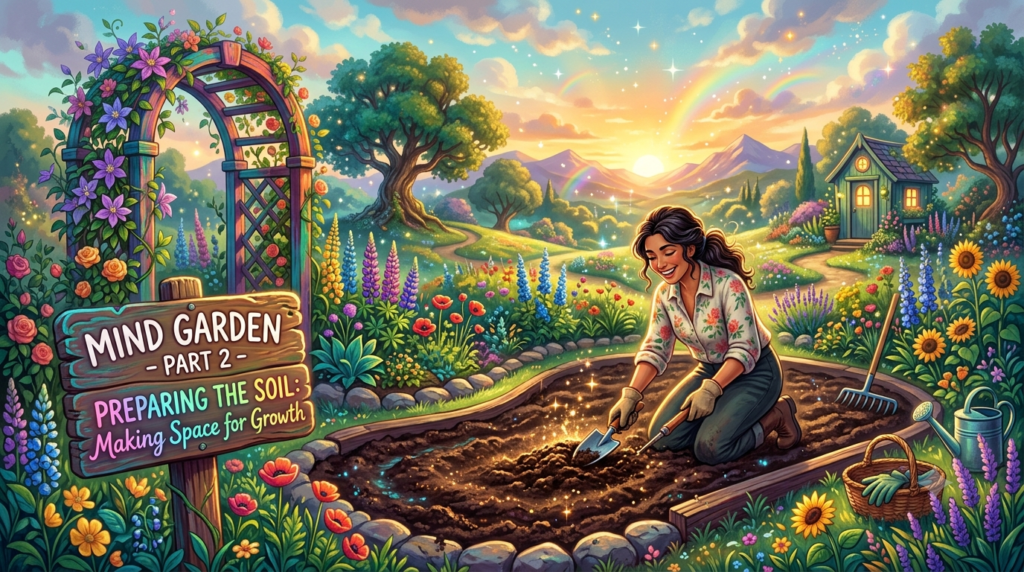
As said in Part 1 you removed the weeds carefully. So after the storm of removal comes the hush.
The weeds are gone, and what’s left is a strange, bare quiet — unsettling to some, liberating to others.
This is the moment between destruction and creation, the stillness before new life stirs beneath the surface.
If the first stage was clearing, this one is cultivating — softening what’s been hardened by years of overthinking, overgiving, overdoing.
Growth doesn’t begin when you plant.
Its time for preparing the soil so that it finally says, I’m ready.
The Unseen Labor of Readiness
We live in a world obsessed with action.
Even healing has been turned into a checklist — meditate, journal, manifest, move on.
But nature never rushes that way.
After the weeds are pulled, the gardener doesn’t immediately sow.
They loosen the ground.
They turn the soil with care, break clumps apart, allow air to flow through.
It looks like nothing is happening, yet everything is happening beneath the surface.
That’s what your mind needs now — loosening.
Not more self-improvement, not more motivation, but a deeper softening of what’s compacted by time, trauma, and tension.
Neuroscience calls it neural plasticity — the brain’s ability to reshape and rewire itself when it’s no longer stuck in the same loops.
But plasticity doesn’t bloom in chaos; it blooms in calm.
Your mind cannot grow while it’s braced in self-defense.
Readiness comes only through relaxation.
The Psychology of Making Space
When people say, “I want to change,” what they often mean is, “I want to stop feeling what I feel.”
But real change begins when you allow yourself to feel without resistance.
You cannot prepare the soil of your mind if you’re afraid of touching it.
Acceptance is not giving up — it’s letting the soil breathe again.
Denial is compression.
Acceptance is aeration.
So before you try to plant peace, sit with the ground of your current truth.
Touch it.
Name it.
See what it’s made of — anxiety, exhaustion, loneliness, hope.
All of it is yours, and all of it is usable.
The Science of Stillness
Inside the human brain, calmness is not an absence — it’s an active state.
When you pause, breathe deeply, or simply close your eyes in silence, the default mode network of the brain activates — the system responsible for reflection, meaning, and insight.
That’s why your best realizations come in the shower, during a walk, or in quiet evenings — moments when the brain finally gets to compost experience into understanding.
Stillness is not stagnation; it’s integration.
The soil isn’t dead while resting — it’s absorbing nutrients, recalibrating pH, preparing for life.
Your mind does the same when you let it rest.
The Sacred Pause
Sit somewhere without noise — no music, no screens, no conversation.
Just stillness.
It will feel uncomfortable at first; the weeds will try to regrow.
Old thoughts will demand attention.
That’s fine — let them surface, but don’t chase them.
Think of your mind as a field after rain — soft, muddy, malleable.
Don’t stomp through it.
Let it breathe.
This stage is about presence without productivity.
Every pause you take now becomes future growth you can’t yet see.
Emotional Composting
What do gardeners do with weeds and dead leaves?
They compost them.
They let decay become nourishment.
That’s what forgiveness does to memory.
Forgiveness isn’t erasure — it’s transmutation.
It turns what once poisoned you into quiet wisdom.
The pain you release doesn’t vanish; it becomes soil for empathy.
So don’t rush to forget.
Instead, let old emotions break down into meaning.
What did this pain teach me about boundaries?
What did that loss teach me about love?
Every emotion decomposes into something fertile if you give it time.
Gentle Practices for Softening the Inner Ground
1. Morning Grounding – Before checking your phone, place a hand on your chest and breathe in for four counts, out for six. It tells the nervous system: we are safe to grow.
2. Silence Ritual – Dedicate 10 minutes daily to soundless presence. No goals, no affirmations — just witnessing.
3. Mindful Movement – Walk, stretch, or flow slowly. The body’s rhythm loosens the mental soil.
4. Forgiveness Letters – Write letters you’ll never send — to yourself, to others. Burn or bury them as symbolic compost.
5. Digital Detox Hours – One evening per week, disconnect completely. The quiet is where your next seed idea will whisper itself to you.
The Mind’s Microclimate
Every garden depends on its climate — so does your inner world.
If the environment is harsh, no seed survives long.
So audit the climate you live in:
What conversations dominate your days?
What kind of content fills your feed?
Do your surroundings inspire openness or defensiveness?
Adjust the microclimate.
Pull yourself toward warmth — art, nature, music, solitude, people who make you exhale.
The soil of your psyche takes its cue from what surrounds it.
The Gentle Turning Point
One morning, you’ll notice it — a subtle ease where there was once tightness.
You’ll think you’re doing less, but you’ll be becoming more.
That’s the paradox of inner work: the softer you go, the stronger you grow.
The soil, once dry and dense, begins to crumble between your fingers — rich, dark, fragrant with possibility.
This is the mind in readiness.
No more rushing.
No more forcing.
Just a quiet agreement with life: I’m open now.
Growth is not what you do.
Growth is what happens when you stop interfering.
By preparing the soil today, you are setting yourself up for long-term mental clarity.
Visit Books and select your pick to get a deeper insight.
Next in the Series
Part 3 – Seeding the Mind: Planting New Thoughts
You may visit Part 1 – Detoxing the Mind: Pulling Out the Weeds
When the ground is ready, you begin to choose what grows within you — the beliefs, intentions, and patterns that will become your new mental ecosystem.Subconscious Mind : Neuroplasticity & Manifestation
Continue the Mind Garden Series
- Part 1: Pulling Out the Weeds
- Part 2: Preparing the Soil
- Part 3: Seeding the Mind (Available from 15 July)
- Part 4 – Watering the Soul (Available from 19 July)
- Part 5 – Harvesting Clarity (Available from 23 July)