Rubber Ducking: How Talking to Yourself Can Transform Self-Learning
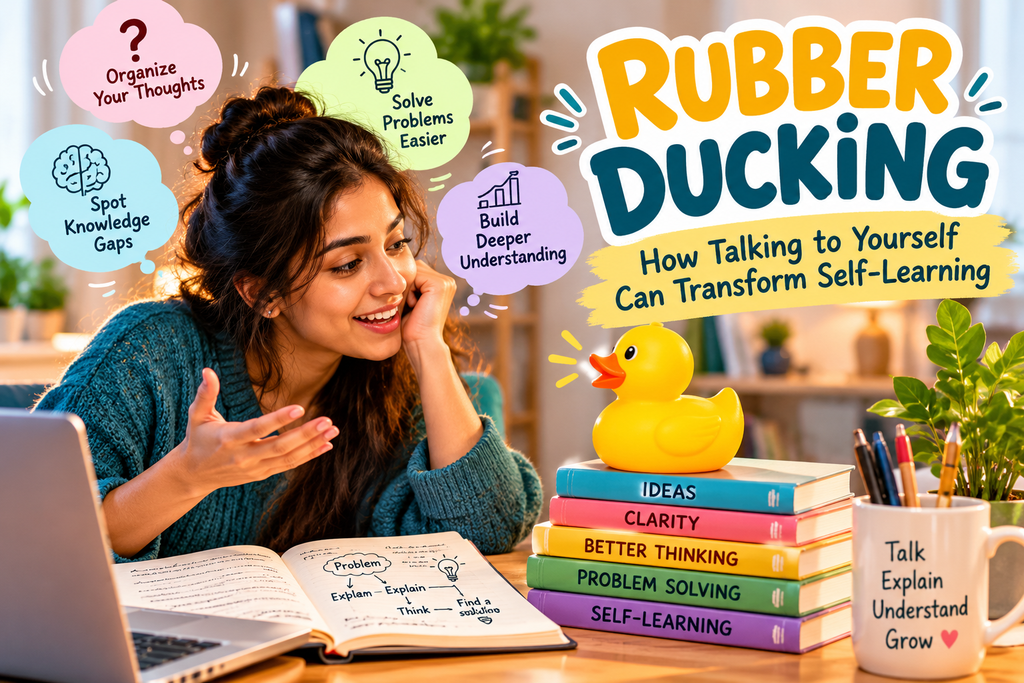
From classrooms to workplaces, from self-development books to self-image, discover how a simple problem-solving technique can help you think clearly, learn deeply, and become your own teacher.
How Can a Rubber Duck Help in Self Learning?
Have you ever struggled to understand something, only to find the answer while explaining it to someone else? Perhaps you were solving a maths problem, preparing for an examination, reading a difficult book, or trying to make an important decision. You felt stuck until you began explaining your thoughts aloud. Somewhere in the middle of the explanation, the confusion started to disappear.
This everyday experience lies at the heart of rubber ducking, a simple technique that encourages us to explain a problem step by step to an imaginary listener, traditionally a small rubber duck.
The listener does not need to respond. The benefit comes from the process of putting our thoughts into words.
Although rubber ducking originated in the world of programming, its underlying principle has applications far beyond computers. It can help students understand lessons, professionals solve problems, readers reflect on what they learn, and individuals examine the beliefs they hold about themselves.
At its heart, rubber ducking is an invitation to pause, articulate what we know, and discover what we do not yet understand.
The Story Behind Rubber Ducking: Who Started It?
Rubber ducking is widely associated with The Pragmatic Programmer: From Journeyman to Master, published by Andrew Hunt and David Thomas in 1999.
In the book’s section on debugging, the authors describe the value of explaining a problem step by step, even when the listener does not need to say anything. A footnote recounts how Greg Pugh, a research assistant who worked with David Thomas when he was an undergraduate at Imperial College London, carried a small yellow rubber duck and placed it on his terminal while coding.
The important distinction is that Greg Pugh is the person identified in the book’s account, but the authors are credited with popularising the story, not inventing the general practice of thinking aloud. There is no reliable evidence establishing who first explained a problem to an imaginary listener.
Why did the story catch on?
Programmers frequently encounter errors that are difficult to locate. They may repeatedly inspect their code, change instructions, or make assumptions about what a particular line does. Explaining the code in plain language forces them to slow down and examine each step.
A programmer might begin by saying, “This instruction should save the information, and the next instruction should display it.” While explaining, they may realise that the information is never saved correctly in the first place.
The duck has not solved the problem. The explanation has exposed it.
The memorable story helped make rubber duck debugging a recognised technique in software development. Its wider appeal lies in the fact that the same habit can be applied to many problems outside programming.
Why Explaining Something Helps Us Learn
The educational idea closely related to rubber ducking is called self-explanation: explaining information to yourself in order to understand it better.
In a 1989 study published in Cognitive Science, Michelene Chi and colleagues examined how students explained worked examples while learning to solve problems. Their research helped establish self-explanation as an important area of learning research.
Later, Dunlosky and colleagues reviewed evidence on learning techniques in Psychological Science in the Public Interest in 2013. Their review discussed self-explanation alongside other methods that can improve learning.
These studies do not prove that talking to a rubber duck is always effective. They support the broader principle that actively explaining material can help learners develop a deeper understanding.
Consider reading a chapter about photosynthesis. The words may seem familiar while the book is open. But if you close it and explain how plants use sunlight, water, and carbon dioxide to produce sugars, you may discover gaps in your understanding.
That discovery is valuable. It tells you what to revisit.
Rubber ducking therefore encourages three useful habits: recalling information, connecting ideas, and checking your own understanding. To avoid reinforcing mistakes, combine it with reliable books, practice questions, feedback, and fact-checking.
Bringing Rubber Ducking Into Self-Learning
Self-learning is not simply collecting information from books, videos, or courses. It involves understanding what you learn, connecting it to existing knowledge, and using it independently.
Rubber ducking provides a practical routine for doing this.
1. Lower School: Making Learning Playful
For younger children, the method can be introduced as a game.
After studying a lesson, a child can explain it to a toy, a teddy bear, or a rubber duck. A child learning about the water cycle might say:
“The sun heats water in rivers and lakes. Some of the water becomes vapour and rises. As it cools, it forms tiny droplets that make clouds. Eventually, water falls back to the ground as rain.”
If the child cannot explain how clouds form, that is an opportunity to revisit the lesson.
Parents and teachers should encourage children to explain in their own words rather than demand perfect sentences. Drawings, everyday examples, and short explanations make the process easier.
The aim is to help children discover that learning means understanding an idea, not merely repeating a sentence.
2. High School: Moving Beyond Memorisation
As school subjects become more demanding, students need to connect facts and understand why things happen.
A student studying quadratic equations could explain what the equation represents, why a particular formula applies, and how changing a value affects the result.
A history student could explain the causes of an event, the sequence of developments, and the evidence supporting a particular interpretation.
A biology student could describe how an organ functions and predict what might happen if one part stopped working.
Rubber ducking also makes revision more meaningful. Instead of repeatedly reading a chapter, students can close the book, explain the main ideas from memory, and then compare their explanation with the textbook.
The gaps become a revision plan.
3. College and University: Learning to Think Independently
Higher education often introduces unfamiliar theories, specialised vocabulary, and complicated problems. Students may understand a lecturer’s explanation while listening but struggle to apply it independently.
Rubber ducking helps bridge that gap.
A psychology student can explain a theory in everyday language and give an example. An engineering student can describe why a design works and what might cause it to fail. A commerce student can explain how changes in interest rates might affect borrowing and business decisions.
The guiding question is simple: “Can I explain this without copying the original wording?”
If the answer is no, return to the source, identify the confusing part, and try again.
This approach can also help students prepare for oral examinations, interviews, presentations, and assignments requiring independent thought.
4. At Work: Becoming a Better Problem-Solver
Rubber ducking is equally useful in professional life.
Imagine a project manager wondering why a project keeps missing deadlines. Explaining the situation aloud may reveal that the team has underestimated review time, overlooked a dependency, or repeatedly changed requirements.
A programmer can explain a software error. A teacher can rehearse a difficult lesson. A manager can organise the reasoning behind a decision before presenting it to colleagues.
The method does not mean avoiding help from others. Instead, it encourages you to think through a problem before asking for assistance.
You may solve the problem yourself. Alternatively, you may identify exactly what you need to ask a colleague.
Both outcomes save time and improve communication.
Reading Self-Development Books With Rubber Ducking
Self-development books can be inspiring, but inspiration does not automatically produce change.
A chapter about discipline, confidence, or productivity may sound convincing when read. The real test is whether you understand the idea and can apply it to your life.
After reading a chapter, close the book and explain its central message to your imaginary listener.
Ask yourself three questions:
- What is the author actually suggesting?
- Why might this advice work, and what evidence supports it?
- How could I apply it to a real situation in my life?
Suppose you have read about building consistent habits. You might explain:
“The author suggests making a new habit easier by connecting it to an existing routine. I already drink tea every morning, so I could review my notes for five minutes immediately afterwards. I will try it for a week and see whether it works with my schedule.”
You have transformed a general idea into an action you can test.
You can also question what you read. Does the advice apply to every situation? What are its limitations? Is the author offering evidence, personal experience, or simply an opinion?
A useful reading journal can contain three short entries after each session: What I understood, what I questioned, and what I will try.
This turns reading into an active conversation with ideas rather than a passive exercise in collecting information.
Self-Talk and Self-Image: Learning to Understand Yourself
One of the most interesting applications of rubber ducking is examining the way we talk to ourselves.
People sometimes make sweeping statements about their abilities: “I am bad at mathematics,” “I never finish anything,” or “I am not confident enough to speak in public.”
These statements can turn individual experiences into fixed descriptions of who we are.
Rubber ducking gives us a way to examine them.
Imagine saying, “I am terrible at public speaking.” Now explain that belief to your imaginary listener.
“What happened? I became nervous during a presentation last month. I forgot one point and spoke too quickly. However, I prepared the slides well and answered two questions correctly. Perhaps I need to practise managing my nervousness instead of assuming I cannot speak in public.”
Notice the shift. The original judgement has become a more specific description of an experience, with room for improvement.
This does not mean pretending that every weakness is a strength. A healthy self-image requires honesty, but it also requires fairness. One mistake does not define your entire ability, and one difficult experience does not determine your future.
When examining a negative belief, ask:
- What actually happened?
- What evidence supports my conclusion?
- Am I ignoring evidence that does not fit it?
- What can I learn or do differently next time?
This kind of reflection can help you develop a more balanced understanding of yourself. Research on self-regulated learning, including Barry Zimmerman’s work, highlights the importance of monitoring progress, evaluating strategies, and adjusting behaviour.
Rubber ducking can support these habits, although it is not a substitute for professional support when persistent distress or severe self-criticism affects daily life.
The goal is not to convince yourself that you are perfect. It is to understand yourself accurately and respond to difficulties constructively.
A Five-Minute Articulation Exercise
Rubber ducking can also help you practise expressing ideas clearly. You do not need an impressive vocabulary or a naturally confident voice. You need a little patience and a willingness to try.
Choose something you learned today, a passage from a book, or a problem you are trying to solve.
Minute 1 — State the idea. Explain what you are trying to understand.
Minute 2 — Explain it simply. Imagine your listener is a beginner. Use everyday language and avoid unnecessary complexity.
Minute 3 — Give an example. Show how the idea works in a familiar situation.
Minute 4 — Find the gap. Identify where you became confused, vague, or uncertain. Check a reliable source if needed.
Minute 5 — Explain it again. Make a second attempt using clearer language and a more accurate example.
For additional practice, record your explanation and listen to it once. Notice whether your thoughts follow a logical order or jump between unrelated points.
Do not focus on your accent or demand perfect grammar. Concentrate on clarity, accuracy, and the ability to make yourself understood.
You can practise with questions such as “What did I learn today?”, “Why do I believe this?”, and “How would I explain this to someone new to the subject?”
With regular practice, this habit can help you organise your thoughts before speaking in class, at work, or in everyday conversations.
Making Rubber Ducking a Daily Habit
Start small. Spend five to ten minutes each day explaining one idea, identifying a gap, and checking your understanding.
You can do this aloud, in writing, while walking, or with a toy on your desk. Keep a short record of what you understood and what you still need to learn.
Over time, your questions may become more precise. Instead of saying, “I do not understand this subject,” you may begin saying, “I understand the first two steps, but I do not understand why the third follows from them.”
That is meaningful progress. You are learning to identify the problem rather than simply feeling overwhelmed by it.
Remember that explaining an idea fluently does not guarantee that it is correct. Use reliable references, test yourself with questions, practise applying what you learn, and seek feedback when necessary.
Rubber ducking works best alongside reading, practice, reflection, and feedback.
Become Your Own Teacher
The beauty of rubber ducking lies in its simplicity.
A school student can use it to understand a lesson. A university student can use it to test a theory. A professional can use it to clarify a difficult decision. A reader can use it to turn a self-development book into meaningful action. Anyone can use it to question assumptions and practise clearer communication.
You do not need a rubber duck, although having one might make the process more enjoyable. You need the willingness to slow down, explain what you think you know, and acknowledge what you do not yet understand.
Sometimes, the most useful step in learning is not immediately searching for another answer. It is giving yourself the opportunity to explain the question first.
So, the next time you feel stuck, pause and ask yourself:
“Let me explain what I understand so far.”
You may discover that the beginning of the answer is already within reach.
You may refer:
- Hunt, A., & Thomas, D. (1999). The Pragmatic Programmer: From Journeyman to Master. Addison-Wesley. See the section on rubber ducking in the debugging chapter.
- Chi, M. T. H., Bassok, M., Lewis, M. W., Reimann, P., & Glaser, R. (1989). Self-explanations: How students study and use examples in learning to solve problems. Cognitive Science, 13(2), 145–182.
- Dunlosky, J., Rawson, K. A., Marsh, E. J., Nathan, M. J., & Willingham, D. T. (2013). Improving students’ learning with effective learning techniques. Psychological Science in the Public Interest, 14(1), 4–58.
- Panadero, E. (2017). A review of self-regulated learning: Six models and four directions for research. Frontiers in Psychology, 8, Article 422.
Disclaimer: The historical account distinguishes the documented story of Greg Pugh’s rubber duck from the much older practice of explaining problems aloud. The educational recommendations draw on research into self-explanation and self-regulated learning; they should not be interpreted as evidence that rubber ducking alone guarantees better learning or mental well-being.