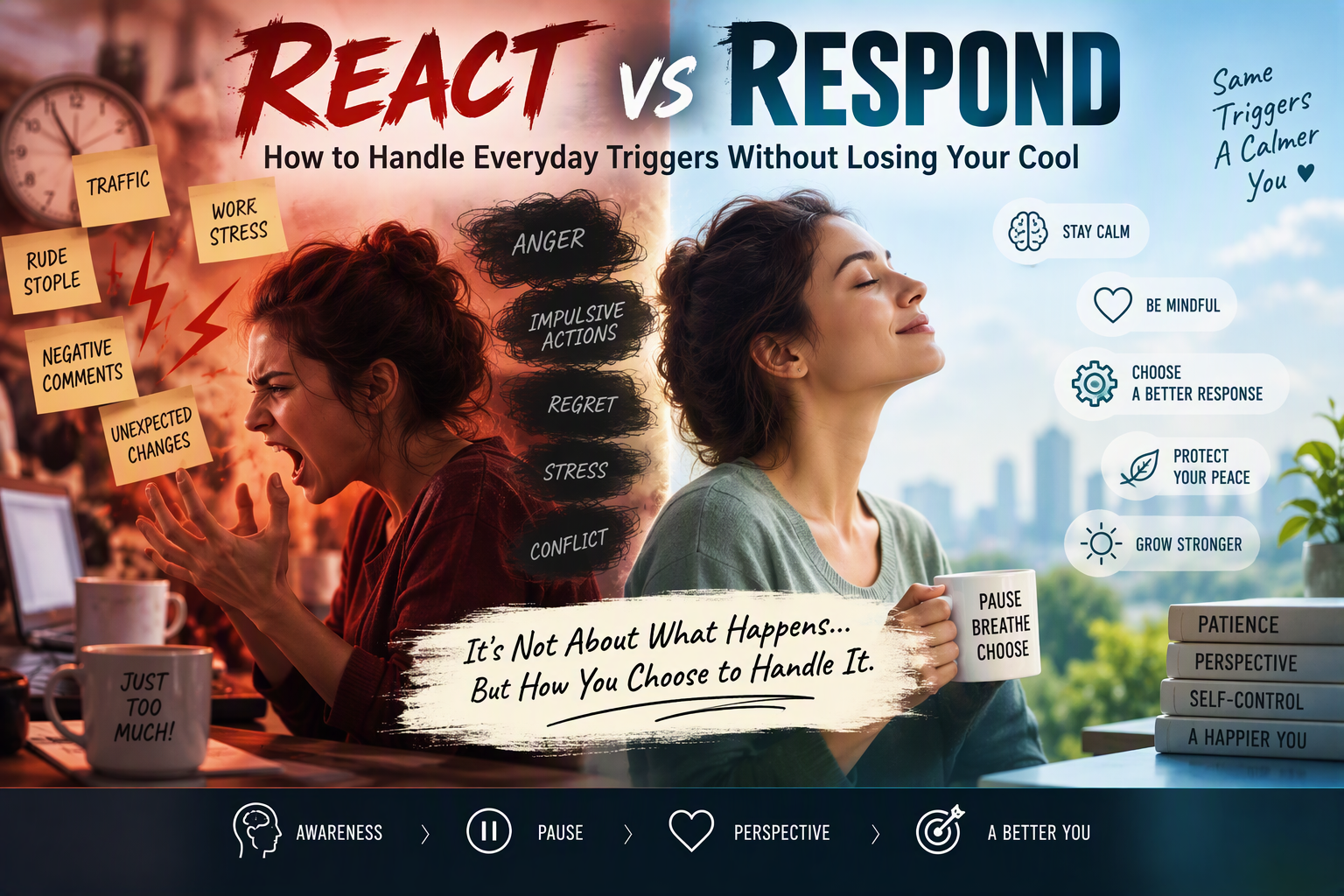
React vs Respond: How to Handle Everyday Triggers Without Losing Your Cool
Have you ever sent an angry reply to an email and regretted it ten minutes later? Snapped at a customer service representative because your problem wasn’t being resolved? Honked at someone in traffic, argued with a stranger in a queue, or felt humiliated when your boss criticised you in front of colleagues?
Perhaps someone at home said something hurtful, and you responded with words you knew would hurt them just as much.
In that moment, you might have felt justified. The other person was rude, unfair, inconsiderate or simply wrong. Why should you remain quiet when someone behaves badly?
But later, when the anger subsides, you may wonder whether you could have handled the situation differently.
This is the everyday struggle behind a familiar expression: React vs Respond.
We hear people say, “Don’t react. Respond.” It sounds simple, almost obvious. Yet when someone pushes our buttons, remembering a piece of advice is far easier than putting it into practice.
The purpose of this article isn’t to tell you to become endlessly patient, tolerate disrespect or pretend that nothing bothers you. It is to explore how you can handle difficult situations without allowing a moment of anger, frustration or wounded pride to dictate what happens next.
Because the real goal isn’t to become a person who never gets triggered. It is to become someone who can deal with a trigger without automatically making the situation worse.
1. Difference Between React Vs Respond
A reaction is often an immediate behavioural response to something that upsets, threatens or frustrates us. It may happen before we have considered the consequences.
A response, in the sense used in this article, is a more deliberate action. We recognise what has happened, consider what matters and choose how to proceed.
Imagine that you receive an email from a colleague pointing out a mistake in your work. The tone seems unnecessarily sharp.
Your immediate thought might be, “Who does this person think they are? They make mistakes too!”
You start typing a reply that highlights their shortcomings. You may even copy your manager into the email to expose the other person’s behaviour.
That is an impulsive reaction.
Alternatively, you could pause, check whether the criticism is accurate, and decide what needs to be addressed. If the criticism is incorrect, you can correct the facts. If the tone is inappropriate, you can address it separately.
That is a deliberate response.
Notice that responding doesn’t mean agreeing with the colleague. You can disagree firmly, defend your work and raise a legitimate complaint. The difference lies in whether your action serves a useful purpose or is primarily intended to discharge your anger.
Reacting asks, “How do I express what I feel right now?” Responding asks, “What is the most useful thing I can do in this situation?”
These aren’t rigid psychological categories. Some reactions are appropriate and protective, and a deliberate response can still be emotional. The distinction is useful because it reminds us that we have more than one possible course of action.
2. Why Do Everyday Incidents Trigger Such Strong Reactions?
Not every trigger is a major event. Sometimes, the smallest incident can spoil an otherwise good day.
A driver cuts in front of you. A shop refuses to replace a defective product. A customer service representative gives you a rehearsed answer instead of solving your problem. Someone jumps the queue while you have been waiting patiently.
Why can such incidents provoke so much anger?
We interpret events, not just experience them
Consider two people who encounter the same situation: a stranger cuts in front of them in a queue.
The first thinks, “What an inconsiderate person. They think the rules don’t apply to them.”
The second thinks, “That person may not have noticed the queue. I’ll point it out.”
The event is the same, but the interpretation differs.
The first interpretation may intensify the feeling of being disrespected. The second leaves room for a straightforward solution.
This doesn’t mean we should always assume good intentions. Sometimes people really are inconsiderate. The point is that our first interpretation is not always the only possible interpretation, and we can sometimes choose a more useful one.
In psychology, deliberately reconsidering how we interpret a situation is known as cognitive reappraisal. Research on emotion regulation suggests that this can help influence our emotional experience, although its usefulness depends on the person and the circumstances. Read the research review on emotion regulation.
Our expectations collide with reality
We expect a product to work, a service representative to help, a colleague to treat us fairly and a fellow driver to follow traffic rules.
When reality falls short, frustration follows.
The frustration itself is understandable. Problems arise when we turn that frustration into a personal battle.
A defective product becomes proof that the company doesn’t respect us. A delayed response becomes evidence that a colleague is deliberately ignoring us. A rude comment becomes a challenge to our dignity that we must immediately defeat.
Sometimes these interpretations are justified. Sometimes they go beyond what we actually know.
Before acting, it helps to separate the problem that needs solving from the story we have constructed around it.
We bring previous frustrations into the present
Perhaps you have had a difficult day at work. Your journey home has been exhausting, and you are already irritated. When someone makes a seemingly minor remark, your reaction is much stronger than the situation alone would explain.
The remark may be the final straw rather than the real source of all your frustration.
This is why sleep, stress, workload and accumulated resentment matter. Emotional self-control isn’t equally easy in every circumstance.
Recognising that you are already running low on patience can help you avoid starting unnecessary arguments or making important decisions at the wrong moment.
We experience disrespect as a challenge to our dignity
Some triggers are especially powerful because they happen in front of other people.
An elder reprimands you publicly. Your boss criticises you during a meeting. A colleague makes a sarcastic remark in front of the team. A stranger speaks to you rudely while others watch.
You may feel embarrassed, angry and compelled to defend yourself immediately.
Part of you may be thinking, “If I don’t answer back, everyone will think I’m weak.”
But an immediate comeback is not the only way to protect your dignity. You can correct the facts, request a private discussion, challenge inappropriate behaviour or raise a formal complaint.
Your dignity does not depend on winning every confrontation in the moment.
The more clearly you understand what has triggered you, the easier it becomes to choose an appropriate response.
3. Everyday Situations That Test Our Ability to Respond
Understanding the difference between reacting and responding is easy when we are calm. The real challenge appears when something happens unexpectedly and we have only a few seconds to decide what to do.
Let’s look at some familiar situations.
When you receive an insulting email
You open your inbox and find a message that sounds accusatory or condescending. You feel your blood pressure rise. You want to reply immediately and make it clear that the sender cannot speak to you that way.
Before replying, ask yourself two questions:
- Is there a genuine issue that needs to be addressed?
- Do I need to address the tone, the substance, or both?
If the email contains incorrect information, correct it with facts. If the tone is inappropriate, address that separately and professionally.
For example:
Instead of writing, “You clearly haven’t understood anything I explained,” you could write, “I think there may be a misunderstanding. Let me clarify the point.”
If the email is genuinely disrespectful, you can be firmer. You do not have to accept inappropriate communication simply to appear professional.
A useful rule is to draft an angry reply if you need to get your thoughts out, but do not send it immediately. Revisit it once you are calmer and remove anything that does not serve your purpose.
When a product is defective or customer service is unhelpful
You purchase a product, discover a defect and contact customer service. After several calls, you receive the same scripted response without a solution.
Your frustration is understandable. You have spent money and time, and the company has not resolved the problem.
But shouting at the representative may not get you any closer to a solution. The representative may not have caused the problem and may not have the authority to resolve it.
Instead, explain the issue clearly, state what outcome you expect, request a complaint reference and ask for escalation if necessary.
If the company continues to fail you, use its formal grievance process or an appropriate consumer complaint channel.
Being in control does not mean accepting poor service. It means pursuing a solution without allowing frustration to derail your efforts.
When someone cuts you off in traffic
Traffic is an everyday test of patience. Someone overtakes dangerously, blocks your path or cuts into your lane without warning.
The immediate impulse may be to honk repeatedly, chase the vehicle or retaliate.
But what would that achieve? You could turn a brief inconvenience into a dangerous confrontation.
The practical response is to maintain a safe distance, avoid retaliation and continue your journey. If the incident presents a genuine safety concern, prioritise safety rather than trying to teach the other driver a lesson.
You cannot control how everyone drives. You can control whether you add another dangerous action to the situation.
When someone jumps the queue
You have waited patiently. Someone arrives and moves ahead of you as if the people waiting do not exist.
You feel angry because the person has violated a basic expectation of fairness.
You can respond without becoming aggressive:
“Excuse me, the queue starts behind us.”
If the person refuses to cooperate, you can seek assistance from the staff responsible for managing the queue.
You do not have to pretend that the behaviour is acceptable. You simply avoid turning a manageable disagreement into a personal battle.
When an elder reprimands you in front of others
This situation can be particularly uncomfortable because it involves both respect and dignity.
You may feel that the elder has crossed a line, but answering back publicly may escalate the situation and shift attention from what was said to how you responded.
If the matter is not urgent, you might say, “I understand that you’re upset. Can we discuss this privately?”
Later, you can explain why the public criticism bothered you and what you would prefer in the future.
Respect does not require you to accept humiliation. Equally, feeling humiliated does not require you to retaliate immediately.
When your boss or colleague criticises you
Workplace criticism can trigger defensiveness, especially when it happens in front of others.
Your first impulse may be to point out the other person’s mistakes or justify every decision you made.
Instead, separate the feedback from the manner in which it was delivered.
If the feedback is valid, acknowledge what needs correcting. If it is inaccurate, explain your position using evidence. If the manner of communication is inappropriate, address that concern separately when appropriate.
For example:
“I understand the concern about the deadline. I’d like to clarify what caused the delay and agree on how we can avoid it next time.”
If public humiliation or unfair treatment becomes a repeated pattern, document relevant incidents and consider the appropriate workplace process.
The aim is neither submission nor retaliation. It is to protect your professional interests while responding deliberately.
4. Recognising Your Triggers Before They Take Over
We often imagine that we lose our temper because of what somebody else did. But the same incident may provoke different reactions in different people, and even the same person may react differently depending on the day.
One person is particularly sensitive to disrespect. Another cannot tolerate being kept waiting. Someone else becomes defensive whenever their competence is questioned.
Your triggers may be connected to your expectations, previous experiences, insecurities, accumulated stress or the importance you attach to a particular situation.
You do not need to uncover the entire history behind every emotion. Start by identifying recurring patterns.
For one week, notice three things whenever you feel unusually irritated:
What happened? Describe the incident without adding assumptions.
What did I tell myself? Perhaps you thought, “They think I’m stupid,” “Nobody respects my time,” or “I cannot let them get away with this.”
What did I feel like doing? Shouting, sending an angry message, insulting the person, withdrawing or proving that you were right.
This simple exercise helps you distinguish the event from your interpretation and your impulse.
For example:
- Event: A colleague did not acknowledge your contribution during a meeting.
- Interpretation: “They deliberately ignored me because they are jealous.”
- Impulse: Confront them angrily in front of everyone.
You may eventually discover that the colleague did deliberately overlook your contribution. Or you may learn that the omission was accidental. Either way, recognising the assumption gives you an opportunity to check the facts before acting.
You are not required to excuse bad behaviour. You are learning to respond to what you know rather than immediately acting on what you suspect.
5. The Difference Between Self-Control and Suppressing Your Feelings
One common misunderstanding about responding rather than reacting is that you must always remain calm, smile politely and keep your anger to yourself.
That is not the objective.
Anger can signal that something important to you has been violated. It may point to unfair treatment, a broken agreement, disrespect or a boundary that needs to be established.
The problem is not necessarily the feeling. It is what you do with it.
Suppressing your anger may mean concealing your feelings while continuing to experience them intensely. Deliberate emotional regulation, on the other hand, involves working with the emotion so that you can decide how best to act.
Research on emotion regulation distinguishes strategies such as cognitive reappraisal from simply suppressing outward emotional expression. Reappraisal involves reconsidering how you interpret a situation, while suppression focuses on controlling the visible expression of an emotion. They can have different consequences. Learn more about emotion regulation research.
Suppose a colleague repeatedly takes credit for your work.
Responding constructively does not mean convincing yourself that the colleague probably means well, nor does it mean remaining silent.
You can document your contributions, clarify responsibilities and raise the issue with your manager.
You can be angry while doing all of these things.
Self-control is not the absence of emotion. It is the ability to choose your actions without making the emotion your only guide.
This distinction matters because the goal is not to turn you into a passive person who never objects. It is to help you become more effective when you do.
6. What If You Are the One Who Wants to Hurt the Other Person?
Sometimes the issue is not that we lose control before we know what we are doing. We know exactly what we want to say, and we intend to hurt the other person.
Perhaps somebody humiliated us, betrayed our trust or repeatedly behaved unfairly. We know their vulnerabilities and can identify precisely which words will cause the greatest pain.
In that moment, we may even feel that retaliation is justified.
Rather than pretending that this impulse never occurs, acknowledge it honestly: “I want to hurt this person because I feel hurt myself.”
Then separate the desire from the decision.
Ask yourself:
- Do I want the person to understand the damage they caused?
- Do I want an apology, accountability or a change in behaviour?
- Do I want to protect myself from further mistreatment?
- Or do I primarily want them to suffer?
These motives can overlap, but recognising them helps you decide what action is likely to be useful.
If you want accountability, address the wrongdoing. If you need a boundary, establish it. If you need distance, take it. If a formal complaint is appropriate, pursue it.
You can impose consequences without deliberately inflicting emotional pain.
This is not about being morally superior. It is about refusing to let another person’s behaviour determine the kind of behaviour you choose for yourself.
7. A Small Practice Before We Move to the Solutions
You do not have to transform your personality overnight. For now, make one change: when you notice a trigger, try to recognise it before acting on it.
At the end of the day, ask yourself:
- What irritated me today?
- What did I feel like doing?
- Did I act on the impulse immediately, or did I consider another option?
Do not judge yourself harshly if you reacted. The purpose is to notice patterns, not to achieve perfection.
You may find that some triggers are easy to manage while others repeatedly catch you off guard. That is useful information. It tells you where you may need more practice and preparation.
In the next part of this series, we will move from understanding triggers to handling them in real time: what to do when anger rises, how to pause without appearing weak, how to respond to rude people, and how to recover when you react before you can stop yourself.
Because knowing the difference between reacting and responding is only the beginning. The real skill is learning how to put that difference into practice when it matters most.
Read more on:
Rubber Ducking: How Talking to Yourself Can Transform Self-Learning