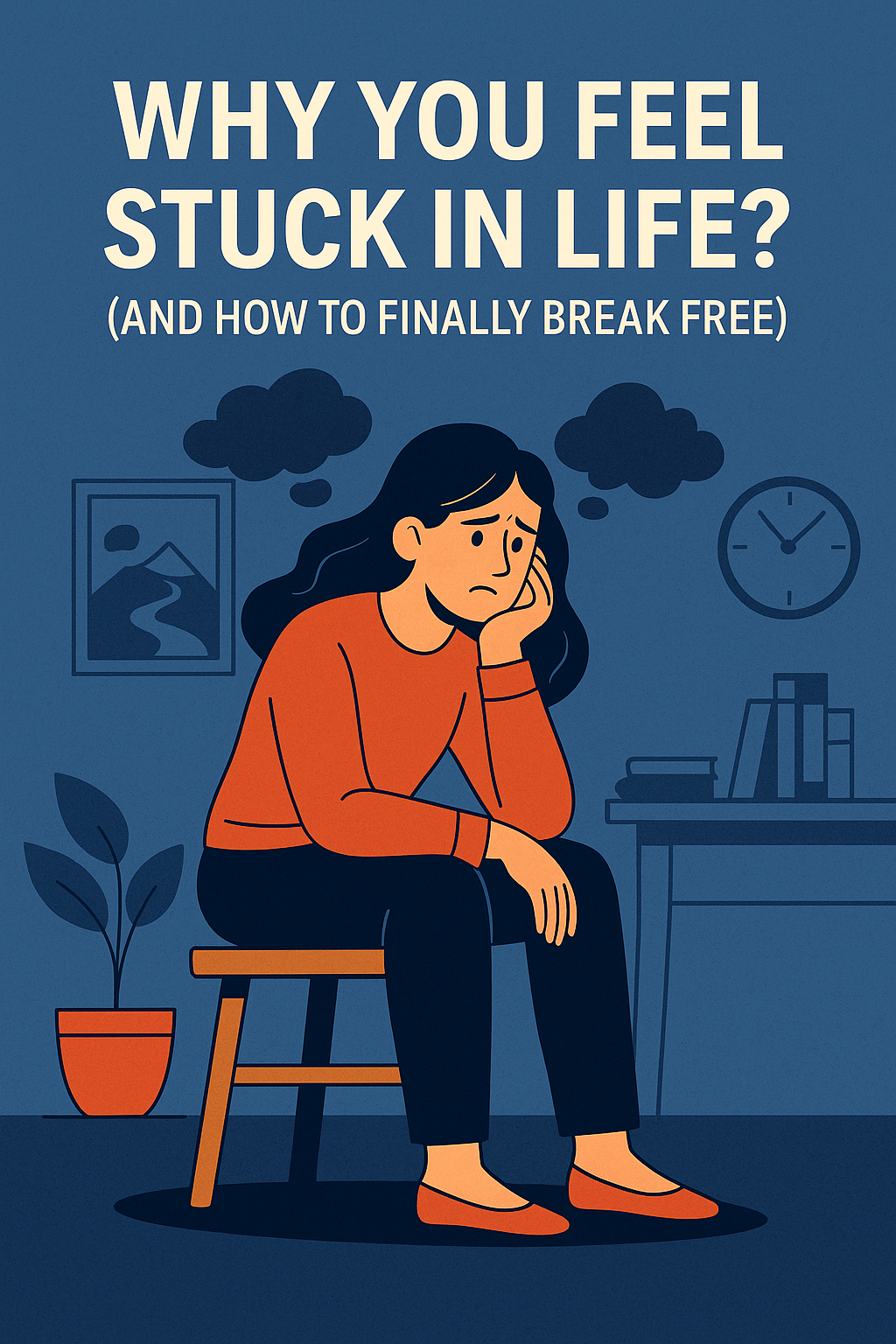
Why You Feel Stuck in Life
(And How to Finally Break Free)
Introduction: That dreaded feeling of ‘Stuckness’
Have you ever looked at your
life and felt like it’s on pause—even though the world is moving fast around
you? Maybe you’re going through the motions at work, stuck in a repetitive
cycle, or simply feeling unfulfilled despite checking all the boxes society
handed you.
You’re not alone. Millions of
people, at every age and stage of life, experience this invisible wall. It’s
frustrating, scary, and worst of all, hard to explain to others.
But this feeling isn’t
permanent—and it’s not a personality flaw. It’s a signal. A signpost pointing
you to areas in your life where change, growth, or honesty is overdue.
In this in-depth guide, we’ll
explore:
- Why people feel stuck at different life stages
- Hidden internal and external causes
- Real-life case studies of people who broke
free - Science-backed strategies to regain clarity
and forward momentum
Let’s break the stagnation.
1. The hidden psychology behind feeling stuck
Feeling stuck is not just
about lack of progress—it’s often about disconnection from purpose, routine
overload, or unresolved emotional loops. Here are some psychological causes
that fuel this state:
a) Decision fatigue
When you’re constantly
bombarded with choices (big or small), you may start avoiding decision-making
altogether. This can lead to passivity and inertia.
b) Learned helplessness
This is when someone believes
they can’t change their situation—even if they can—due to past experiences of
failure or trauma. They stop trying.
c) Identity crisis
You may feel stuck because
your current life doesn’t align with who you truly are—or who you’re becoming.
This gap can cause emotional confusion and paralysis.
Psych Insight: A study from the University of Chicago found that
people who regularly reflect on their “ideal self” vs. “actual self” are more
likely to report feelings of being stuck.
2. Case Study: Maya (Age 34) – The high performer who lost her why
Maya was a marketing manager
in a top firm. On paper, she had it all—good pay, work-from-home flexibility,
and a strong résumé. But every morning felt like a weight. She couldn’t explain
why she hated opening her laptop.
After a coaching session, she
realized her work had no connection to her deeper values. She had always wanted
to work in sustainability but had “accidentally” built a career in luxury
goods.
How she broke free:
- She began volunteering part-time with an
environmental NGO. - She pivoted into sustainable marketing within
10 months. - Today, she runs her own eco-brand and reports
feeling “awake for the first time in years.”
Takeaway: Being good at something doesn’t mean it’s right for you.
3. Midlife discontent: The illusion of “Too Late”
Midlife is a prime time when
people feel stuck. You’ve likely made many commitments—career, family,
mortgage—but you’re also realizing you might’ve compromised your passions.
The problem? You feel too
invested to walk away, but too uninspired to keep going.
Common midlife thoughts:
- “What happened to the dreams I had in my 20s?”
- “I should be grateful—but I’m not.”
- “It’s too late to start over.”
Reality Check: Studies from Stanford and Harvard show that people who make intentional
life changes in midlife often feel more fulfilled and live longer
due to renewed purpose.
4. Case study: Raj (Age 48) – Burnout, bottled-Up dreams, and reinvention
Raj had been in IT for 22
years. Stable, yes. But he dreaded Mondays. What he really loved was cooking,
but he dismissed it as “just a hobby.”
After a minor health scare and
a long sabbatical, he enrolled in culinary school.
Outcome:
- Started a food blog for busy professionals.
- Built a community of 40k followers in 1.5
years. - Now runs a weekend pop-up kitchen and feels
“ten years younger.”
Takeaway: It’s never too late to course-correct. Passion doesn’t expire.
5. The trap of comfort zones and false stability
Comfort zones are cozy—but
they often become cages.
Here’s how to tell you’re
stuck in one:
- You’re not learning anything new
- You say “yes” to things that drain you
- You fear uncertainty more than boredom
Quote to Remember: “People settle for
comfort when their dreams demand courage.”
6. Mental habits that keep you trapped
Sometimes it’s not the world
holding you back—it’s your own mental loops. These habits silently sabotage
your momentum:
a) Overthinking
Too much analysis leads to
paralysis. You weigh all the options but take no action.
b) Comparison
Measuring your life against
others on social media creates unrealistic standards and shame.
c) Catastrophizing
You imagine the worst possible
outcome, which stops you from trying.
Fact: Research in cognitive behavioral therapy (CBT) shows that breaking these
thought patterns leads to more proactive behavior and less anxiety.
7. Case study: Laila (Age 29) – The dreamer who couldn’t start
Laila wanted to be a writer.
She read books about writing, watched YouTube tutorials, and followed authors
on Twitter—but never wrote anything.
She was stuck in a loop of consuming
without creating.
Her breakthrough:
- Joined a 30-day writing challenge.
- Committed to 300 words a day, no editing.
- Finished her first short story and published
it on Medium. - Is now working on a novel.
Takeaway: Action cures fear. Start small, start messy.
8. The role of environment: How your surroundings keep you stagnant
Sometimes it’s your external
world that holds you back:
- Toxic social circles: Friends or family who discourage risk or growth.
- Cluttered spaces: Messy environments drain energy and creativity.
- Routine overload: Over-scheduling leaves no time for exploration.
Design Principle: Behavioral scientists recommend “environment design”—altering
your surroundings to support the person you want to become.
9. Case Study: Marcus (Age 41) – The stuck father who rearranged his life
Marcus had three kids, a
demanding job, and zero “me time.” He felt like a machine, not a man.
Instead of quitting
everything, he optimized:
- Cleared his garage and turned it into a quiet
retreat room. - Scheduled one “creative hour” before work
daily. - Reignited his passion for music and joined a
local band.
Takeaway: You don’t always need to escape your life—just redesign it.
10. Strategies to unstick your life
Now that you understand the why,
let’s explore the how—practical, proven ways to break free from
stuckness.
a) Audit your life wheel
Draw a circle and divide it
into sections: career, health, relationships, fun, growth, finances, etc.
Rate each on a scale of 1–10.
What’s low? That’s your first
clue where change is needed.
b) Practice “Mini Experiments”
Instead of making one big,
scary leap, test small changes:
- Try a new hobby for 30 days
- Take a weekend course
- Shadow someone in a different field
This lowers the pressure while
building momentum.
c) Stop seeking permission
Waiting for approval from
family, society, or your inner critic delays everything. Your path doesn’t need
validation—it needs commitment.
d) Move your body to move your mind
Physical stagnation fuels
mental stuckness. Daily walks, workouts, or yoga can help unlock clarity and
creativity.
e) Find a coach, mentor, or accountability partner
You’re not meant to figure
everything out alone. Get support from someone who’s been there—or who can hold
you accountable to your goals.
11. Case Study: Eleanor (Age 62) – Reinventing after retirement
Eleanor retired after 35 years
as a teacher. At first, she enjoyed the freedom. But soon, boredom and
depression crept in.
She thought her “meaningful
years” were behind her.
Her pivot:
- Began mentoring young teachers online.
- Started a community project to teach reading
to kids in underserved areas. - Now says, “I’ve never felt more useful.”
Takeaway: Purpose doesn’t retire when you do.
12. When to seek professional help
If your stuckness is accompanied
by:
- Ongoing sadness
- Loss of appetite or sleep
- Hopelessness
- Isolation
…you may be dealing with
depression or anxiety. Talk therapy, counseling, or even a simple conversation
with your doctor can be the first step toward clarity.
You’re not weak for asking for
help—you’re wise.
Tools to Break Free
Mind Mapping: Clarify what you want vs. what you have
Accountability Partner: Someone to challenge your excuses
Weekly Reflection Journal: Track patterns, progress, and mindset
Vision Board: Keeps your goal in sight
Pomodoro Method: Break tasks into manageable focus blocks
Digital Detox: Take 1 day a week off social media to reconnect with real goals
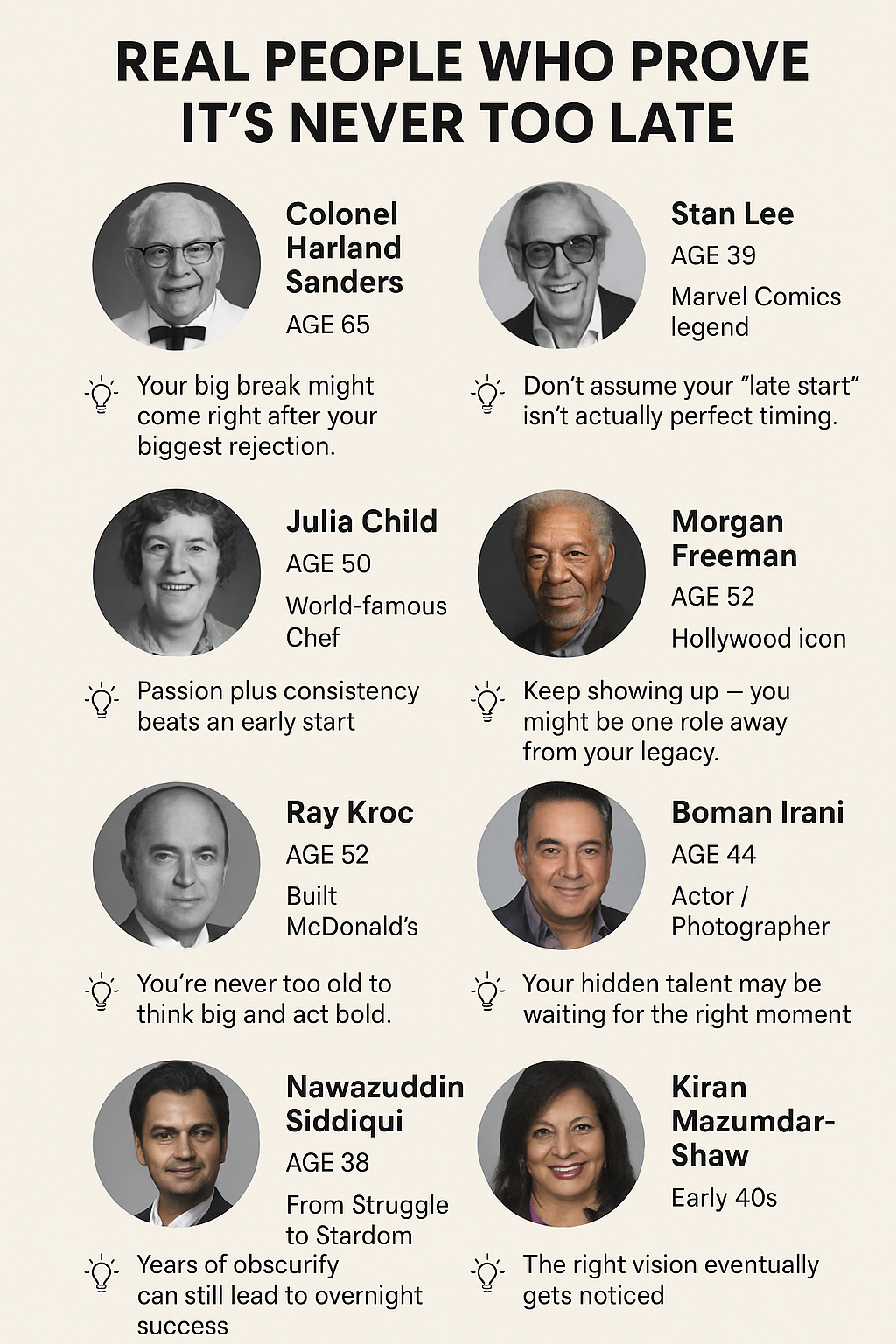
Real people who proved it’s never too late
These are the real inspirers and motivators who will not let you hold on to the lame excuse of age
International Late Bloomers
Colonel Harland Sanders (65) – KFC founder, launched at retirement age.
Stan Lee (39) – Created Marvel heroes in late 30s.
Julia Child (50) – Learned to cook and published her first cookbook at 49.
Morgan Freeman (52) – Gained global fame late in life.
Ray Kroc (52) – Made McDonald’s a global brand at 52.
Laura Ingalls Wilder (65) – Published “Little House” books starting in her 60s.
Some of Indian Trailblazers
Boman Irani (44) – From bakery owner to Bollywood star.
Nawazuddin Siddiqui (38) – From extra roles to international fame.
Kiran Mazumdar-Shaw (40s) – Built Biocon from a garage.
Dr. Verghese Kurien (47+) – Amul and White Revolution pioneer.
Sanjeev Kapoor (Late 30s) – Became a household name after a late TV debut.
Jaspal Bhatti (Late 30s) – Popular comedian who rose to fame with satire TV.
Kalpana Saroj (40s) – Revived Kamani Tubes from bankruptcy to a billion-dollar company.
Conclusion: Start where you are
Being stuck isn’t a sign of
failure—it’s a signal. It’s your inner self asking for honesty, courage, and
action. Whether you’re 29 or 69, change is always possible. You don’t need to
burn everything down to begin again. You just need to take the next right
step.
Quick recap: 7 Signs you’re stuck and how to get unstuck
|
Sign you’re stuck |
How to get unstuck |
|
Boredom & burnout |
Revisit your values & |
|
Lack of progress |
Set micro-goals and track small |
|
Emotional numbness |
Journal daily, seek |
|
Toxic routines |
Break the cycle with new |
|
Comparing to others |
Go on a digital detox, |
|
Too many options |
Limit choices and commit to |
|
Fear of failure |
Take small, safe risks |
Feeling stuck today? Try this:
Write down 3 areas where you feel the most frustrated. For each, write ONE
small step you can take this week. Then schedule it—don’t just think about it.
You can move again
Stuckness isn’t a wall—it’s a
wake-up call. Every life has chapters. You’re allowed to write a new one at any
time.
And you don’t have to do it
alone.
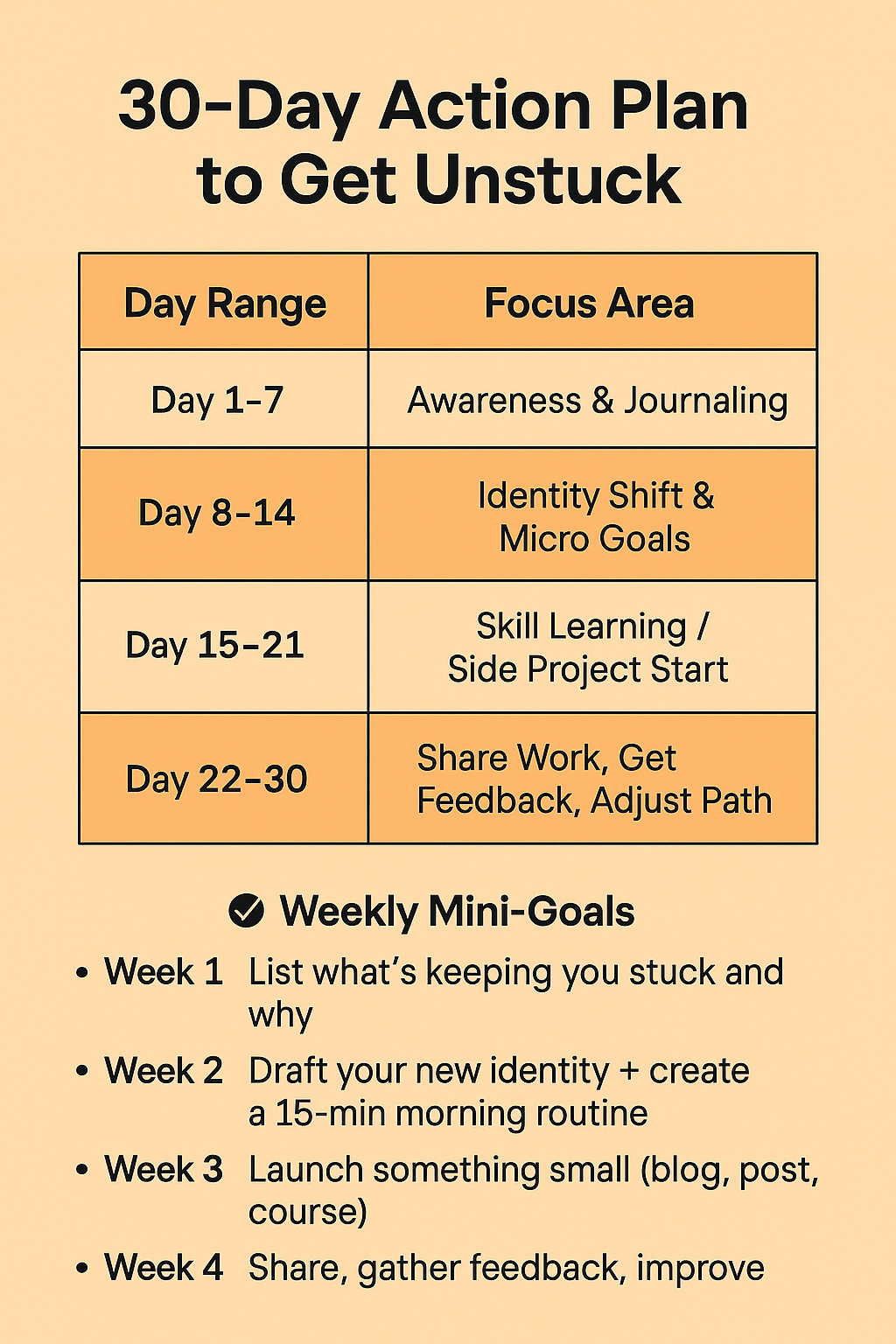
30-Day Action Plan to Break Free
| Day Range | Focus Area |
|---|---|
| Day 1–7 | Awareness & Journaling |
| Day 8–14 | Identity Shift & Micro Goals |
| Day 15–21 | Skill Learning / Side Project Start |
| Day 22–30 | Share Work, Get Feedback, Adjust Path |
Weekly Mini-Goals
- Week 1: List what’s keeping you stuck and why
- Week 2: Draft your new identity + create a 15-min morning routine
- Week 3: Launch something small (blog, post, course)
- Week 4: Share, gather feedback, improve
Repeat monthly and scale gradually.