From Navy SEAL to One of the World’s Toughest Endurance Athletes
David Goggins: The Man Who Refused to Stay Broken (Part 3)
For most people, becoming a Navy SEAL would have been the destination.
For David Goggins…
…it was only the starting line.
He had already done what almost everyone considered impossible.
He had escaped a violent childhood.
He had transformed from an obese pest control worker into one of the world’s elite military operators.
He had survived the training that broke thousands of stronger, younger and seemingly more talented men.
Surely, he had nothing left to prove.
Except…
David Goggins wasn’t trying to prove anything to the world.
He was trying to discover where his own limits truly ended.
The Enemy Returns
Life has a strange habit.
The moment we think we’ve conquered ourselves…
comfort quietly returns.
David feared comfort more than pain.
Pain had changed him.
Comfort had nearly destroyed him.
So instead of celebrating what he had achieved, he searched for another mountain to climb.
It wasn’t because he enjoyed suffering.
It was because suffering had taught him who he really was.
A Race He Had No Business Entering
One day David heard about an ultramarathon.
Not five kilometres.
Not ten.
Not even the traditional marathon distance.
One hundred miles.
He had never run anything remotely close.
Most sensible people would have trained for months.
David didn’t have months.
He entered anyway.
People questioned his decision.
Experienced runners thought it was reckless.
Some believed he would quit halfway.
Others doubted he would even reach the halfway mark.
When the race began, David quickly discovered that military toughness and endurance racing were completely different worlds.
Hour after hour…
the road stretched endlessly ahead.
His muscles cramped violently.
His feet blistered until every step felt like walking on broken glass.
Then his kidneys began shutting down.
He was passing blood.
His body was waving every warning flag imaginable.
Most people would have climbed into the medical vehicle waiting nearby.
David refused.
He slowed down.
He suffered.
But he kept moving.
Crossing that finish line was more than a sporting achievement.
It qualified him for one of the most brutal races on Earth.
The Valley of Death
The Badwater 135.
One hundred and thirty-five miles.
Across Death Valley.
Temperatures often soar above 120°F (49°C).
The ground can become hot enough to damage shoes.
Even elite athletes approach it with respect.
David approached it with determination.
There were moments when his vision blurred.
Moments when exhaustion distorted reality.
Moments when every muscle demanded surrender.
Yet he had learned something years earlier while staring into a bathroom mirror.
The voice telling us to quit isn’t always telling the truth.
Step after painful step…
mile after relentless mile…
he continued.
Not because it became easier.
Because he became stronger.
The Body Breaks
Success didn’t protect David from pain.
If anything…
pain became his constant companion.
He suffered stress fractures.
Broken bones in his feet.
Damaged knees.
Back problems.
Countless injuries that would have convinced most athletes to retire.
Yet he continued adapting.
Sometimes he ran.
Sometimes he cycled.
Sometimes he simply found another way to keep moving.
His philosophy was never to ignore medical advice.
It was to refuse using discomfort as an excuse to abandon his purpose.
The Record Nobody Expected
In 2013, David attempted to break the world record for the most pull-ups completed in 24 hours.
His first attempt ended in failure.
His hands tore open.
His body gave way.
Many people saw failure.
David saw information.
He adjusted.
Recovered.
Trained again.
Months later, he returned.
This time he completed an astonishing 4,030 pull-ups in 17 hours, setting a Guinness World Record.
Blood covered his hands.
Pain covered his body.
Satisfaction covered his face.
Another impossible mountain had quietly disappeared behind him.
The Lessons Hidden in the Struggle
As David’s story spread, people wanted to know his secret.
They expected a miracle.
A shortcut.
A motivational trick.
Instead, they found uncomfortable truths.
He spoke about confronting the person in the mirror before judging anyone else.
He encouraged people to collect victories in what he called the “Cookie Jar”—not to live in the past, but to remind themselves that they had overcome adversity before.
He challenged people to stop negotiating with their excuses.
One of his best-known ideas became the “40% Rule”—his belief that when most people feel completely finished, they often still have far more mental and physical capacity than they realize. Whether or not that percentage is literally true, the principle inspired countless people to question the limits they had accepted.
These ideas weren’t born in classrooms.
They were forged through years of pain, failure and relentless persistence.
From Unknown to Unforgettable
The man who once hid from mirrors eventually wrote books read around the world.
He inspired athletes.
Military personnel.
Business leaders.
Students.
Parents.
People recovering from illness.
People rebuilding their lives.
Millions found pieces of themselves in his story.
Not because they wanted to become Navy SEALs.
But because everyone carries a battle that feels impossible.
The Real Victory
Many believe David Goggins’ greatest achievement is becoming a Navy SEAL.
Others point to Badwater.
Some mention the pull-up world record.
They are all remarkable.
But perhaps his greatest achievement happened years earlier.
It happened on an ordinary evening.
An overweight pest control worker stood alone before a mirror.
Nobody applauded.
Nobody believed in him.
Nobody promised success.
There were no cameras.
No interviews.
No audience.
Only one difficult truth.
“If I continue living like this, nothing will ever change.”
That moment mattered more than any finish line.
Because every victory that followed…
every medal…
every race…
every military achievement…
every book…
every speech…
began with one decision.
A decision to stop lying to himself.
What David Goggins Teaches Us
David Goggins’ story isn’t really about running.
Or the military.
Or world records.
It’s about human potential.
It reminds us that our past does not have to dictate our future.
That discipline often succeeds where motivation fades.
That failure is not the opposite of success—it is frequently part of the journey.
Most importantly, it reminds us that courage rarely arrives after confidence.
More often, confidence arrives because we chose courage first.
Perhaps your mountain isn’t a 135-mile ultramarathon.
Perhaps it’s recovering from failure.
Starting a business.
Writing a book.
Changing careers.
Saving a relationship.
Losing weight.
Or simply believing in yourself again.
Whatever your mountain is, remember this:
David Goggins wasn’t born standing on a summit.
He began at the bottom.
Overweight.
Broken.
Afraid.
Unknown.
He climbed one painful step at a time.
So can you.
The road will test your patience.
It will expose your weaknesses.
It will tempt you to quit.
But every meaningful journey asks the same question:
“Will you keep going?”
David Goggins answered that question long ago.
Now life is asking it of you.
The answer, as always, belongs to the person staring back from your own mirror.
Points to Ponder
The world celebrates extraordinary achievements, but it rarely witnesses the ordinary choices that create them.
One healthy meal.
One early morning.
One extra mile.
One honest conversation with yourself.
One decision not to quit.
Repeated long enough, those small choices can reshape a body, rebuild a mind, redefine a life, and, sometimes, inspire millions.
That is the true legacy of David Goggins.
Not that he became one of the toughest men alive.
But that he proved toughness is not something we’re born with.
It is something we build—one relentless choice at a time.
Lessons We Can Learn from David Goggins
David Goggins’ story isn’t extraordinary because he became a Navy SEAL or an endurance athlete. It is extraordinary because he proved that transformation begins long before the world notices.
His journey offers lessons that extend far beyond military training or ultramarathons.
1. Accept Reality Before You Try to Change It
David’s transformation began the day he stopped making excuses. He looked honestly at his life—his weight, his habits, and his unfulfilled potential. Real change starts when we stop denying reality and start confronting it.
2. Discipline Outlasts Motivation
Motivation is emotional. Discipline is deliberate.
There were countless days when David didn’t feel like training, yet he trained anyway. Waiting to “feel motivated” often delays progress. Consistent action, even on difficult days, produces lasting results.
3. Your Past Doesn’t Have to Define Your Future
An abusive childhood, learning difficulties, racism, obesity, and repeated failures could easily have become permanent labels. Instead, David treated them as chapters—not the ending of his story.
Your past explains you. It doesn’t have to imprison you.
4. Failure is Feedback, Not Finality
David didn’t become a Navy SEAL on his first attempt. Injuries, illness, and setbacks forced him to start over more than once. Each failure became information rather than a reason to quit.
Sometimes the only difference between success and failure is the willingness to begin again.
5. Growth Lives Outside Your Comfort Zone
Comfort rarely transforms people.
Every meaningful achievement in David’s life demanded discomfort—whether losing over 100 pounds, enduring Hell Week, or running through extreme conditions.
Growth begins where comfort ends.
6. Small Choices Shape Extraordinary Lives
David’s story wasn’t built on one heroic moment.
It was built on thousands of ordinary decisions:
Choosing a healthy meal.
Going for one more run.
Waking up early.
Continuing despite pain.
Refusing one more excuse.
Great achievements are often the result of small actions repeated consistently.
7. Compete With the Person in the Mirror
David rarely compared himself with others. His greatest opponent was always the person he had been yesterday.
The healthiest competition isn’t with your neighbour, your colleague, or a stranger on social media.
It’s with your own potential.
Final Reflection
Not everyone needs to become a Navy SEAL.
Not everyone needs to run ultramarathons.
But everyone faces battles that demand courage, resilience, and discipline.
For some, the mountain is poor health.
For others, it’s anxiety, financial hardship, grief, addiction, career setbacks, or the fear of starting over.
The mountain may be different.
The climb is the same.
One honest decision.
One difficult step.
One day at a time.
David Goggins’ greatest achievement wasn’t proving that impossible goals can be reached.
It was proving that ordinary people can become extraordinary when they refuse to surrender to the limits they once accepted.
Perhaps the next inspiring story won’t be about David Goggins.
Perhaps it will be about you.
Frequently Asked Questions
1. Who is David Goggins?
David Goggins is a retired U.S. Navy SEAL, endurance athlete, bestselling author, and motivational speaker. Before his transformation, he worked as a pest control technician and struggled with obesity, weighing nearly 300 pounds.
2. How much weight did David Goggins lose to become a Navy SEAL?
David Goggins lost more than 100 pounds (around 45 kg) in approximately three months to meet the Navy SEAL weight requirement. His transformation required an extremely disciplined diet and an intense daily training routine.
3. Did David Goggins fail Navy SEAL training?
Yes. His journey included injuries, illness, and setbacks that forced him to repeat parts of the training before he successfully earned the Navy SEAL Trident.
4. What is David Goggins’ “40% Rule”?
The “40% Rule” is David Goggins’ personal philosophy that when most people feel they’ve reached their limit, they often still have significant untapped mental and physical capacity. It’s a motivational concept rather than a scientifically established rule.
5. What books has David Goggins written?
David Goggins is best known for Can’t Hurt Me and Never Finished, both of which explore his life story, mindset, and approach to discipline and personal growth.
6. What is the biggest lesson from David Goggins’ life?
His story shows that lasting change comes from honesty, discipline, resilience, and consistent action. While not everyone needs to pursue extreme challenges, his journey illustrates that meaningful transformation is possible through sustained effort.
7. Can anyone become like David Goggins?
Not everyone will choose the same path or achieve the same feats. However, the principles behind his transformation—personal accountability, perseverance, and disciplined action—can be adapted to many different goals and walks of life.
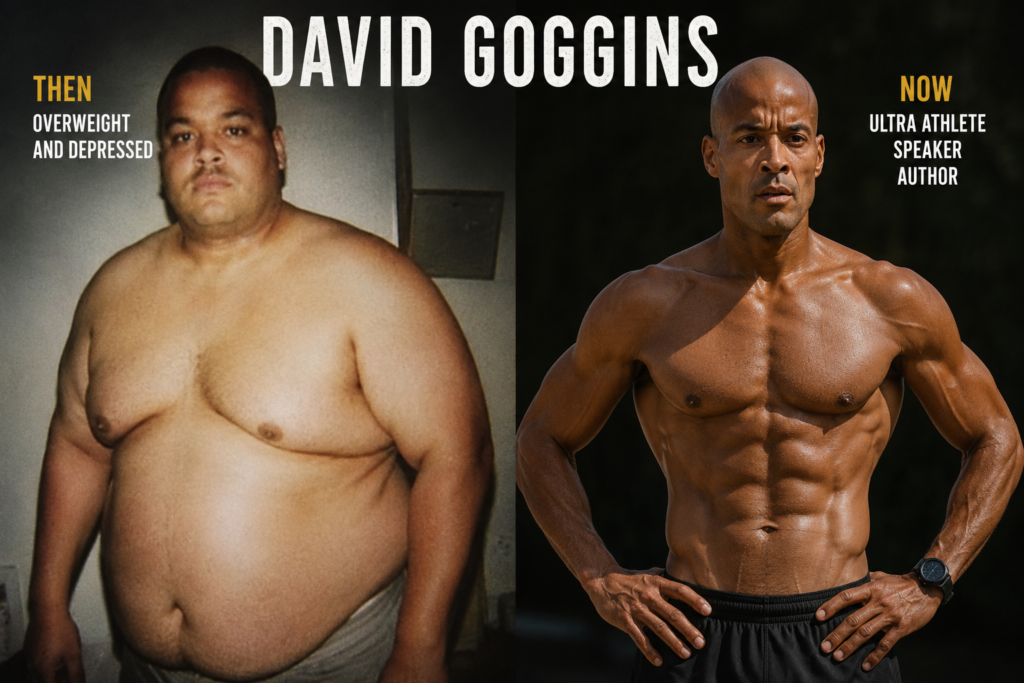
This is what he achieved by working relentlessly on his mind and body.
You may read David Goggins’ book Can’t Hurt Me on amazon.
Refer Books to learn about How to Overcome Limiting Beliefs, Self Development, Neuroplasticity, NLP
Why Your Brain Notices a Rustle in the Grass more than a Beautiful Landscape? 10 08 2026