Why Your Brain Notices the Rustle in the Grass More Than the Beautiful Landscape: The Evolutionary Threat Perception
“Nothing has changed except my attitude; therefore, everything has changed.”— Anthony de Mello
Have you ever wondered why one harsh comment ruins your entire day, even after receiving ten compliments?
Why do you replay a mistake for hours while forgetting all the things that went right?
Why does uncertainty make your heart race, your palms sweat and your mind jump to the worst possible conclusion?
The answer lies in an ancient survival system that has been protecting human beings for millions of years.
It is so efficient that it often mistakes modern inconveniences for life-threatening dangers.
Understanding this system may be one of the most valuable lessons you ever learn—not because it removes stress, but because it teaches you how to respond instead of react.
Meet Your Body’s Silent Autopilot
Most of us know about the brain, the spinal cord and the nerves that allow us to move our hands or legs.
But hidden beneath conscious awareness is another remarkable network called the autonomic nervous system (ANS). It is not imaginary.
It is a real, physical network of nerves, nerve cells and chemical messengers spread throughout your body. Every second of every day, it regulates functions you rarely think about—your heartbeat, breathing, blood pressure, digestion, body temperature and much more.
The autonomic nervous system has two major divisions. The sympathetic nervous system acts like the accelerator in a car. It prepares you for action.
The parasympathetic nervous system acts like the brake. It restores calm, conserves energy and allows your body to recover.
Neither is “good” or “bad.” You need both.
Without the accelerator, you could not escape danger.
Without the brake, your body would eventually wear itself out.
Health depends on the balance between these two systems.
Who Decides Which System Takes Control?
Many people imagine these systems switching on automatically without reason. In reality, they are directed by your brain.
Every moment, your senses gather information from the world around you.
Your eyes notice movement.
Your ears detect sounds.
Your skin feels temperature.
Even your thoughts and memories become information for the brain.
Deep inside the brain, a small almond-shaped structure called the amygdala constantly scans for potential danger.
It asks one simple question: “Am I safe?”
If the answer appears to be “no,” it immediately alerts another region called the hypothalamus.
Think of the hypothalamus as the body’s command centre. Within fractions of a second, it activates the sympathetic nervous system.
Your heart beats faster
Your breathing becomes quicker
Your muscles tighten
Your pupils widen
Adrenaline floods your bloodstream
Blood is redirected away from digestion and towards the muscles
Your body is now ready to fight, flee or freeze
The remarkable part is how quickly this happens.
Long before you consciously analyse a situation, your survival brain has already made its decision.
The Rustle in the Grass
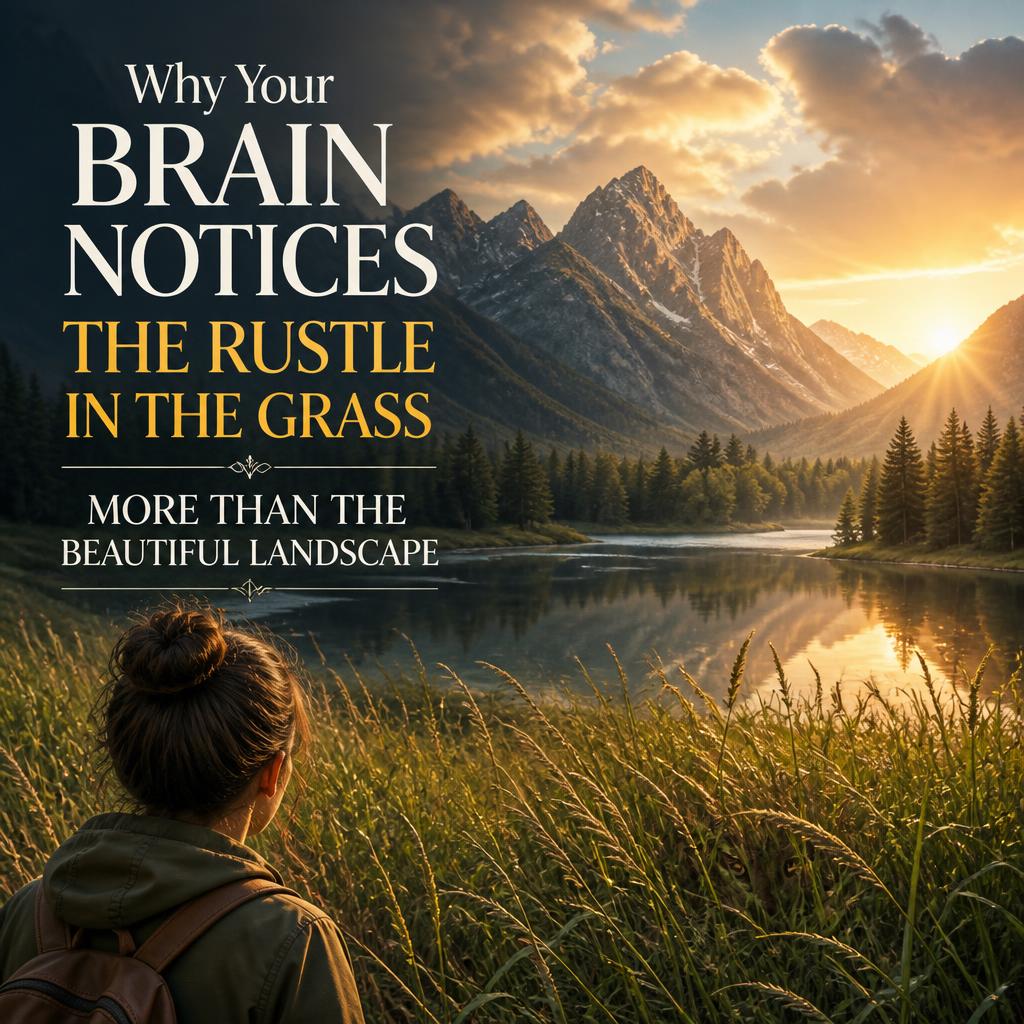
Imagine two early humans walking through a forest. One pauses to admire the golden sunset. The other hears a faint rustle in the dry grass.
Who survives longer?
Nature rewarded the one who investigated the rustle.
Perhaps it was only the wind. But perhaps it was a hungry predator.
Ignoring beauty rarely cost lives.
Ignoring danger often did.
As a result, evolution shaped our brains to notice threats before opportunities.
Psychologists call this the negativity bias. It explains why one criticism outweighs ten compliments.
Why bad news spreads faster than good news?
Why frightening headlines attract more attention?
Why your mind remembers failures more vividly than successes?
Your brain is not trying to make you unhappy. It is trying to keep you alive.
The problem is that the modern world is very different from the one our ancestors inhabited.
Your Brain Cannot Always Tell the Difference
Today, most of us are not escaping predators. Yet our nervous system reacts as though we are.
A delayed message.
A poor performance review.
Financial uncertainty.
A disagreement at home.
An unexpected expense.
These are emotionally painful experiences, but they are rarely life-threatening.
Unfortunately, your brain often treats perceived danger almost the same as actual danger.
That is why your heart races before a presentation.
Why your stomach feels tight before an interview?
Why a frightening thought can trigger anxiety even while you are sitting safely in your living room?
The body responds not only to reality but also to the brain’s interpretation of reality.
Understanding this changes everything.
Your first reaction is often automatic.
Your second response can be intentional.
Why We Overreact When Things Don’t Go as Planned
Most suffering begins with a gap. The gap between expectation and reality.
” I thought this job would be mine.”
“I expected people to appreciate my effort.”
“I never imagined this relationship would end.”
The larger the gap, the stronger the emotional response. When reality refuses to match expectation, the sympathetic nervous system becomes active.
Your thinking narrows. Your attention focuses on problems. The negativity bias becomes even stronger.
Instead of asking, “What can I learn?”
The mind asks, “Why does this always happen to me?”
This is not weakness.It is biology.But biology is not destiny.
Returning to Calm
The goal is not to eliminate stress. Stress is part of life. The real skill is helping your nervous system shift from survival mode back to recovery mode. Fortunately, your parasympathetic nervous system can be activated deliberately.
Start with your breathing. Slow, gentle breaths with a longer exhale signal to the brain that the immediate danger has passed. Name what you are feeling. Simply saying, “I feel disappointed,” or “I feel anxious,” helps reduce emotional intensity because it engages the thinking parts of the brain.
Separate facts from stories
Fact: “The project failed”
Story: “I am a failure”
Facts help. Stories often hurt.
Move your body
A short walk, stretching or light exercise helps metabolise stress hormones that were released in preparation for action.
Ask better questions
Instead of asking, “Why is this happening to me?”
Try asking, “What is one thing I can control right now?”
Control restores confidence.
Finally, remember that thoughts are not always truths. Your brain is making predictions based on survival, not certainty.
Train the Brake, Not Just the Accelerator
Modern life constantly stimulates the sympathetic nervous system.
Endless notifications
Breaking news
Traffic
Deadlines
Social media comparisons
Financial pressures
Few people intentionally strengthen the parasympathetic system. Yet this is where resilience is built.
Quality sleep
Mindful breathing
Exercise
Time in nature
Meaningful conversations
Gratitude
Prayer or meditation
Reading quietly
Listening to calming music
These are not luxuries. They are ways of telling your nervous system, “You are safe. ”
Over time, your brain becomes better at returning to balance after stress. Researchers call this resilience.
The Lesson Hidden in the Rustle
Perhaps the greatest lesson is this:
Your brain evolved to keep you alive, not necessarily to keep you happy.
It notices danger before beauty
Problems before possibilities
Threats before gratitude
Knowing this gives you a choice
When your mind races towards fear, you can gently remind yourself, “My brain is doing what it evolved to do. “
Then consciously look for the wider picture
Notice the sunset as well as the rustle
Prepare for problems without becoming imprisoned by them
Respond instead of reacting
Because peace does not come from living in a world without uncertainty. It comes from training a nervous system that knows how to return home after every storm. The rustle in the grass may deserve your attention. But don’t forget to look up. The landscape is still beautiful.
Training Your Peace Response
Most people spend years strengthening their stress response without ever realising it.
Every notification demands attention
Every deadline creates urgency
Every argument raises tension
Slowly, the sympathetic nervous system becomes the body’s default setting. Many people eventually mistake this constant state of alertness for “normal.”
It isn’t.
The good news is that your parasympathetic nervous system can also be trained.
Like building stronger muscles in the gym, you can strengthen your body’s ability to return to calm after stress.
The objective is not to eliminate challenges. It is to recover from them faster.
1. Breathe Like You Are Safe
Your breath is the fastest doorway into your nervous system.
When frightened, breathing becomes rapid and shallow.
When calm, it becomes slow, deep and rhythmic.
Your brain constantly monitors this pattern. Slow breathing sends a powerful message:
“There is no immediate danger.”
Try this simple practice
Inhale gently through your nose for four seconds
Pause briefly
Exhale slowly through your mouth for six to eight seconds
Repeat for five minutes
The longer exhalation stimulates the vagus nerve—the body’s main communication pathway for activating the parasympathetic nervous system.
2. Move Your Body Every Day
Exercise is often promoted for weight loss or fitness.
Its greatest gift may actually be emotional stability.
Walking
Cycling
Swimming
Yoga
Strength training
Dancing
Each helps burn excess stress hormones while improving mood through endorphins and other beneficial brain chemicals.
The best exercise is not the hardest one.
It is the one you will continue doing for years.
Even a brisk twenty-minute walk can interrupt anxiety and restore mental clarity.
3. Strength Training Builds More Than Muscles
Lifting weights teaches your brain something profound.
Stress is temporary
Recovery follows effort
Each repetition creates a small challenge followed by relief
Over time, your brain becomes more confident in handling discomfort, both physical and emotional.
That confidence often spills over into everyday life.
4. Yoga: Movement Meets Stillness
Yoga combines slow movement, controlled breathing and focused attention.
Instead of telling your body to relax, yoga helps your body experience relaxation directly.
Numerous studies have shown improvements in stress levels, sleep quality and emotional wellbeing among regular practitioners.
You do not need advanced poses.
Ten to fifteen minutes of gentle stretching performed mindfully can make a noticeable difference.
5. Meditation Trains the Mind
Meditation does not stop thoughts.
It changes your relationship with them.
Instead of chasing every worry, you learn to observe thoughts without immediately reacting.
With regular practice, the brain becomes less emotionally reactive and better able to regain balance after stressful events.
Begin with just five minutes.
Consistency matters far more than duration.
6. Sleep is the Night Shift for Healing
A tired brain detects more danger.
A well-rested brain thinks more clearly.
Poor sleep keeps the sympathetic nervous system on high alert.
Quality sleep allows your body to repair tissues, regulate hormones and restore emotional balance.
Protect your sleep as carefully as you protect your income.
It influences almost every aspect of physical and mental health.
7. Spend Time in Nature
Nature gently reminds the nervous system that not everything requires vigilance.
A park
A garden
Trees after rain
Birdsong
Flowing water
Natural environments reduce mental fatigue and help lower physiological stress.
Sometimes the most productive thing you can do is sit quietly beneath a tree.
8. Nourish Relationships
Safety is not only physical.
It is also emotional.
A heartfelt conversation
A hug from someone you trust
Laughing with family
Playing with children
Sharing a meal
These experiences signal to the brain that you belong, and belonging is one of the strongest antidotes to chronic stress.
9. Create Small Daily Rituals
Peace grows through repetition.
Begin your morning without checking your phone
Read a few pages of an inspiring book
Write three things you are grateful for
Listen to calming music
Enjoy your tea or coffee without distraction
Water your plants
Sit silently for five minutes
These simple rituals repeatedly activate the brain’s “safe mode.”
Over months and years, they reshape your nervous system.
10. Limit Artificial Threats
Your ancestors worried about predators.
Today, many of us consume hundreds of artificial threats every day through endless news updates, social media outrage and constant comparison.
Ask yourself honestly:
Does this information help me?
Or does it simply keep my nervous system activated?
Protect your attention.
It is one of your most valuable resources.
A Home Routine for Everyday Peace
You do not need expensive equipment or weekend retreats.
A simple daily routine is enough.
Morning:
Five minutes of slow breathing.
Ten minutes of stretching or yoga.
A healthy breakfast without scrolling through your phone.
Afternoon:
A brisk twenty-minute walk.
Drink water.
Take short breaks between mentally demanding tasks.
Evening:
Light exercise or gentle stretching.
Limit screens during the final hour before bed.
Read, meditate or practise gratitude for ten minutes.
Night:
Aim for seven to nine hours of quality sleep.
These habits appear ordinary.
Their effects are extraordinary.
Peace is a Practice
Many people search for the perfect job, relationship or house believing peace will finally arrive.
Yet peace rarely comes from changing the world.
It comes from changing how your nervous system responds to the world.
Life will still surprise you.
Plans will fail.
People will disappoint you.
Unexpected problems will appear.
But when your parasympathetic nervous system becomes stronger, you recover more quickly.
You think more clearly
You make wiser decisions
You suffer less from imagined catastrophes
You begin to notice not only the rustle in the grass—but also the beauty of the landscape
That is not escaping reality.
That is living it fully.
Because a peaceful life is not built in extraordinary moments.
It is built in ordinary moments, repeated every single day.
Frequently Asked Questions (FAQ)
1. What is the autonomic nervous system?
The autonomic nervous system (ANS) is the part of your nervous system that automatically controls vital body functions such as heart rate, breathing, blood pressure, digestion and body temperature. It works continuously without conscious effort to keep your body functioning properly.
2. What is the difference between the sympathetic and parasympathetic nervous systems?
The sympathetic nervous system prepares your body to respond to danger or stress by increasing alertness, heart rate and energy availability. It is often called the “fight, flight or freeze” system.The parasympathetic nervous system does the opposite. It slows the heart, improves digestion, promotes healing and helps the body recover. It is commonly known as the “rest and digest” system.
3. Why does my brain focus on negative events more than positive ones?
This is known as the negativity bias. Human beings evolved to detect threats quickly because recognising danger increased the chances of survival. As a result, our brains naturally give more attention to problems, criticism and uncertainty than to pleasant experiences.
4. Can thoughts alone activate the sympathetic nervous system?
Yes. The brain responds not only to real danger but also to perceived danger. Worrying about the future, replaying painful memories or imagining worst-case scenarios can trigger the same stress response as an actual physical threat.
5. Is stress always harmful?
No. Short-term stress can improve focus, motivation and performance. Problems arise when the body remains in a constant state of stress without enough time to recover. Chronic stress increases the risk of anxiety, depression, high blood pressure, poor sleep and several other health conditions.
6. What is the fastest way to activate the parasympathetic nervous system?
Slow, controlled breathing is one of the quickest methods. Breathing in through the nose for four seconds and exhaling slowly for six to eight seconds for several minutes helps signal safety to the brain and encourages relaxation.
7. Does exercise reduce stress even if I am not trying to lose weight?
Absolutely. Regular physical activity helps lower stress hormones, improves mood, enhances sleep and strengthens your body’s ability to recover from stressful situations. Walking, yoga, swimming, cycling and strength training are all effective.
8. Can meditation change the brain?
Research suggests that regular meditation can improve emotional regulation, attention and resilience while reducing excessive stress responses. Like physical exercise, the benefits develop gradually with consistent practice.
9. What is the vagus nerve, and why is it important?
The vagus nerve is one of the longest nerves in the body and plays a major role in activating the parasympathetic nervous system. Healthy vagal activity is associated with better stress recovery, improved digestion, a slower heart rate and greater emotional resilience.
10. Can I train myself to become calmer?
Yes. The nervous system is adaptable. Consistent habits such as quality sleep, regular exercise, mindful breathing, meditation, spending time in nature, maintaining supportive relationships and reducing unnecessary stressors gradually strengthen your ability to remain calm and recover more quickly after setbacks.
11. Why do I feel anxious even when nothing dangerous is happening?
Your brain is designed to predict possible threats. Sometimes it interprets uncertainty, negative thoughts or emotional memories as danger, activating your stress response even when you are physically safe. Learning to recognise this pattern is the first step towards regaining control.
12. What is the most important lesson from understanding the autonomic nervous system?
Your first emotional reaction is often automatic because it is driven by your survival brain. Your next response, however, is a choice. By understanding how your nervous system works and practising habits that activate your parasympathetic nervous system, you can become more resilient, think more clearly and cultivate a calmer, more peaceful life.