When Work Takes Over Life: Regain Your Work Life Balance

We go to work to build a life.
We work to earn money, support our families, educate our children, buy a home, become independent and perhaps achieve something we can be proud of.
Work is supposed to support life.
But what happens when work slowly begins to consume the life we are working for?
This is no longer a question confined to a few unhappy employees.
Across the world, concerns about excessive working hours, job insecurity, bullying, harassment, lack of control and constant workplace pressure are becoming increasingly serious.
In 2026, the International Labour Organization estimated that more than 840,000 deaths each year are linked to psychosocial risks at work, including long working hours, job insecurity and workplace bullying and harassment.
And India has had some painful reminders of the human cost of an unhealthy work culture.
The death of 26-year-old chartered accountant Anna Sebastian Perayil, who had worked at an EY member firm in Pune for only a few months, triggered a nationwide debate after her mother alleged that an overwhelming workload and long hours had severely affected her daughter.
The allegations led to a government investigation. They should be described as allegations rather than as a legally established cause of death.
The larger issue, however, goes far beyond one company or one employee.
It is about how we have come to think about work.
When did being exhausted become a sign of success?
There was a time when saying:
“I have been working all day.”
meant you had worked hard.
Today, in some workplaces, the conversation has become almost competitive.
“I worked until midnight.”
“I haven’t taken leave in months.”
“I was answering emails at 2 a.m.”
“We had a meeting at 11 p.m.”
“I worked through the weekend.”
And sometimes these statements are met with admiration.
“What a dedicated employee!”
But perhaps we should be asking a different question:
Why did the job require this person to sacrifice so much of their life?
Long working hours aren’t merely tiring. WHO and ILO estimated that working 55 hours or more per week was associated with 745,000 deaths from stroke and ischemic heart disease in 2016.
They found a significantly higher risk of stroke and death from ischemic heart disease among people working such long hours.
So this isn’t about people being unwilling to work hard.
It is about recognising that human beings have limits.
The workplace can follow you home
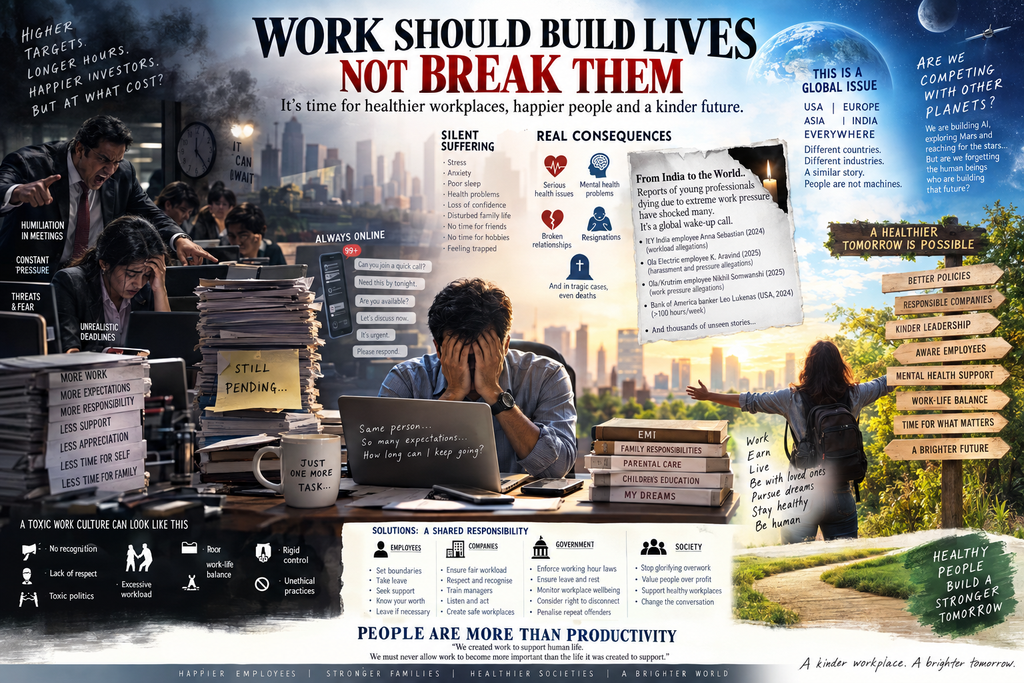
The office once had a physical boundary.
You entered at 9.
You left at 6.
The office stayed behind.
Technology changed that.
Today, the office can be in your pocket.
A WhatsApp message at 10 p.m.
An email at 11.
“Just one small thing.”
A meeting request on Sunday.
“Can you quickly join?”
You may physically be sitting with your family, but mentally you are still at work.
And gradually, the boundaries disappear.
Work enters dinner.
Work enters weekends.
Work enters holidays.
Work enters bedrooms.
And eventually, it enters the mind even when there is no message.
Sunday evening anxiety.
Monday morning dread.
Checking the phone before getting out of bed.
Waking up at night thinking about tomorrow’s deadline.
That isn’t a healthy relationship with work.
The employee who looks perfectly fine may not be fine at all
This is perhaps the most dangerous part.
People don’t always announce that they are struggling.
They continue coming to work.
They attend meetings.
They complete assignments.
They smile.
They say:
“I’m fine.”
But inside, they may be exhausted.
Some people eventually resign.
Others become emotionally detached.
Some stop participating.
Some lose confidence.
Some begin making mistakes.
Some develop physical or psychological symptoms.
Some take their frustration home.
And some may reach a point where they feel completely trapped.
This is why we shouldn’t look only at resignation statistics.
The person who leaves is visible.
The person who stays and silently suffers is often invisible.
What pushes people towards that breaking point?
There isn’t usually one single reason.
It is often a combination of small things that keep accumulating.
1. When effort becomes invisible
People don’t need constant praise.
But everyone wants to feel that their work has some value.
Imagine spending weeks completing an important assignment and hearing nothing when it succeeds.
Then making one mistake and immediately being called out.
Over time, the message becomes:
“Your good work is expected. Your mistakes are remembered.”
That can destroy motivation.
Recognition doesn’t have to be expensive.
Sometimes a sincere “Thank you” is enough.
2. When authority turns into humiliation
A manager has the right to correct an employee.
A manager has the right to demand quality.
A manager can say:
“This isn’t good enough. Please correct it.”
But there is a world of difference between correction and humiliation.
Shouting.
Insulting.
Mocking.
Threatening.
Belittling someone in front of colleagues.
Questioning their intelligence.
Using fear to get compliance.
These things may happen in meetings that are officially called “performance discussions.”
But an employee can walk out of such a meeting carrying the humiliation for days.
Correction improves performance. Humiliation damages people.
3. When the meeting room becomes a place of fear
This is becoming particularly visible through social media.
Videos and personal accounts from Indian workplaces periodically go viral showing employees allegedly being shouted at, publicly humiliated, threatened or subjected to bizarre “training” practices.
One 2025 Bengaluru case that circulated widely involved a young technology employee who reportedly broke down during a virtual meeting after an interaction with management; the account described repeated humiliation and calls at odd hours.
The story was based on an account shared online, so it should not be treated as an independently established finding.
Another disturbing video from Karnataka that went viral reportedly showed a bank manager locking junior employees inside a branch after working hours to make them continue working. Again, such reports require investigation rather than instant conclusions from a viral clip.
And in Kerala, a viral video involving employees subjected to humiliating activities during what were described as training/team meetings resulted in police and labour authorities examining the matter.
The disturbing part isn’t merely the individual incidents.
It is that many people watching such videos recognise the behaviour.
“This happens in my office too.”
“My manager speaks like that.”
“We also get calls at midnight.”
“Our team is afraid to take leave.”
That is when an individual incident becomes a cultural question.
4. When “busy” becomes a permanent condition
Some jobs are genuinely demanding.
Deadlines happen.
Emergencies happen.
Important projects sometimes require extra effort.
The problem begins when the emergency becomes the normal working model.
One difficult week is understandable.
Six difficult months is not a temporary situation.
It is a structural problem.
If a company consistently requires people to work excessive hours, perhaps the question isn’t:
“Why aren’t employees working harder?”
Perhaps it is:
“Why haven’t we hired enough people, planned properly or set realistic targets?”
5. When the office enters family life
An employee may tolerate a difficult day.
But what happens when difficult days become difficult years?
A parent misses the child’s school event.
A couple postpones a holiday.
A person stops exercising.
Friends stop inviting them because they always say:
“I’m busy.”
Parents complain that they never visit.
The employee keeps saying:
“Just a few more years. Once I succeed, I’ll have time.”
But life doesn’t always wait.
Children grow up.
Parents age.
Relationships change.
And one day, someone may realise:
“I spent years building a life I never had time to enjoy.”
6. When saying “no” becomes dangerous
A healthy workplace should allow an employee to say:
“I can’t finish this by tomorrow.”
Or:
“I need leave.”
Or:
“This workload isn’t manageable.”
Or even:
“I disagree with this decision.”
But if saying these things threatens someone’s appraisal, promotion or job security, employees learn a different lesson:
Don’t speak. Just comply.
That creates silence—not commitment.
And silence can hide enormous problems.
7. When merit is replaced by politics
Employees can accept competition.
What they struggle to accept is the feeling that the rules are different for different people.
One employee works hard but receives no recognition.
Another gets opportunities because of personal connections.
One person is punished for taking leave.
Another is praised despite doing the same thing.
Promotions become mysterious.
Decisions aren’t explained.
Soon people stop asking:
“How can I perform better?”
They start asking:
“Whom do I need to please?”
That is corrosive to an organisation.
8. When employees are forced to choose between livelihood and conscience
Perhaps the most difficult situation arises when an employee is asked to do something they believe is wrong.
Change the numbers.
Hide the mistake.
Mislead the customer.
Ignore a safety concern.
Silence a complaint.
Blame someone else.
The employee may know it is wrong.
But they also have a family to support.
So what do they do?
A good organisation should never force people to choose between their salary and their integrity.
There must be safe channels for raising ethical concerns.
India: Are we creating a culture of overwork?
India is ambitious.
We are growing rapidly.
Our technology sector is expanding.
Startups are competing globally.
Young people want to succeed.
Companies want productivity.
Investors want growth.
Employees want better salaries and faster careers.
None of these aspirations is wrong.
The danger comes when “ambition” becomes an excuse for permanently unhealthy working conditions.
There is also a particular cultural pressure in India.
Many employees have substantial family responsibilities.
Parents may depend on them.
Children’s education costs money.
There may be home loans, medical expenses and other obligations.
So when a manager says:
“If you don’t like it, leave. There are hundreds waiting for your job.”
the employee may not feel free to leave.
That isn’t genuine choice.
That is economic pressure.
And then there is the glorification of the “hustle”
Work until midnight.
Sleep four hours.
Wake up.
Do it again.
Call it ambition.
Call it commitment.
Call it hustle.
Call it the price of success.
But there is nothing inherently admirable about destroying yourself for a target.
Hard work is admirable.
Self-destruction is not.
We need to learn the difference.
This isn’t just an Indian problem
India should look at itself honestly.
But we shouldn’t pretend toxic work culture is uniquely Indian.
The same issues exist across industries and countries.
Investment banking.
Medicine.
Law.
Technology.
Consulting.
Startups.
Manufacturing.
Hospitality.
Academia.
Healthcare.
In different countries, the details differ.
The underlying problem is often similar:
Too much demand + too little control + insufficient recovery + fear + inadequate support.
The ILO’s 2026 report describes psychosocial workplace risks as being shaped by how jobs are designed, how work is organised and managed, and the policies and practices governing the workplace. It specifically identifies factors such as excessive demands, low control, job insecurity, long hours and bullying or harassment.
So this is not simply about employees needing to become mentally stronger.
Sometimes the workplace itself needs to become healthier.
The tragic cases should make us pause
We need to be careful here.
Whenever a young employee dies, we cannot automatically conclude that work caused the death.
But we also cannot ignore credible allegations of extreme workplace pressure.
Anna Sebastian Perayil’s death brought this issue into national conversation in India. Her mother’s allegations about long hours and an overwhelming workload prompted a government inquiry.
And there have been other cases and allegations since then.
The important lesson isn’t:
“This company killed this person.”
unless that has been established by competent authorities.
The more responsible lesson is:
If employees are repeatedly reporting extreme pressure, humiliation, fear and exhaustion, we should investigate the working environment before another tragedy occurs.
Prevention is far better than post-mortem outrage.
What can employees do?
Employees also have a role.
Recognise the warning signs.
If you are constantly exhausted, unable to sleep, emotionally overwhelmed, anxious about work, losing interest in everything outside work or unable to recover even during holidays, don’t simply tell yourself:
“Everyone is going through this.”
Seek support.
Set boundaries where possible.
Don’t make yourself permanently available simply because technology makes it possible.
Take your leave.
Leave isn’t a favour from your employer.
Rest is part of functioning well.
Maintain a life outside work.
Friends.
Family.
Exercise.
Hobbies.
Reading.
Nature.
Silence.
Whatever restores you.
Speak up early.
Talk to your manager, HR, a trusted colleague or an appropriate professional before the situation becomes unbearable.
And if necessary, leave—but plan.
Leaving a toxic workplace isn’t failure.
Sometimes it is the healthiest decision available.
But where possible, don’t jump without considering finances, alternatives and responsibilities.
But we cannot tell employees to “just manage their stress”
This is where companies must take responsibility.
If the workload is unreasonable, meditation isn’t going to solve the workload.
If a manager is abusive, yoga isn’t going to fix the manager.
If employees cannot take leave, a wellness webinar isn’t enough.
If people are being humiliated in meetings, giving them a stress-management booklet isn’t the solution.
Fix the source of the problem.
Counselling can be extremely useful when someone needs professional support.
But counselling should complement workplace reform—not replace it.
What should companies do?
Companies should regularly examine the reality of working life, not merely what their HR policies say.
Ask employees anonymously:
- Are you able to take leave?
- Do you regularly work beyond your scheduled hours?
- Are you contacted unnecessarily outside work?
- Can you disagree with your manager safely?
- Do you feel respected?
- Do you feel afraid of making mistakes?
- Have you witnessed humiliation or bullying?
- Are targets realistic?
- Do you have enough people to do the work?
- Do you have time for your family and personal life?
And importantly:
Act on the answers.
Don’t conduct a survey and then file the results somewhere.
Managers need training too
Being technically excellent doesn’t automatically make someone a good manager.
Someone can be a brilliant engineer and a terrible leader.
A brilliant salesperson and a terrible manager.
A brilliant accountant and a terrible manager.
Companies should train managers in:
- communication
- conflict resolution
- giving feedback
- recognising burnout
- workload planning
- respectful leadership
- handling complaints
- preventing bullying
- psychological safety
- ethical decision-making
A manager should know how to say:
“This needs improvement.”
without saying:
“You are useless.”
What should governments do?
Government regulation should not wait until another tragedy makes headlines.
India’s four Labour Codes came into effect on 21 November 2025, including the Occupational Safety, Health and Working Conditions Code. The government says the framework provides for safe and healthy working conditions, annual health check-ups in prescribed circumstances and provisions relating to working hours and leave.
The OSH Code framework sets the standard at eight hours a day and 48 hours a week, with overtime provisions and additional safeguards; government FAQs also state that overtime is payable at twice the normal wage rate under the applicable provisions.
The question now is not simply:
“Do we have laws?”
It is:
Are the laws actually being enforced?
Because a beautiful rulebook sitting on a shelf cannot protect an exhausted employee.
We need to measure psychological safety—not spy on people’s minds
Governments and companies should consider periodic workplace wellbeing assessments.
But there is an important distinction.
We shouldn’t create a system where employees feel:
“My company is monitoring my mental health.”
That would create another source of fear.
Instead, organisations could measure workplace conditions anonymously:
- average working hours
- overtime
- leave utilisation
- employee turnover
- absenteeism
- workplace complaints
- bullying and harassment reports
- psychological safety
- workload
- employee satisfaction
- work-family conflict
The objective should be to identify unhealthy workplaces, not label individual employees.
Should companies have a Happiness Index?
Perhaps—but let’s call it something more meaningful:
A Workplace Wellbeing Index
Because happiness is difficult to measure.
A company shouldn’t get a high score merely because it provides beanbags, free coffee and a Friday party.
We should measure things that actually matter.
Can employees switch off?
Can they take leave?
Are working hours reasonable?
Are complaints taken seriously?
Are managers respectful?
Do employees feel safe speaking up?
Are people routinely working excessive hours?
Does the company retain people because they are happy—or because they are afraid to leave?
Such measures could eventually become part of corporate reporting or independent certification.
Companies that consistently demonstrate healthy workplaces could be recognised.
Companies with repeated serious violations could face stronger inspections, corrective orders and penalties where the law permits.
And what about a Right to Disconnect?
This deserves serious consideration in the digital age.
India has already seen proposals in this direction.
A Right to Disconnect Bill, 2025, introduced as a private member’s bill in the Lok Sabha, sought to recognise employees’ ability to refuse work-related calls, emails and messages outside working hours. It was introduced, not passed into law.
That distinction matters.
But the idea itself is worth discussing.
Because if an employee is officially off duty, should they really have to spend the evening wondering:
“Will my boss think I’m irresponsible if I don’t reply?”
There will always be emergencies.
There will always be genuinely time-sensitive work.
But an emergency should not become the everyday operating system.
What about the person causing the problem?
We sometimes divide workplace situations into:
victim and villain.
Sometimes that’s exactly what has happened.
But sometimes the manager is also under enormous pressure from above.
The manager pressures the team.
The senior manager pressures that manager.
The CEO pressures the senior manager.
The board pressures the CEO.
Investors pressure the company.
And eventually, the pressure travels downward until it reaches the person with the least power.
That doesn’t excuse bullying or humiliation.
But it shows why changing the system matters.
We shouldn’t merely replace one bad manager.
We should ask:
Why did the organisation reward this behaviour in the first place?
The employee is not the only stakeholder
A company’s responsibility isn’t simply to its shareholders.
Employees are stakeholders too.
So are their families.
If an employee spends 12 hours a day working, that time is being taken from somewhere.
Perhaps from their children.
Perhaps from their spouse.
Perhaps from ageing parents.
Perhaps from sleep.
Perhaps from exercise.
Perhaps from community life.
Perhaps from themselves.
So when we calculate the economic value of long working hours, we should also ask:
Who is paying the hidden bill?
Perhaps we need a new definition of a successful company
Today, we celebrate:
Revenue.
Profit.
Growth.
Market capitalisation.
Unicorn status.
Global expansion.
Productivity.
But imagine adding a few more questions:
How many employees are thriving here?
How many are burning out?
How many are afraid to speak?
How many routinely work beyond reasonable hours?
Can employees take their holidays without guilt?
Do managers treat people with dignity?
Do employees have a life outside the company?
Would we recommend this workplace to our own children?
That last question might be particularly revealing.
Where are we heading?
This may be the biggest question of all.
We are developing artificial intelligence.
We are building machines that can work around the clock.
We are automating factories.
We are sending spacecraft deeper into the universe.
We are discussing settlements on other planets.
We are trying to make everything faster.
More efficient.
More productive.
More competitive.
But somewhere in this race, we need to stop and ask:
What exactly are we competing for?
Are we competing against other companies?
Other countries?
Artificial intelligence?
Machines?
And eventually…
other planets?
What is the point of reaching Mars if the person who helped build that future is too exhausted to enjoy life on Earth?
What is the point of earning more if we have no time to spend it?
What is the point of building a successful career if our children remember us mainly as someone who was always working?
What is the point of economic growth if the human beings creating that growth are increasingly unhappy?
We don’t need less ambition. We need healthier ambition.
This isn’t an argument against hard work.
It isn’t an argument against competition.
It isn’t an argument against business.
It isn’t an argument against high standards.
Some of the world’s greatest achievements came from extraordinary effort.
But extraordinary effort and permanent exhaustion are not the same thing.
We can demand excellence without demanding humiliation.
We can expect accountability without creating fear.
We can pursue profit without treating employees as disposable.
We can embrace technology without allowing technology to invade every hour of our lives.
We can build successful companies without destroying the people who build them.
The workplace of the future must be human
The next revolution in work shouldn’t simply be about artificial intelligence.
It should also be about human intelligence.
Knowing when to push.
Knowing when to stop.
Knowing how to lead.
Knowing how to listen.
Knowing that a person is more than their productivity.
And understanding that an employee doesn’t leave their humanity at the office door.
The person sitting across the conference table may be:
A parent.
A son.
A daughter.
A spouse.
A friend.
A caregiver.
Someone fighting a private battle nobody knows about.
Or simply someone who wants to do good work and then go home and live.
We should allow them to do both.
Because ultimately, we created work to support human life.
We must never create a work culture where people have to sacrifice the very life they are working to build.