How to Stop Reacting Emotionally: Practical Techniques for Difficult Moments
You know you shouldn’t send that angry email. You know shouting at a customer service representative won’t necessarily solve your problem. You know that trading insults with a colleague can make an uncomfortable situation worse.
Yet, when the moment arrives, knowing what to do and actually doing it can feel like two entirely different things.
Learning how to stop reacting emotionally begins with recognising what happens inside us when something goes wrong.
Your heart races. Your thoughts become defensive. You prepare your reply while the other person is still speaking. You want to prove your point, expose their mistake or make them understand that they cannot treat you this way.
By the time you realise what is happening, you may already have said something hurtful or done something you regret.
This is where the familiar advice to “respond rather than react” often falls short. It tells us what we should do but doesn’t explain how to do it when emotions are running high.
The good news is that you don’t need to eliminate anger, become endlessly patient or develop extraordinary willpower. You need a few practical techniques that you can practise in ordinary situations until they become easier to use.
Let’s explore how.
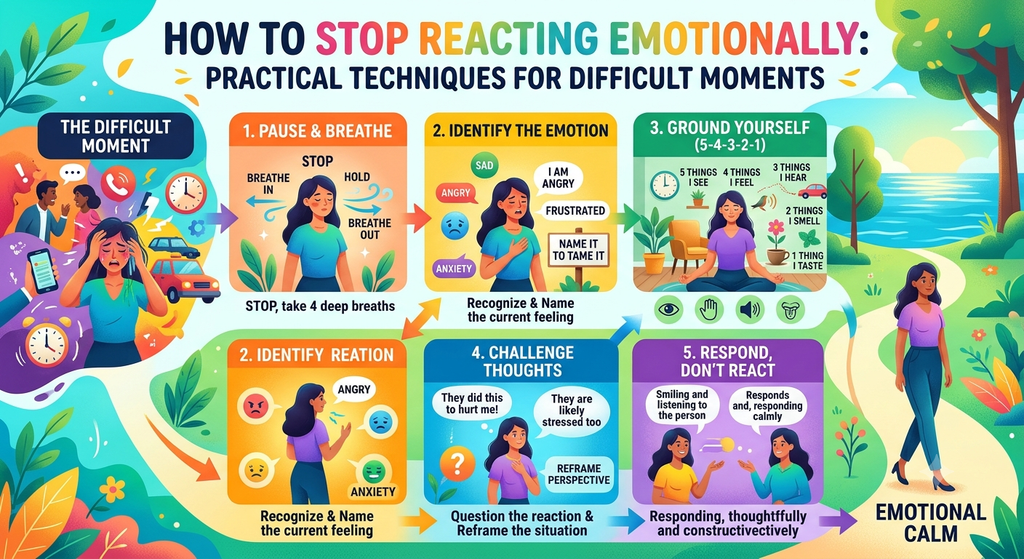
1. Stop Reacting Emotionally: Recognise Your Warning Signs
Most people notice their anger only after it has intensified. By then, it may be harder to think clearly and choose their words carefully.
Instead, learn to recognise your personal warning signs.
For some people, the first sign is physical: a clenched jaw, a tightening chest, faster breathing or a raised voice.
For others, it is mental. They start thinking:
- “Who does this person think they are?”
- “I won’t let them get away with this.”
- “I must give them an answer.”
- “Why should I always be the one who adjusts?”
These thoughts don’t automatically mean you are wrong. The other person may genuinely be behaving badly. But the urgency to retaliate is a useful signal that you should slow down before deciding what to do.
Your first objective isn’t to become calm. It is to notice that you are becoming reactive.
Try this for a few days: whenever you feel unusually irritated, identify the first physical or mental sign you notice. You will gradually become more familiar with your own pattern.
2. Create a Pause Between the Feeling and the Action
Imagine receiving a rude email. You immediately start composing a reply that exposes the sender’s incompetence.
Learning how to stop reacting emotionally begins with recognising what happens inside us when something goes wrong.
You don’t have to persuade yourself that the email is acceptable. You simply have to delay sending your response.
Close the draft. Take a few slow breaths. Get a glass of water or return to the message after a short break.
The same principle applies during a face-to-face disagreement.
When you feel yourself becoming overwhelmed, stop speaking for a moment. Relax your jaw, let your shoulders drop and breathe slowly without forcing your breath.
If necessary, say:
“I’m getting frustrated, and I don’t want this conversation to become unpleasant. Give me a little time, and we’ll continue.”
This isn’t running away from the problem. It is postponing the conversation until you are better able to handle it.
A pause doesn’t need to last a specific number of seconds. A minor irritation may require only a moment; a heated argument may require considerably longer.
Learning to manage anger doesn’t mean suppressing it. It means recognising its warning signs and choosing how to act. The American Psychological Association offers practical guidance on managing anger and responding more constructively.
If you take a break during a discussion, make a reasonable commitment to return to it when you are able. Otherwise, the other person may experience the break as avoidance or punishment.
3. Stop Trying to Win Every Encounter
One reason we react so strongly is that we treat ordinary disagreements as contests.
When learning how to stop reacting emotionally, it helps to distinguish between solving a problem and winning an argument.
Someone challenges our opinion, and we feel compelled to prove them wrong. Someone questions our competence, and we immediately list our achievements. Someone behaves rudely, and we want to demonstrate that we can be equally unpleasant.
But before responding, ask yourself:
“What am I trying to achieve here?”
Consider three possible objectives:
- Solving a problem.
- Protecting a boundary or correcting misinformation.
- Making the other person feel bad.
The first two may require action. The third deserves closer examination.
Suppose a colleague makes a sarcastic comment during a meeting. You could respond with an equally cutting remark. You might even win the exchange.
But the comment could then turn into a public argument, damage your working relationship and distract everyone from the issue being discussed.
A more useful response might be:
“I disagree with that characterisation. Let’s focus on the facts.”
You have defended yourself without turning the meeting into a contest of insults.
This doesn’t mean that every confrontation should be avoided. It means choosing the confrontation that serves a purpose.
4. Respond to Rude People Without Becoming Rude Yourself
You cannot always control how another person speaks to you. You can, however, prepare a few sentences that help you respond when you are caught off guard.
Having words ready is useful because finding the right language becomes harder when you are upset.
When someone speaks disrespectfully
Try:
“I’m willing to discuss the issue, but please speak to me respectfully.”
If the person continues, you may need to end the conversation or seek assistance.
When someone criticises you unfairly
Try:
“I don’t agree with that assessment. Let me explain what happened.”
State the relevant facts rather than attacking the person’s character.
When someone interrupts you repeatedly
Try:
“Please let me finish my point, and then I’ll listen to yours.”
You don’t have to raise your voice to establish that you deserve an opportunity to speak.
When someone provokes you deliberately
You may not know whether the person is deliberately provoking you. Regardless, you don’t have to respond to every remark.
You can say:
“I’m not going to trade insults. If you want to discuss the actual issue, I’m willing to do that.”
If the conversation has become pointless or unsafe, disengage.
The important distinction is that restraint does not mean surrender, and assertiveness does not require aggression.
5. Handle Different Triggers With Different Responses
Not every difficult situation requires the same technique. A defective product needs a solution; an insult may require a boundary; a dangerous driver requires a safety-conscious response.
An insulting email
Don’t reply while angry. Identify the specific issue, remove personal attacks from your draft and send a factual response.
If the sender’s tone is inappropriate, address it directly or through the appropriate workplace process.
Poor customer service
State the problem, explain the resolution you expect and ask about the next step. Request a complaint number or escalation when necessary.
If the representative cannot help, seek someone who can. Repeating your anger to someone without the authority to solve the problem may prolong your frustration without advancing your case.
A confrontation in traffic
Prioritise safety. Maintain distance, avoid retaliatory driving and don’t pursue someone to prove a point.
A dangerous situation calls for protective action, not an attempt to teach another driver a lesson.
Being reprimanded publicly
You may feel an immediate urge to defend yourself, particularly if an elder or senior colleague criticises you in front of others.
If the matter can wait, try:
“I understand that you have a concern. Can we discuss the details privately?”
Later, address the substance of the criticism and, if appropriate, explain why the manner in which it was delivered was unacceptable.
A family argument
When a disagreement turns into accusations about old incidents, don’t answer every accusation with another one.
Try:
“I want to discuss this, but we’re bringing too many things into the argument. Let’s deal with one issue at a time.”
If the discussion continues to escalate, take a break and return to the issue when it is safe and practical to do so.
Different situations require different actions, but the underlying principle remains the same: identify the actual problem and choose an action that addresses it.
6. What If You Genuinely Want to Hurt the Other Person?
Sometimes we are not merely overwhelmed by emotion. We deliberately want to cause pain.
Perhaps someone has humiliated us, betrayed our trust or repeatedly behaved unfairly. We know which words will hurt them most, and we want them to experience what we have experienced.
At that moment, simply taking a breath may not change our intention.
Start by acknowledging it honestly: “I want to hurt this person because I’m hurt and angry.”
You don’t have to pretend that the feeling isn’t there. But you can distinguish between wanting to do something and deciding to do it.
Ask yourself what you actually want to achieve.
Do you want the person to acknowledge the harm? Do you want their behaviour to change? Do you need to protect yourself or end a relationship? Or do you want them to suffer, regardless of whether anything improves?
If you need accountability, address the wrongdoing. If you need a boundary, establish one. If you need distance, take it.
You may still decide to report misconduct, withdraw your support or end a relationship. Those decisions can have serious consequences for the other person, but their purpose is to address the situation rather than inflict suffering for its own sake.
If you feel at risk of physically harming someone, put distance between yourself and the person, move away from anything that could be used as a weapon, and seek immediate support if necessary.
The goal is not to eliminate every angry impulse. It is to avoid allowing that impulse to determine your actions automatically.
7. What If You React Before You Can Stop Yourself?
You will not always get it right.
You may raise your voice, send an unnecessarily harsh message or make a remark that hurts someone. The fact that you are practising emotional regulation does not make you immune to mistakes.
What matters next is how you handle the aftermath.
First, acknowledge what you did without immediately shifting the blame.
Instead of saying, “I’m sorry, but you made me angry,” try:
“I’m sorry I spoke to you that way. I was angry, but I shouldn’t have used those words.”
Second, address the original problem separately. Apologising for an insulting remark does not mean agreeing with everything the other person said or abandoning a legitimate complaint.
Third, identify the point at which you could have acted differently. Perhaps you should have delayed sending the email, ended the conversation earlier or recognised that you were already exhausted.
Finally, choose one adjustment to try next time.
Don’t turn a mistake into a judgement about your entire personality. Saying “I always lose control” can make improvement feel impossible. Identifying a specific behaviour gives you something you can actually work on.
The ability to recover from a reaction is part of learning to respond.
8. A Seven-Day Exercise to Build the Habit
For the next seven days, don’t try to control every emotion. Focus on practising one small behaviour each day. Practising these small steps can gradually make it easier to stop reacting emotionally in situations that once overwhelmed you.
Day 1: Notice your first warning sign when you become irritated.
Day 2: Take one slow breath before replying to a frustrating remark.
Day 3: Delay sending an angry email or message until you have reviewed it.
Day 4: Practise one assertive sentence, such as “I disagree, and here’s why.”
Day 5: When provoked, identify what you want to achieve before choosing your words.
Day 6: If you react badly, acknowledge it and make an effort to repair the damage.
Day 7: Review the week. Which situations were hardest? Which technique helped? What will you practise next week?
You don’t need a perfect score. If you remember to pause once in a situation where you would normally retaliate immediately, that is useful progress.
Over time, repeat the exercise and focus on the situations that continue to challenge you.
Practice, Don’t Just Preach
Reacting and responding are not two fixed categories of people. The same person can respond thoughtfully in one situation and react impulsively in another.
Your ability to manage a difficult moment depends on several things, including the intensity of your emotions, your stress levels, the circumstances and the habits you have developed.
You will not always remain calm. You will sometimes misunderstand people, lose your temper or say something you regret.
The aim is not perfection.
It is to recognise your triggers earlier, create a little more space before acting, communicate more effectively and recover more constructively when you make mistakes.
Start with one situation that repeatedly gets the better of you. Practise one technique there before trying to change everything else.
And remember: you can be firm without being cruel, angry without being destructive, and assertive without turning every disagreement into a battle.
You do not have to let go of your right to stand up for yourself. You simply have to learn how to do it in a way that serves you better.
In Part 3, we will explore how reactions become cycles of blame and retaliation in our closest relationships and workplaces—and how to stop mutual hurt from becoming a recurring pattern.
If you haven’t read Part 1 yet, start here: React vs Respond: How to Handle Everyday Triggers Without Losing Your Cool.