Part 3: The Different Types of Trataka – Discover the Best Practice for Your Mind
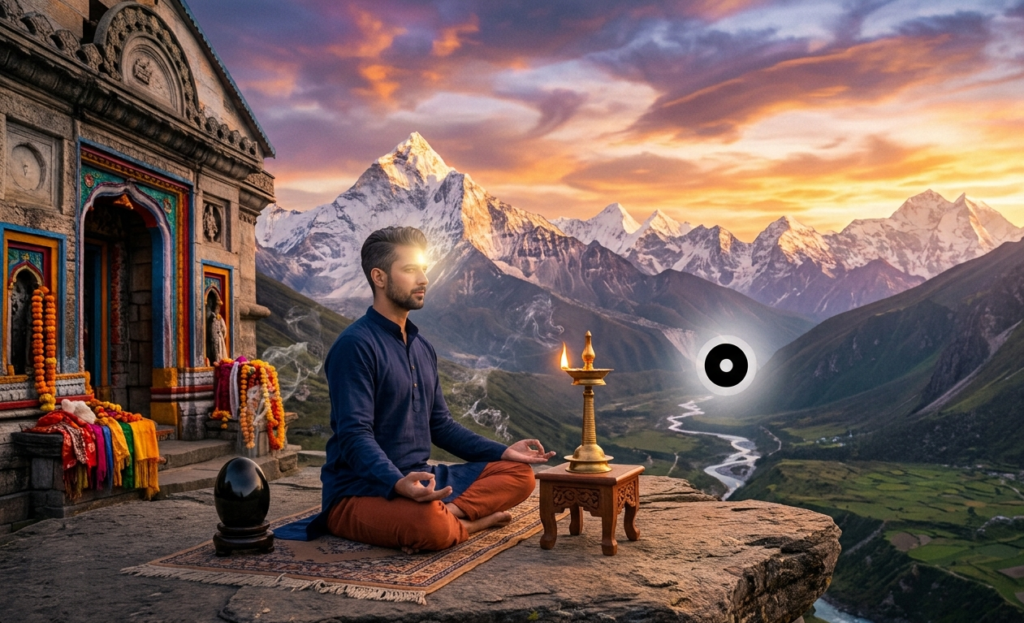
One of the greatest misconceptions about Trataka is that it simply means staring at a candle flame.
While candle gazing is undoubtedly the most popular form today, the classical yogic tradition describes several variations, each designed to cultivate different aspects of the mind.
Some practices sharpen concentration. Others awaken devotion, deepen self-awareness, or prepare the mind for meditation. Although the objects differ, the underlying principle remains the same—training the mind to remain steady by giving it a single point of focus.
Let’s explore the major forms of Trataka and understand how each one influences the brain and the mind. Let’s explore the 10 types of Trataka in detail.
1. Bindu Trataka – The Power of a Single Point
If there is one form of Trataka that beginners should master first, it is Bindu Trataka.
The word Bindu means “point” or “dot.” The object is usually a small black dot, about the size of a pea, placed on a plain white wall at eye level.
At first, staring at such a tiny object may feel surprisingly difficult. Within seconds, the mind begins searching for something more interesting. Thoughts arise. The urge to blink becomes stronger. Attention drifts.
That is precisely the training.
Each time you gently return your gaze to the dot, you strengthen the brain’s ability to sustain attention despite distractions.
How to practise
Sit about one to two metres away from the wall. Keep your spine straight and your body relaxed. Gaze naturally at the dot without straining. When your eyes begin to water or feel tired, gently close them and observe the afterimage between the eyebrows for a few moments before opening your eyes again.
Best suited for
- Students
- Professionals
- Writers
- Anyone struggling with concentration
- Beginners learning meditation
Modern psychological explanation
Bindu Trataka resembles focused attention training used in cognitive psychology. By repeatedly directing attention back to a single visual target, the brain gradually becomes more efficient at resisting distractions and maintaining cognitive control.
2. Jyoti Trataka – Candle Flame Meditation
This is the form most people recognise.
The candle flame has fascinated meditators for centuries because it is bright, stable, and naturally attracts human attention.
Unlike a black dot, the flame is alive. It flickers gently while remaining centred, making it easier for beginners to sustain visual focus.
How to practise
Place the candle approximately one metre away at eye level in a dark or dimly lit room. Focus on the brightest part of the flame, just above the wick. Avoid following the flickering edges. When tears appear, close your eyes and observe the glowing afterimage until it gradually fades.
Benefits
- Improves concentration
- Reduces mental restlessness
- Prepares the mind for meditation
- Encourages relaxation before sleep
- Builds patience
Modern explanation
The flame provides a gentle but engaging visual stimulus. Because the brain does not need to constantly search for new information, mental activity gradually becomes quieter. Many practitioners also notice slower breathing and reduced physical tension during candle Trataka.
3. Murti Trataka – Gazing Upon the Sacred
In this form, the object is a sacred image, deity, enlightened master, or spiritual teacher.
Unlike Bindu Trataka, Murti Trataka combines attention with emotion.
The purpose is not merely to strengthen concentration but also to cultivate reverence, gratitude, compassion, or devotion.
Suitable objects
- Krishna
- Shiva
- Buddha
- Jesus Christ
- Guru Nanak
- A respected spiritual teacher
The image should inspire peace rather than fear or excitement.
Modern explanation
Psychology tells us that emotionally meaningful images receive greater attention than emotionally neutral ones. By combining focused attention with positive emotional states, Murti Trataka may strengthen beneficial emotional associations while calming negative mental patterns.
4. Tamvastra Trataka – Gazing Into Stillness
In this lesser-known practice, the object is a plain black cloth or dark surface.
At first glance, it appears to contain nothing at all.
Yet this apparent emptiness reduces visual stimulation, allowing the mind to become increasingly quiet.
Instead of being attracted by colours, shapes, or movement, attention rests upon simplicity itself.
Benefits
- Deep relaxation
- Reduced sensory overload
- Mental quietness
- Preparation for deeper meditation
Modern explanation
Our brains naturally respond to novelty. A plain dark surface offers very little sensory information, encouraging the visual system to settle rather than continually analyse.
5. Pratibimba Trataka – Looking Into Yourself
Pratibimba means “reflection.”
Here, the practitioner gazes into a mirror, usually focusing gently on one eye or the space between both eyes.
Initially, this may feel uncomfortable.
After a few minutes, however, many people notice changes in facial perception, emotional responses, and self-awareness.
Traditional yoga views this practice as a means of deep inner observation.
Psychological explanation
Mirror gazing activates neural systems involved in self-recognition, identity, and emotional processing. It encourages us to observe ourselves without immediate judgement, making it a valuable practice for self-awareness and emotional growth.
6. Drishya Trataka – Nature as the Teacher
Not every object used in Trataka needs to be man-made.
Nature itself offers countless opportunities for focused observation.
You may gaze gently at:
- A mountain peak
- A tree
- A flower
- A flowing river
- The ocean
- The horizon
Unlike digital screens, natural scenes rarely overwhelm the senses.
Instead, they invite quiet observation.
Benefits
- Reduces stress
- Encourages mindfulness
- Builds emotional resilience
- Creates a sense of connection with nature
Modern explanation
Research consistently shows that exposure to natural environments lowers stress levels, reduces mental fatigue, and restores attention. Combining these restorative effects with focused gazing makes Drishya Trataka particularly calming.
7. Chandra Trataka – Moon Gazing
The moon has long symbolised calmness and reflection in many spiritual traditions.
Practitioners gaze gently at the full or nearly full moon for a few minutes before closing their eyes and observing the afterimage.
Unlike sunlight, moonlight is soft and soothing.
Traditionally, this practice is believed to cool emotional agitation and promote inner peace.
Many people also find it deeply relaxing before bedtime.
8. Tara Trataka – Gazing at the Stars
On a clear night away from city lights, a single bright star can become the point of concentration.
Star gazing naturally evokes feelings of wonder, humility, and perspective.
Many practitioners describe it as one of the most peaceful forms of Trataka.
Beyond concentration, it reminds us how small our daily worries appear within the vastness of the universe.
9. Yantra Trataka – Sacred Geometry
A Yantra is a geometric symbol used for meditation.
Among the most well-known is the Sri Yantra, composed of interlocking triangles, circles, and lotus patterns.
Rather than focusing on a single point, practitioners gradually allow the eyes to explore the symmetry before settling on the central point known as the Bindu.
This practice combines concentration with symbolic contemplation.
10. Antar Trataka – The Highest Stage
Eventually, external objects become unnecessary.
In Antar Trataka, or internal gazing, the object exists entirely within the mind.
The practitioner visualises a candle flame, sacred symbol, lotus, or point of light with closed eyes while maintaining unwavering mental focus.
This requires considerable concentration and is generally practised only after becoming comfortable with external Trataka.
Ancient yogic texts regard Antar Trataka as a bridge between concentration (Dharana) and meditation (Dhyana).
From a psychological perspective, it strengthens visual imagery, working memory, and sustained attention without relying on external sensory input.
Which Form Should You Choose Out of These 10 Types of Trataka
There is no universally “best” form of Trataka.
The right practice depends on your goal. Now let’s discuss the types of Trataka and the use of each.
- If you want sharper concentration, begin with Bindu Trataka.
- If you’re new to meditation, Candle Flame Trataka is usually the easiest starting point.
- If your path is devotional, Murti Trataka offers both emotional and spiritual depth.
- If you’re mentally exhausted, Drishya Trataka in nature can be wonderfully restorative.
- If you seek deeper self-understanding, Pratibimba Trataka provides a unique opportunity for introspection.
- As your practice matures, Antar Trataka becomes a natural progression toward meditation.
Ultimately, the object is only a tool.
The real purpose of Trataka is not to master the art of looking—it is to master the art of attention.
And when attention becomes steady, the mind gradually follows.
Trataka Part 1
Trataka Part 2
Explore Books for more topics
Research has also examined whether Trataka influences working and spatial memory, with one study reporting improvements in performance on the Corsi-block tapping task after Trataka practice.