Trataka: The Ancient Yogic Practice That Trains Your Brain, Sharpens Focus, and Calms the Mind
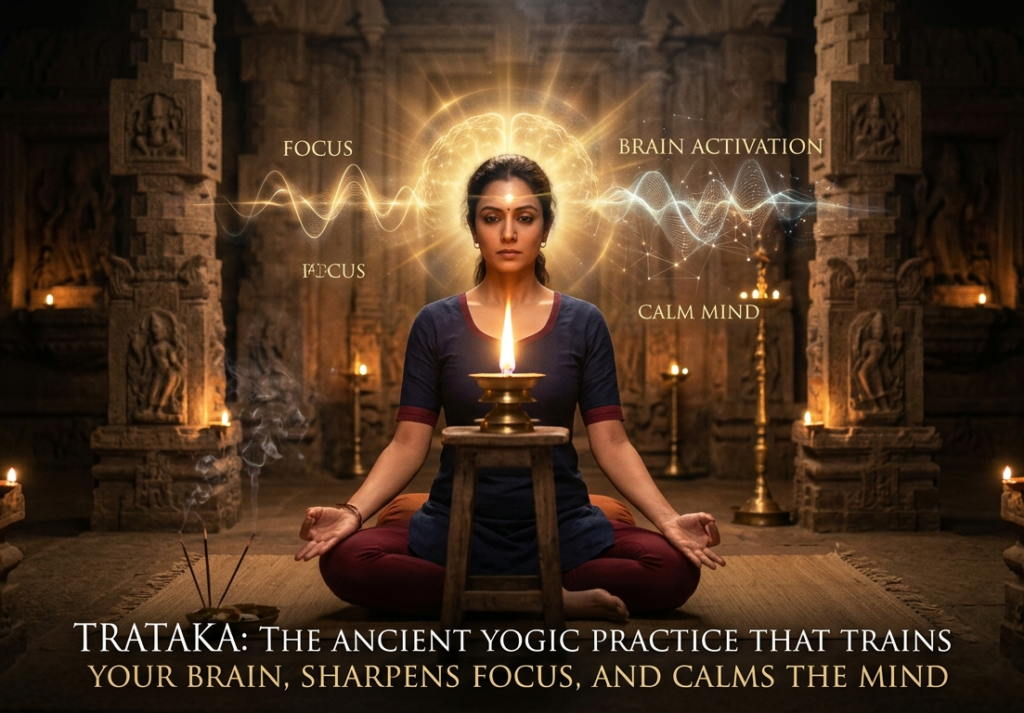
I had this problem in concentration for long and had suffered a lot because of that. The more I delved deeper in search of the menace the more I understood that the disease has already caught up with a major chunk of global population. When I searched for the antidote I was introduced to many techniques some of which I had discussed in my previous blogs and one of my books too. But this one stands out. Though the practice is ancient the modern science recognizes the concept and endorses it too. Lets get into the groove. Before we begin I would like to inform you that since topic is vast I am splitting it into 4 parts and the first part is here.
Introduction
Every day, your brain is fighting a battle for your attention. The average person checks their phone dozens — sometimes even hundreds — of times a day. Notifications interrupt conversations. Endless scrolling keeps the mind restless. Work demands constant multitasking, while stress and anxiety make it increasingly difficult to focus on even the simplest tasks.
In this age of digital distraction, maintaining attention has become one of the greatest challenges of modern life. But centuries before smartphones, social media, and information overload existed, Indian yogis had already discovered a remarkably simple technique to strengthen concentration, quiet the mind, and cultivate inner awareness. That practice is called Trataka.
At first glance, Trataka appears deceptively simple. You merely gaze steadily at a single object—a candle flame, a small black dot, a sacred symbol, or even the rising moon—without allowing your eyes to wander. Yet beneath this simplicity lies a profound practice that has been revered for centuries in yogic traditions.
Traditionally, Trataka is described as a cleansing practice for the eyes and the mind. Today, modern neuroscience offers another perspective. Researchers studying attention, meditation, eye movements, and brain plasticity have begun to understand why sustained visual focus can influence concentration, emotional regulation, stress levels, and cognitive performance.
While ancient yogis spoke of developing Ekagrata—one-pointed concentration—modern psychologists describe improvements in sustained attention, executive control, and mindfulness. Different words, perhaps, but strikingly similar observations.
In this article, we’ll explore what Trataka really is, the different forms in which it is practiced, how to perform it safely, what modern science says about its effects on the brain, and how you can incorporate this timeless technique into your daily routine.
Whether you’re a student struggling with concentration, a professional overwhelmed by digital distractions, or simply someone seeking greater mental clarity, Trataka offers a fascinating bridge between ancient wisdom and modern science.
What is Trataka?
The word Trataka comes from the Sanskrit root trat, meaning “to gaze steadily” or “to look attentively”. It is one of the Shatkarmas (Shatkriyas) —the six actions, classical yogic purification practices described in traditional Hatha Yoga texts.
(The others being Neti: Nasal cleansing, Dhauti: Digestive tract purification, Nauli: Abdominal massaging and churning, Basti: Yogic colon cleansing or enema, Kapalabhati: Respiratory and skull sinus cleansing)
Unlike the other cleansing techniques, which primarily purify the body, Trataka focuses on cleansing and stabilizing the mind through disciplined visual attention. The practice involves fixing your gaze on a single object without blinking for as long as is comfortably possible. Once the eyes begin to water or feel fatigued, they are gently closed, and the practitioner observes the afterimage in the mind’s eye before repeating the cycle.
Although this may sound like an exercise for the eyes, Trataka is fundamentally a training method for the mind. Our eyes naturally dart from one object to another several times every second. These rapid movements, known as saccades, help us gather information from our surroundings. While essential for everyday functioning, they also reflect the restless nature of the mind.
When the eyes constantly shift, attention often shifts with them. Trataka gently interrupts this pattern. By learning to hold the gaze steady, we also learn to steady attention. Over time, this simple act of visual stillness can cultivate greater mental stability, patience, and awareness.
In classical yoga, Trataka serves as a preparation for Dharana (deep concentration), which eventually leads to Dhyana (meditation). Rather than forcing the mind to become quiet, it provides the mind with a single, unwavering point of focus. As distractions gradually fade into the background, a state of effortless concentration begins to emerge.
For this reason, many experienced practitioners consider Trataka not merely an eye exercise or relaxation technique, but a gateway to meditation itself.
Why Trataka Matters More Than Ever
Human attention has always been valuable. Today, it has become one of the world’s most sought-after commodities. Technology companies compete relentlessly to capture and retain our focus. Every notification, recommendation, autoplay video, and infinite feed is carefully designed to keep our attention engaged for just a little longer. The result is a mind that rarely rests.
Many people notice that they can spend hours scrolling through social media yet struggle to read a book for fifteen minutes. Meetings feel longer, conversations become fragmented, and even moments of silence are quickly filled by reaching for a phone. This constant switching of attention comes at a cost.
Research has shown that frequent interruptions can reduce productivity, increase mental fatigue, elevate stress levels, and make it more difficult to sustain deep concentration. Over time, many people begin to experience symptoms such as brain fog, forgetfulness, restlessness, emotional exhaustion, and difficulty remaining present. Trataka offers a refreshing counterbalance.
Instead of training the brain to seek constant novelty, it trains the brain to remain with a single object. Instead of reacting to every distraction, it cultivates deliberate attention. Instead of stimulating the nervous system with endless sensory input, it encourages stillness, patience, and mindful observation. This is perhaps why a practice developed hundreds of years ago feels surprisingly relevant in today’s fast-paced digital world.

Trataka reminds us that attention is not merely something we spend—it is a skill that can be strengthened through regular practice. And in an age where distraction is everywhere, learning to focus may be one of the greatest forms of self-care.
Trataka isn’t just an ancient ritual—it is a systematic technique for visual control. Modern neuroscientists studying visual attention networks have found that single-point fixation helps stabilize neural activity and sharpen mental clarity.”
WHY WE OVERTHINK: 7 Tips to Reduce Overthinking